Rahul tapped buy on a stock his colleague swore by, and then just sat there staring at the screen. Order placed, but placed where? Sold by whom? He had no clue what happened between the tap and the confirmation. That gap is exactly what stock exchange learning is supposed to fix, and most beginners skip past it entirely; they learn to place trades before they understand what an exchange actually does.
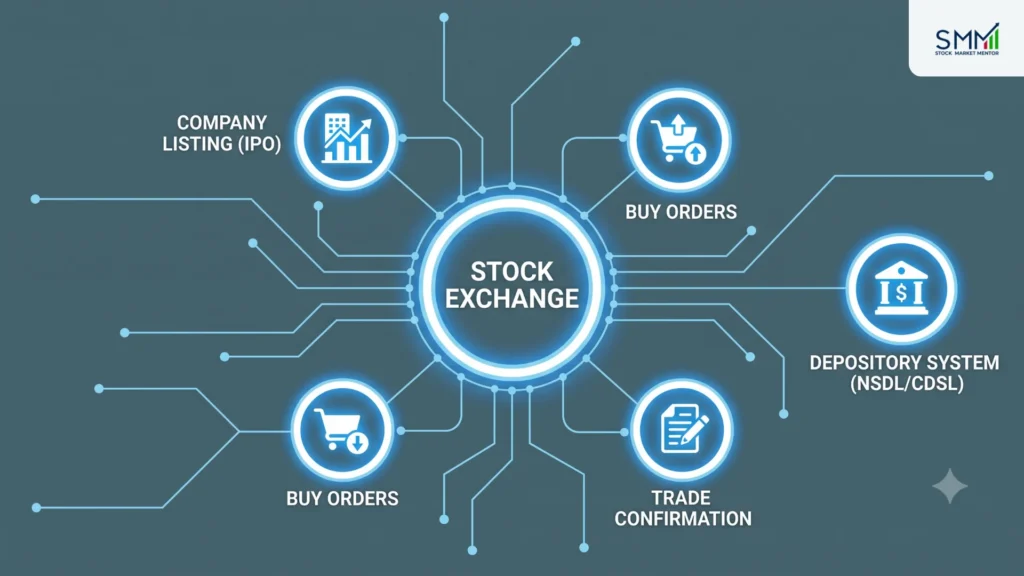
A stock exchange is the regulated marketplace where all of this actually happens, where your buy order meets someone else’s sell order, gets matched, and turns into an actual trade. It’s not a mysterious algorithm making decisions behind closed doors. It’s a system built on rules, timing, and thousands of orders lining up at once. Once you understand how that system works, the rest of investing, like reading prices, picking stocks, and managing risk, starts making a lot more sense.
In this blog, we’ll tell you what a stock exchange really is, how an order travels from your app to an actual trade, how NSE and BSE differ, and what you should learn first before you risk real money, starting with stock market basics for beginners.
What You’ll Learn Here
- A stock exchange connects buyers and sellers of shares under a regulated system.
- Trades move through order placement, matching, execution, clearing, and settlement.
- SEBI governs both NSE and BSE, however they differ in age and trading focus.
- Your shares live in a Demat account via NSDL or CDSL, not with your broker or the exchange.
- Real learning about stock exchange starts with the mechanics, order books, pricing, and settlement. Not tips or predictions.
Ready to Go Beyond the Basics?
What Is a Stock Exchange?
Picture a digital marketplace. Companies list their shares there. Investors show up with buy and sell orders. The exchange’s job is to match those orders fairly and confirm the trade, the actual record of who owns what lives with a separate depository system, which we’ll get to shortly.
The exchange doesn’t own the stocks, and it doesn’t set the price by itself; it provides the platform, the rulebook, and the technology that keeps trading safe and orderly. In India, the two main exchanges are the National Stock Exchange (NSE) and BSE Ltd. (BSE), both regulated by the Securities and Exchange Board of India (SEBI).
Why Does This Actually Matters?
What most newcomers miss is that the exchange does not produce the stock’s worth, it only sets the mechanism where buyers and sellers agree on a price. And the price that you see on your screen (LTP) is not usually the price you will actually get. Between that number and your executed trade lies the bid-ask spread, available liquidity and potential slippage. Knowing that gap will do more for your trade than any suggestion could possibly accomplish.
Stock Market vs Stock Exchange: Are They the Same?
Stock Exchange | Stock Market |
A specific platform, like NSE or BSE | The wider system of buying and selling securities. |
Has its own listing and trading rules | Includes exchanges, brokers, regulators, and investors together. |
You trade on an exchange | You participate in the market. |
The exchange is the venue; the market is everything happening around it.
How Does a Stock Exchange Work?
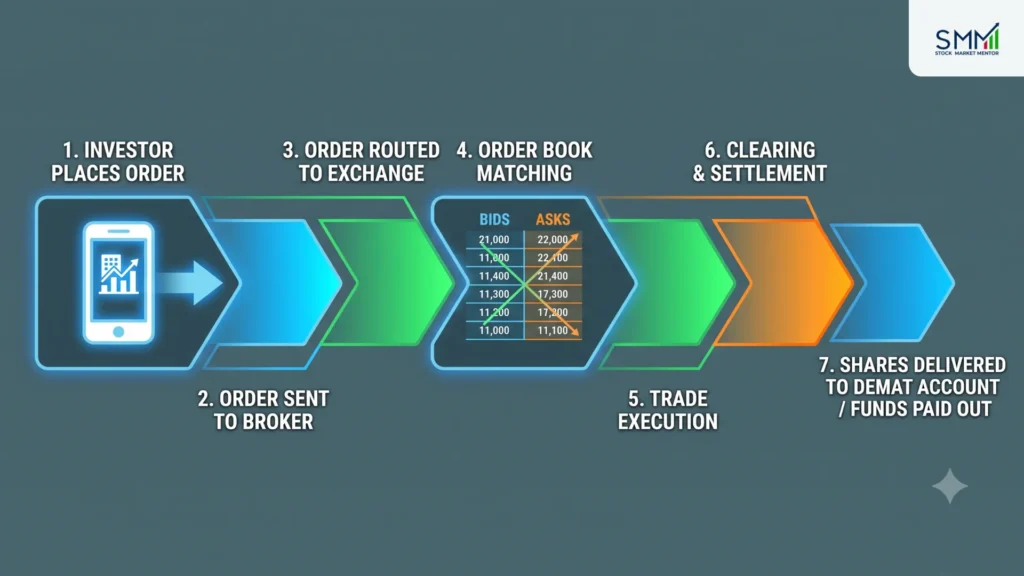
- A company gets listed, going public through an IPO once it clears SEBI’s disclosure rules and the exchange’s listing requirements.
- You put an order, either a market order ( buy/sell at the current price) or a limit order ( buy/sell only at the price you set ) .
- That order is placed into the order book, a live list of pending buy and sell orders waiting to be matched.
- Within milliseconds, the exchange’s technology takes the best available price and matches buyers with sellers.
- The trade takes place and is confirmed on an exchange.
- Clearing and settlement are different procedures. The clearing organization verifies that the trade is genuine and makes arrangements for the money and shares to be transferred from one side to the other.
- Shares reach your Demat account, generally on a T+1 settlement basis for the standard equity cash segment, the next working day, subject to applicable rules.
That’s the whole loop. It is fast, but every step matters.
What Is an Order Book?
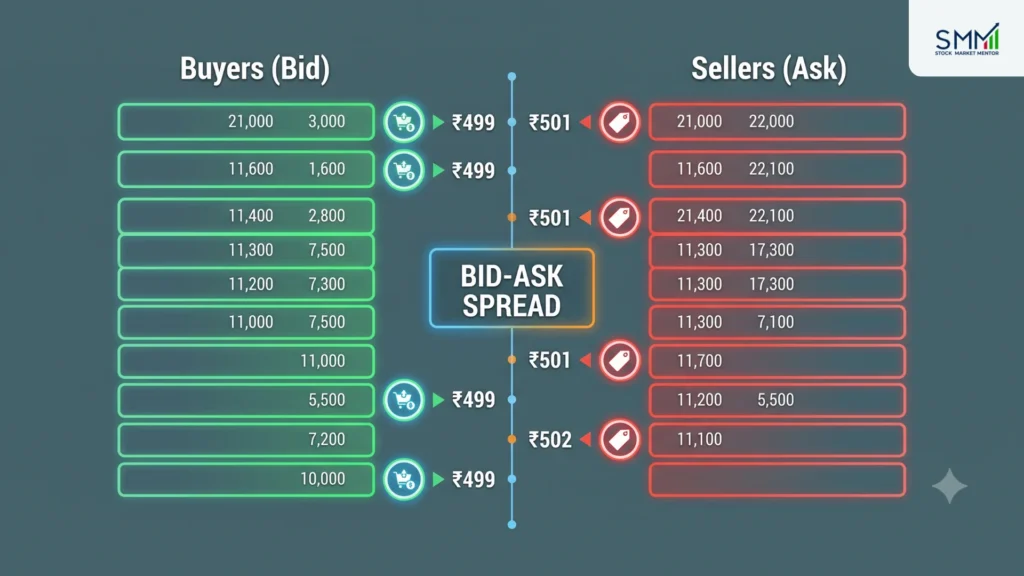
An order book lists every live buy order (a bid) and every live sell order (an ask) for a stock, ranked by price. The gap between the best bid and best ask is the bid-ask spread; the full set of visible bids and asks is called market depth.
Buyers (Bid) | Price | Sellers (Ask) |
Buyer A | ₹499 | — |
Buyer B | ₹498 | — |
— | ₹501 | Seller X |
— | ₹502 | Seller Y |
A new buyer placing a ₹501 limit order gets matched instantly with Seller X. Orders are generally prioritised first by price, then by the time they entered the book, known as price-time priority.
You’ll also see LTP (Last Traded Price), the price of the most recent executed trade. It’s what most apps display as “the price,” though the best bid and ask can sit slightly above or below it.
Who Actually Decides the Stock Price?
A stock market does not ‘decide’ a price like a shop decides a price of goods. Price discovery is the never-ending battle between buy orders, sell orders, and liquidity that sets prices. What moves them? How many people desire to purchase vs sell, liquidity of a stock, corporate news and earnings, and general market mood, which can change as markets move through different market cycles.
Who Actually Participates in a Stock Exchange?
A trade isn’t just “you and the market.” This is a simplified view of a typical equity trade:
Investor → Broker → Exchange → Clearing Corporation → Depository
- Investors. Retail, institutional, and foreign.
- Brokers: access to the stock markets
- Stock exchanges – NSE and BSE that match and execute the orders.
- Clearing corporations: clearing trades and mitigating settlement risks.
- Depositories: NSDL and CDSL, which maintain your records electronically.
- SEBI: The body which is monitoring the entire process.
What Is SEBI’s Role?
SEBI regulates the market, oversees brokers and exchanges, and works to keep trading fair and transparent; see its material on the SEBI Investor Website.
One distinction worth being precise about: SEBI regulation makes the system fair; it doesn’t protect you from investment losses. It reduces fraud and manipulation risk; it doesn’t guarantee returns. That risk stays yours to manage.
Where Are Your Shares Actually Stored?
Your broker doesn’t hold your shares, and neither does the exchange. Your securities sit electronically in your Demat account, through a depository system run by NSDL or CDSL. In short: the broker gives you access, the exchange executes the trade, and the depository is where your shares actually come live.
What Happens When You Buy or Sell a Stock?
Selling mirrors buying. You submit a sell order → your broker routes it to the exchange → it’s matched with a buyer → the trade executes → clearing and settlement happen → shares leave your Demat account → proceeds are credited on the settlement date.
What if there is no buyer? For example, you wish to sell at Rs.500 and no one is prepared to buy at that price. Your order merely sits there until a buyer comes along or you tweak your price closer to the best available bid. That’s why liquidity is important: a stock that trades a lot is going to have narrow spreads and fast matches; a stock that trades little can have a considerably wider gap between bid and ask. Between the order you place and the final execution, understanding technical analysis in the Indian stock market can help you better understand how traders interpret price movements, trends, and market behaviour.
Primary Market vs Secondary Market
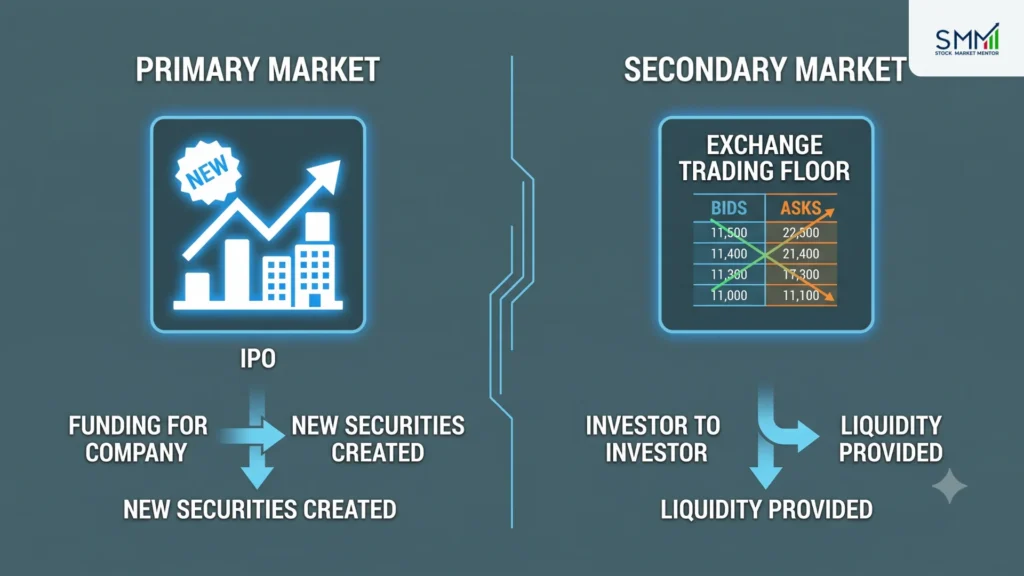
- Primary market: where a company sells shares for the first time, through an IPO. Money raised goes directly to the company.
- Secondary market: where those shares trade afterward, between investors. This is what people usually mean by “the stock market,” and it’s where NSE and BSE operate day-to-day.
Once listed, a company gets no proceeds when one investor later sells shares to another; that money simply moves between the two investors.
NSE vs BSE: The Core Differences
Feature | NSE | BSE |
Full name | National Stock Exchange | BSE Ltd. |
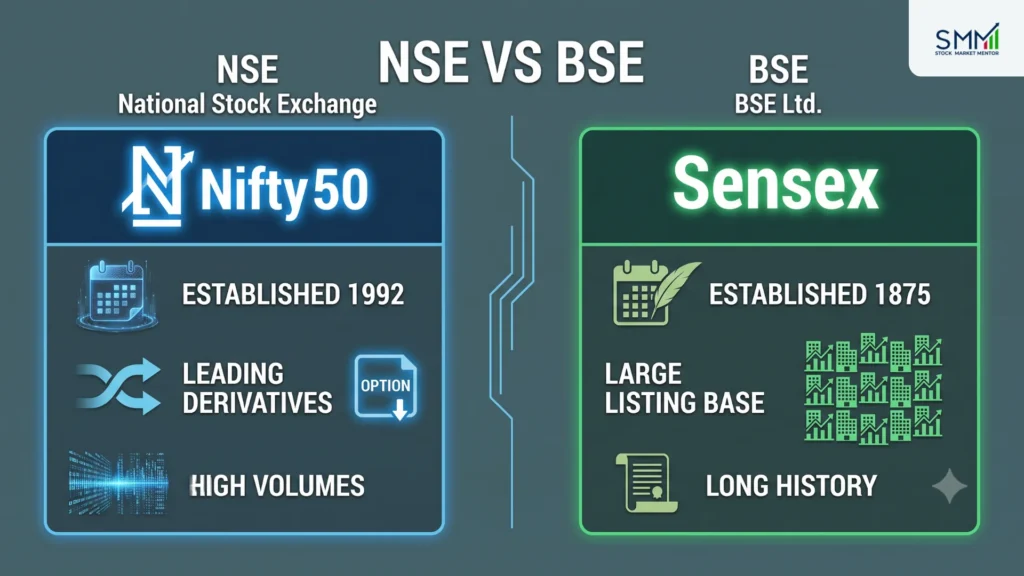
Established | 1992 | 1875, Asia’s oldest stock exchange. |
Benchmark index | Nifty 50 | Sensex |
Known for | Strong derivatives activity and high volumes. | Long history and a large listing base. |
Regulator | SEBI | SEBI |
Many brokers offer access to both exchanges, and whether your order travels through one or the other can depend on the broker’s methodology, order type and availability at that moment. For real volumes and listing counts, refer directly to NSE and BSE.
The Major Stock Exchanges Around the World
Zooming out, here are the major stock exchanges in the world by market capitalization in 2026:
Rank | Exchange | Country |
1 | Nasdaq | United States |
2 | New York Stock Exchange (NYSE) | United States |
3 | Shanghai Stock Exchange | China |
4 | Japan Exchange Group (Tokyo) | Japan |
5 | Euronext | Europe |
The NYSE and Nasdaq together represent close to half of the world’s total listed equity value. That’s a staggering concentration of capital sitting on just two American exchanges.
What Are The Indian Stock Market Trading Hours?
The regular session of NSE and BSE (Equity Cash) is from 9:15 AM to 3:30 PM (Monday to Friday, excluding exchange holidays). A brief pre-open is held from about 9:00 AM to 9:08 AM for order entry and then matching, to help the market determine a fair opening price rather than opening on a random first order.
Worth mentioning for 2026: NSE has extended the closing time for equity derivatives (F&O) to 3:40 PM from August 3, 2026, while the timings for the equity cash market remain the same. This is after the NSE circular dated May 30, 2026, which is in line with the new Closing Auction Session in the cash market, as confirmed on NSE’s official Closing Auction Session page. The timings change during holidays and special sessions; therefore, it’s better to check the current schedule on the NSE website.
Price Bands vs Circuit Breakers
- Price bands limit how far a single stock’s price can move in a session.
- Market-wide circuit breakers can pause trading across the market after an extreme move in a benchmark index like the Nifty 50 or Sensex.
Both slow down panic-driven price swings and keep trading orderly.
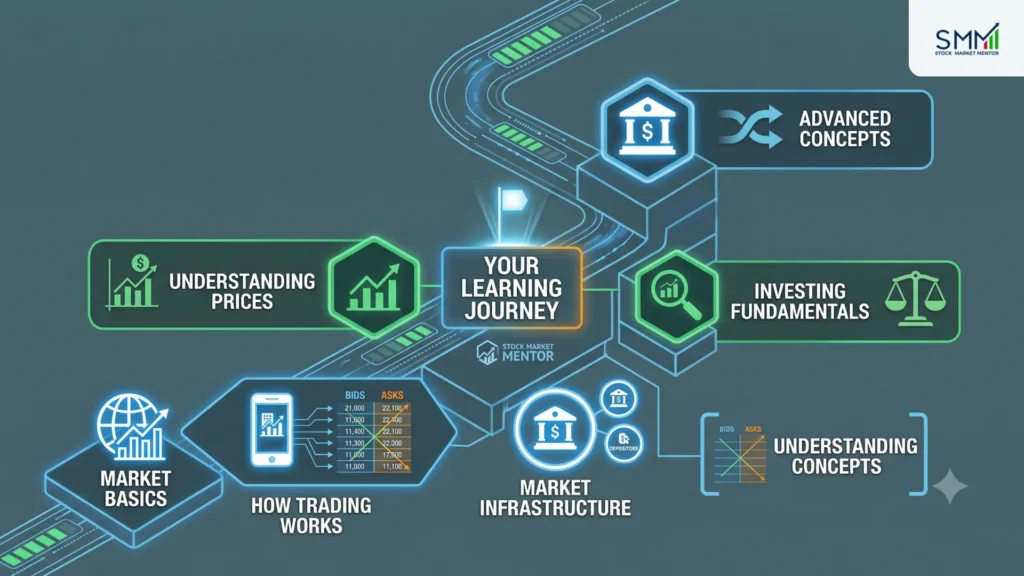
Stock Exchange Learning Roadmap for Beginners
Work through this in order, and check yourself at each stage.
- Market basics: stocks, exchanges, indices, market structure.
- How trading works: brokers, order books, market vs limit orders.
- Market infrastructure: clearing, settlement, Demat, NSDL/CDSL.
- Understanding prices: price discovery, LTP, liquidity, volatility.
- Investing fundamentals: company analysis, technical vs fundamental analysis, risk management, and diversification.
- Advanced concepts: derivatives, futures, options, margin trading, and eventually learning how to backtest a trading strategy before relying on it in live markets.
The Habit We Teach All New Students
In our classes, we need students to answer one question before we let them make a single live trade. “If your order doesn’t get filled at the price you expected, can you tell us why? That looks easy. It is not. Most of the beginners can’t answer it and that gap is precisely why SEBI’s own investigation indicated that 9 out of 10 individual F&O traders lost money over a three-year timeframe.
Traders who didn’t understand how execution worked well enough to handle risk properly were also to blame for losses. So we teach predictions later, mechanics first. It is slower. It’s also the difference between somebody who knows their craft and somebody who is just hoping.
The 5 Questions to Ask Before You Trade
- Where does my order actually go once I place it?
- How does the exchange match it with someone else’s order?
- Why did I get the price I got?
- Where are my shares held once the trade settles?
- When does my trade actually settle?
Beginners often reach for chart patterns and stock tips before understanding order execution, liquidity, and settlement, which is why learning technical analysis in the Indian stock market should come after understanding the basic mechanics of trading.
Here’s the pattern worth remembering: the price on your screen isn’t always the price you can transact at, it’s just the last trade, sitting somewhere between the best live bid and ask. And an exchange doesn’t create value in a stock; it only creates the mechanism through which buyers and sellers agree on one. Once that clicks, order books, spreads, and slippage stop feeling like jargon and start feeling like common sense.
If you can’t yet answer all five questions, spend more time with stock market basics for beginners before moving from stock trading basics into active trading; that foundation is what everything else gets built on. It’s also why the basics module in any solid course exists before the advanced ones; the shortcuts don’t work without it.
Common Mistakes Beginners Make
- Confusing a broker with the exchange: the broker gives access; the exchange matches orders.
- Assuming a rising Nifty or Sensex means every stock is up.
- Treating execution and settlement as the same event.
- Skipping risk management on the assumption that “the market always recovers”.
If you’re comparing structured market education with certification, it’s also worth understanding the difference between NISM certification and a stock market course before choosing your learning path.
Taking Your Stock Exchange Learning Further With Stock Market Mentor
Stock exchange learning doesn’t really end with one article or one course. Once you’re comfortable with the order book, settlement, and the differences between NSE and BSE, you’ll start noticing how each concept connects to the next.
If you’re starting from zero, keep building your knowledge with stock market basics for beginners and then move into the concepts below:
- Stock market basics
- Trading account vs Demat account
- Market vs limit orders
- Fundamental analysis
- Risk management
Work through these in order and you’ll have the foundation most traders build for years, before they ever open a chart, and if you’re interested in turning these skills into a career, you can also explore careers and jobs after stock market training.
So, keep asking questions, keep following the market, and take the time to understand what’s happening behind the price on your screen. There’s always another piece of the market to figure out.
Disclaimer: This article is for educational purposes only and does not constitute investment advice.