You have passed your NISM exam and have the certification. But when you sit in front of a live trading screen for the first time, you don’t know what to do.
The Stock Market in India has boomed over the past few years, and India’s participation in the stock market has reached an all-time high. As per the Economic Survey of 2025-26, there has also been a significant increase in the number of demat accounts in India, with 21.6 crore accounts last year.
There has also been an increase in both the need for financial education and demand for market-related certifications.
Thousands of students and finance professionals in India take the NISM certification every year. But working professionally in the finance industry is nothing like passing the NISM exam.
The NISM exam is mostly about learning the NISM rules, regulations, and compliance requirements, not just about how the stock market works in real life. People also learn about trading, technical analysis, and investing through practical courses. They develop the practical skills to make investments.
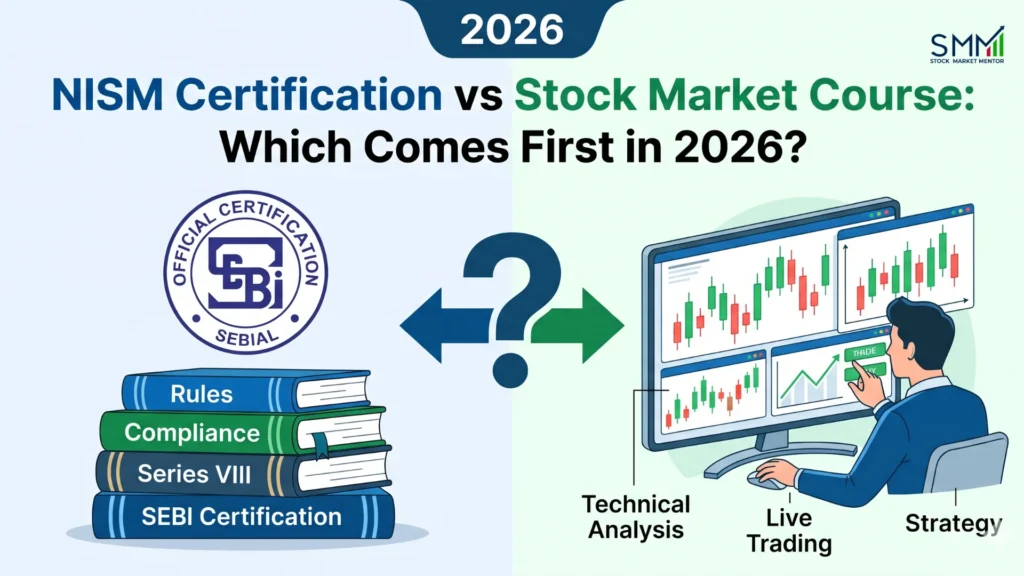
So what should you do first? Get your NISM Certification first, or take a Stock Market Course?
Through this blog, you will understand the differences between NISM certification and the stock market course. What is included in the NISM educational setup, and what practical courses are offered by stock market educators?
How can you create a customized learning plan? And how you can take advantage of both paths to maximize your financial opportunities.
Understanding NISM Certification in 2026
What is NISM?
To improve the knowledge and standards in India’s financial markets, SEBI established the National Institute of Securities Markets (NISM) as a subordinate organization in 2006.
NISM offers training and certification exams for individuals in various professional roles in the finance industry, including financial advisers, dealers, distributors, and analysts.
NISM Certifications in 2026
The NISM exam 2026 offers more than 22 certification programs that focus on financial services, including the stock market, stock trading, and investments.
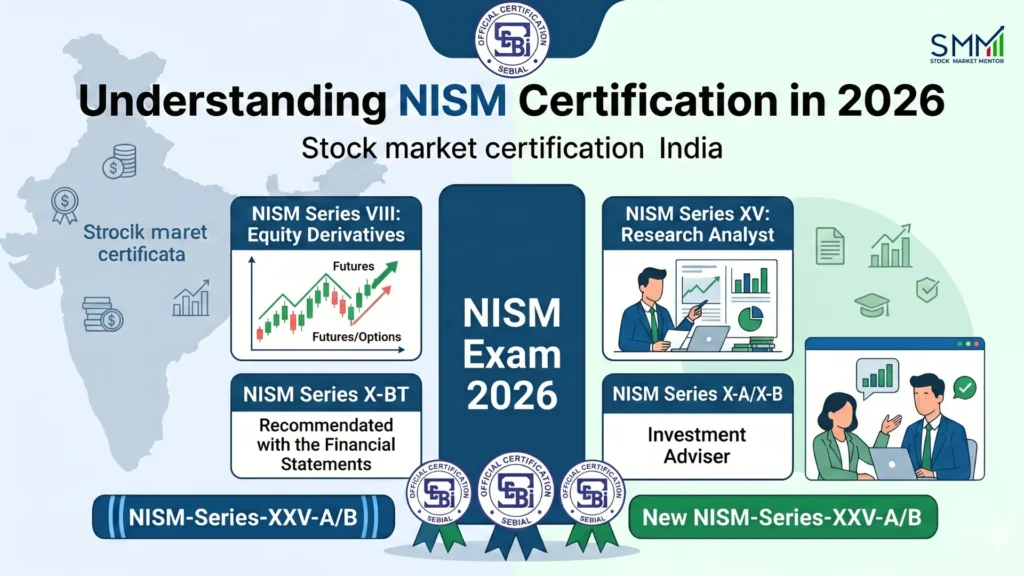
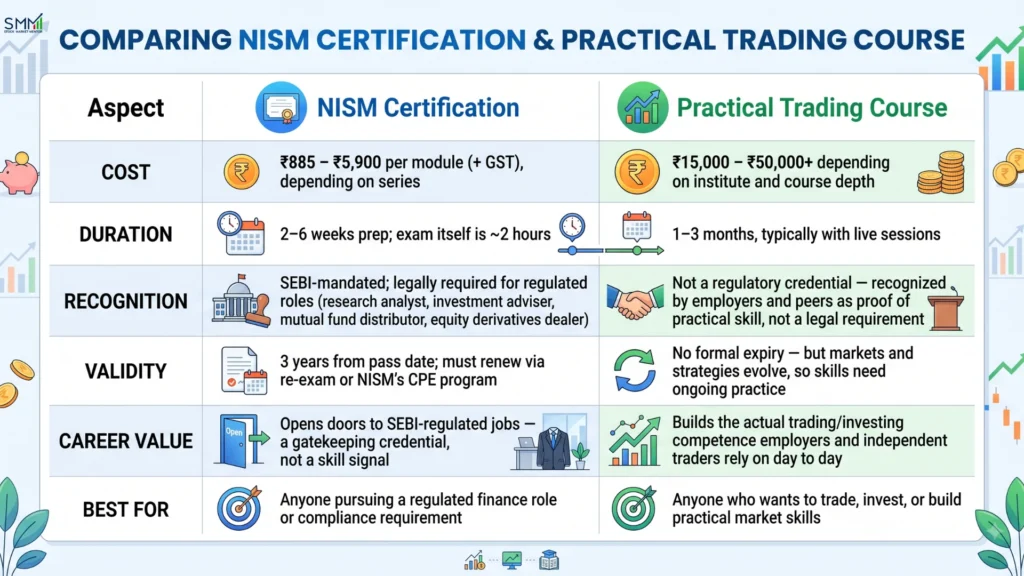
NISM Series VIII, Equity Derivatives: This certification is for individuals interested in trading in equity and derivatives. Once certified, the individual has a 3-year certification period and must be recertified after 3 years.
NISM Series XV, Research Analyst: This Certification is required for anyone seeking to become a research analyst.
NISM Series X-A and X-B, Investment Adviser: Mostly professionals who wish to provide investment advice or register as an investment adviser with NISM opt for this certification.
NISM Certifications in 2026
NISM-Series-XXV-B: New certification program as of June 2026 for individuals who are engaged in sales of investment advice and other support roles. This NISM-Series-XXV-B certification will establish a minimum standard of required knowledge for non-core staff.
NISM-Series-XXV-A: New certification program as of February 2026 for individuals who are involved in the sales of research services and other support roles. This certification establishes a minimum standard of knowledge for non-core staff.
NISM-Series-XV (Research Analyst): This certification program was updated as of January 2026 and will be the standard certification requirement for all SEBI-registered research analysts and their partners.
What Does a Practical Stock Market Course Cover That NISM Doesn't?
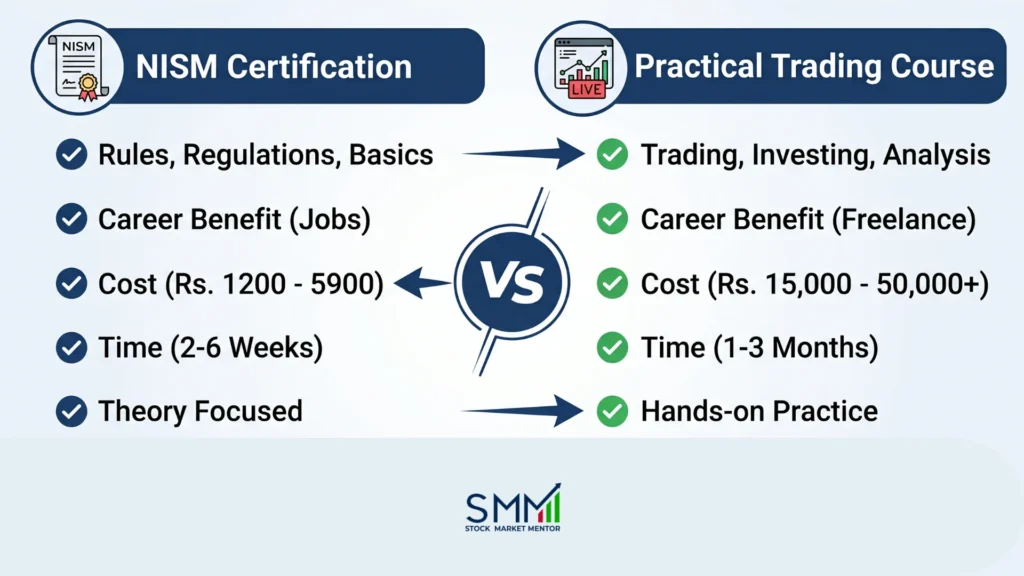
NISM provides information about the theoretical and regulatory framework of financial markets. This includes:
- SEBI guidelines and regulations.
- Overview of how stock markets function.
- Basic concepts of mutual funds, options, and futures.
- Concepts of risk and protection for investors.
A practical course on trading in the stock market provides real-world skills required to trade effectively:
- Live trade execution and order placement.
- Reading charts and performing technical analyses.
- Risk management and money management.
- Creating investment portfolios.
- Development of trading strategies, using real-world chart patterns such as the Cup and Handle pattern, breakouts, and trend continuation setups.
- Controlling emotions when trading.
NISM teaches the theory of the market and the rules that govern its operation, while a practical course teaches how to trade in a real-world environment and how to execute trades.
NISM Certification vs Stock Market Course: Comparison
Aspect | NISM Certification | Practical Trading Course |
What You Learn | Rules, regulations, and finance basics. | Trading, investing, and market analysis. |
Career Benefit | Needed for finance jobs in regulated companies. | Helps in trading, investing, and freelance work. |
Cost | Rs. 1,200 – ₹5,900 | Rs. 15,000 – ₹50,000+ |
Time Required | 2–6 weeks | 1–3 months |
Practical Learning | Mostly theory. | Live trading and hands-on practice. |
ROI (Value for Money) | Good for getting finance jobs. | Good for earning through trading and investing. |
Who Should Do NISM First?
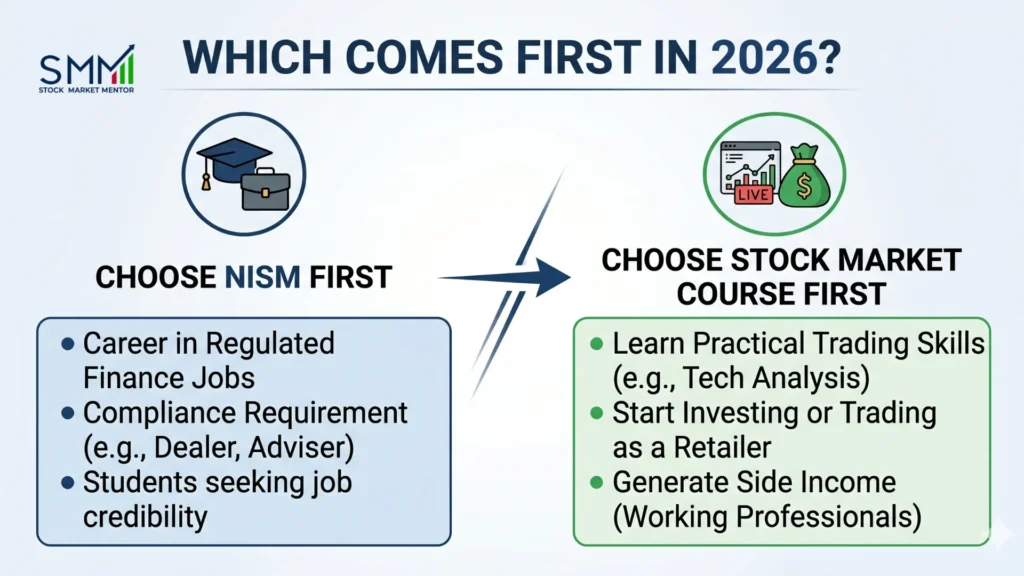
Students (B.Com, MBA Finance, CA, CFA): If you want to improve your job prospects in the financial market, consider taking NISM Series VIII or XVI in your final year of school.
Job Seekers in the Financial Market: If you are looking for a job in the financial market, many financial jobs, such as those in brokerage firms, mutual funds, or the market, will require you to hold a certification or license from NISM before applying.
Banking Professionals: If you are a banking professional seeking to move into investment advisory or wealth management, completing NISM helps validate your investment capability.
Research Analysts & Investment Advisers: To become a research analyst or investment adviser, you must hold a NISM Series XV certification in order to meet the SEBI requirements for a research-related role.
Choose Stock Market Mentor for NISM preparation in Delhi if you need a recognized certification for employment, compliance, or a professional career in the financial market.
Who Should Do a Stock Market Course First?
First, Pick a Real-World Training Course.
A new trader: Start by learning the fundamentals of how to trade, manage risk, and analyze markets, then invest your newfound knowledge.
A retail investor: Develop your investing skills, analyze stocks, and create wealth without needing to pass the NISM Exam.
A working professional: If your goal is to create an income through trading on the side, you will benefit from practical courses like swing trading, technical analysis, or F&O. These courses provide real-world tools for creating new income streams.
Only consider the course if your goal is to trade, invest, generate profits, or build your knowledge of the markets, and not work as a certified financial advisor.
Best Learning Path for Working Professionals in 2026
Steps to Learn How to Trade
Month 1-2: Take a structured online course to learn the basics of the market, how to read charts, chart reading, and understand whether technical analysis or fundamental analysis should come first in your learning journey..
Month 2-3: Gain more experience trading with a paper trading account.
Month 3-4: Prepare for the NISM certification exam by using a study guide and completing practice exams.
Month 4: Once you feel confident in trading, pick a trade, such as F&O, algorithmic trading, or investing.
Case Study: How a Working Professional Turned Into a Trader
Ramesh, an engineer with a degree in computer science and six years of work experience, traded stocks on his own for three years using video tutorials and tips from expert stock traders, but he couldn’t get consistent results.
To solve this issue, Ramesh decided to enroll in Stock Market Mentor’s Pro Trader Course to gain a defined trading method. Through the Pro Trader Course, Ramesh learned to use technical analysis, how to use the best risk management tools for stock market traders, and how to evaluate trades systematically.
The Pro Trader Course delivered excellent results for Ramesh. One month after completing the course, Ramesh passed the NISM Series VIII exam on the first attempt. With his consistency, he achieved annual returns of 12% to 18% from his own trading activities.
Best Learning Path for Students in 2026
Learning about finance is important for job seekers in the finance field. Students can use a plan to prepare for a career in finance.
Semesters 1 & 2: Complete an introductory finance course like shares, the stock market, and futures & options.
Semesters 3 & 4: Complete a practical course on the stock market, including how to read charts, and learn about technical analysis and the mechanics of trading.
Semesters 4 & 5: Obtain appropriate NISM certifications like Series V-A & VIII.
Semesters 5 & 6: Increase knowledge regarding future & options trading, stock research, and value investing.
Final semester: Create a real-world investment portfolio, obtain NISM certification, and apply to internship programs.
How Stock Market Mentor Prepares Students ?
SMM (Stock Market Mentor) in Bangalore, with a strong reputation, has educated more than 10,000 students and is ranked among India’s best Stock Management Educational Institutes.
Students at SMM will develop a practical understanding of how to trade and be prepared for NISM Exams.
NISM Support: Students receive individualized study plans, including mock and practice tests. Strategies for time management and how to increase your score when taking the exams
Training From An Expert Mentor: Receive guidance and live training from an experienced mentor with 15+ years of trading experience.
Career Development: Students who are NISM-qualified can receive placement assistance at stock brokerage firms, research firms, and advisory firms.
To learn more about SMM’s courses, visit their website.
Conclusion
NISM gives you professional credibility, while practical training builds the confidence and competence employers and the marketplace require.
With an NISM certification and real-world market experience, you will have a successful career in stock market trading or investing.
Join 10,000+ other successful traders for stock market certification in India at Stock Market Mentor. Acquire practical experience and skills that will help you become more employable more quickly.