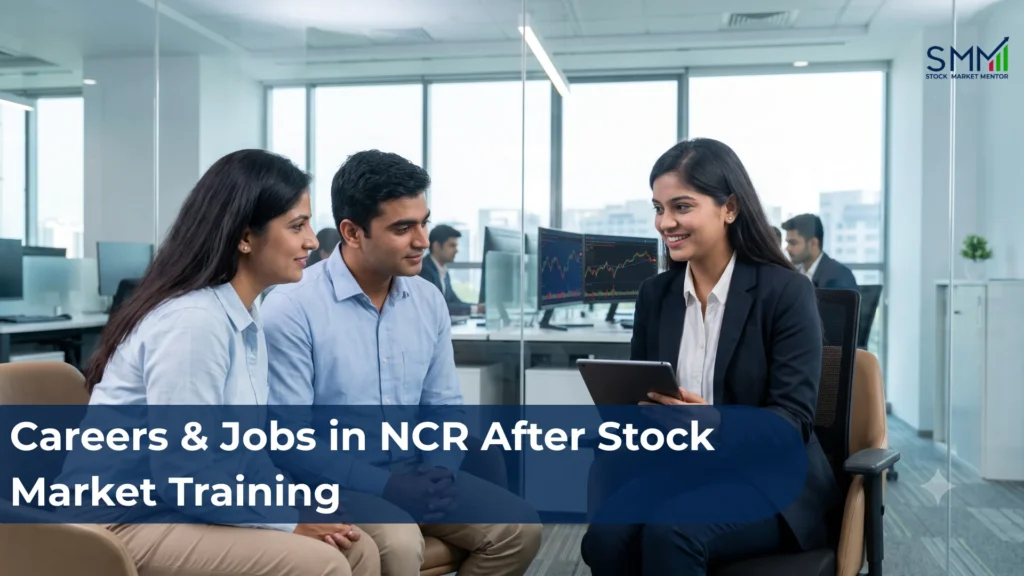
You finish your stock market course, feel pretty confident about what you’ve learned, and then reality hits: what job do you actually apply for? A lot of people reach this point and feel stuck. You have got knowledge of trading basics, perhaps you may have applied certain strategies too, but when it’s about getting jobs after a stock market course, everything becomes vague.
The truth is, there isn’t just one path. The finance industry has a lot more options than most people think. You could go into research, trading, advisory, or even wealth management. And in 2026, it is genuinely a good time to enter this field.
India’s financial services sector is projected to nearly double profits by FY30, with NBFCs growing around 16% annually and wealth management identified as a key growth driver, according to IBEF (India Brand Equity Foundation), a Government of India-backed trade promotion body.
In this blog, we’ll break things down in a simple way, the kinds of stock market jobs in Delhi NCR you can go for, what skills actually matter, which certifications can help, what salaries look like in Delhi NCR, and how you can realistically get started without feeling lost.
Is a Stock Market Course Enough to Get a Job in Delhi NCR?
Let’s be honest, just doing a stock market course doesn’t automatically land you a job. It helps, but it’s only the starting point.
A course gives you the basics:
- How financial markets work.
- What technical analysis is.
- How derivatives function.
- The importance of risk management.
That’s useful, no doubt. But when you sit in an interview, companies aren’t just checking if you’ve completed a course. They want to see if you actually understand what you’ve learned. For example you might be requested to:
- Look at the chart and tell what’s going on.
- Talk about a recent market move.
- Share your view on a stock or sector.
What really makes a difference?
Hands-on experience is very important. Even simple things can help:
- Using a demo trading account.
- Maintaining a trading journal.
- Following the market news daily.
These show that you’re really interested, not just collecting certificates. Learners who combine theory with practical exposure through a trading program for students and working professionals often find it easier to build confidence before appearing for interviews.
What about certifications?
Certifications like NISM or NCFM do help:
- Many companies like candidates who have them.
- Some roles actually require them.
But they’re not magic tickets to get into a company. They just strengthen your profile.
2026 Update – What You Should Know About It: SEBI relaxed its qualification norms in 2025. Students of any branch can now apply for registration as Investment Advisers (IAs) and Research Analysts (RAs), if they are certified by NISM. Earlier, only those with an educational background in finance, commerce, and economics could apply.
Other things you shouldn’t ignore
- Communication skills: how clearly you explain your ideas.
- Clarity of thought, especially during interviews.
- Internships, even a short one, can make a big difference.
Before you start sending out applications, take a minute to get ready:
- Review basic concepts.
- Stay updated with market news.
- Be ready to explain your thinking.
- Keep your resume simple and clean.
If you’re completely new to financial markets, starting with a stock market course for beginners can help you understand the basics before moving on to advanced trading or investment concepts.
The right skills and consistent practice can help you build a successful career in the stock market.
SEBI Certification Changes 2026: What Job Seekers Need to Know?
For years, everybody providing financial advice at a SEBI-registered advising firm, including sales staff and relationship managers who had client interaction, had to clear the complete NISM-Series-X-A and X-B tests. This is a big job for a junior relationship manager or client-servicer.
SEBI, in a circular dated June 24, 2026, divided “Persons Associated with Investment Advice” (PAIA) into two tracks.
If your role involves… | You now need… |
Actually giving advice, analysing risk profiles, recommending products, building financial plans. | NISM-Series-X-A + NISM-Series-X-B (full, unchanged). |
Only sales, onboarding, or client servicing, no advice-giving. | The new, lighter NISM-Series-XXV-B exam |
Why this matters: if you want to be a Relationship Manager or Sales Associate at an advising firm, the lighter XXV-B module may qualify you faster than the toughest two-level adviser exam. If you want to become a registered Investment Adviser (someone who may legally advise clients on purchases), you must take the whole X-A + X-B path.
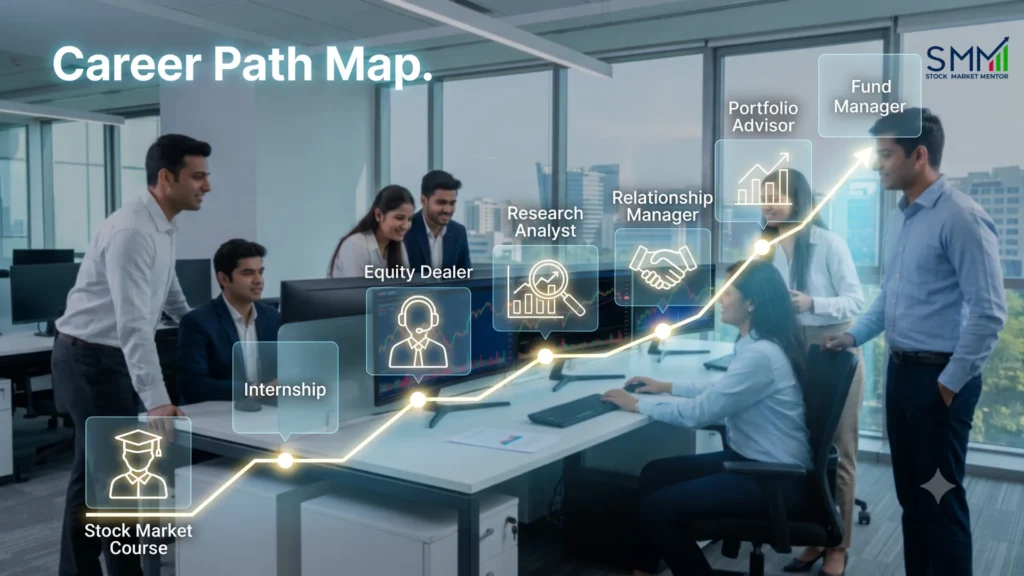
Career Path for Jobs After Stock Market Course
One of the best things about this field is flexibility. You’re not limited to just one career option in the stock market in India. There are multiple directions that you can take.
Most people don’t jump straight into senior roles. You start small, learn the essentials and then go from there.
Here is a clear professional path:
Stock Market Course
↓
Internship or Entry-Level Role
↓
Equity Dealer / Research Analyst / Relationship Manager
↓
Senior Analyst / Portfolio Executive / Proprietary Trader
↓
Investment Advisor / Portfolio Manager / Team Lead
What happens at each stage?
Initially, the big thing you want to do is learn:
- How deals are done.
- How research is conducted.
- How we treat our clients.
When you get experience, you get greater responsibilities. For instance:
- An equity dealer can move into trading or managing a trading desk.
- A research analyst can go to a senior analyst or portfolio manager.
- A relationship manager can move into wealth management roles.
Skills Also Evolve Over Time
At the start:
- Basic market knowledge.
- Understanding of technical analysis.
- Familiarity with trading platforms.
- Good communication.
As you grow:
- Strong analytical skills.
- Portfolio understanding.
- Risk management.
- Client handling or team leadership.
Expert Insight: Candidates who’ve only studied theory tend to freeze the moment we show them a live chart in an interview simulation. The ones who get hired are the ones who’ve actually placed trades, even small ones, even on a demo account, because they can explain why they made a decision, not just recite a definition. That’s the gap a good mentorship program is meant to close: turning course knowledge into decision-making under real market conditions.

What Are The Top Jobs After a Stock Market Course?
After completing a stock market course, there are quite a few roles you can explore. These careers after a trading course are available in brokerages, investment firms, fintech companies, and wealth management firms.
Equity Dealer
Equity dealers buy and sell stocks for the company or for clients.
This can be a fast-paced career because markets move quickly. You’re going to be watching prices all the time, taking orders and accuracy.
You also need to stay on top of market news, as even small changes can affect the value of stocks.
To perform under pressure you have to be quick, accurate and cool. Many dealers get into trading or research.
Research Analyst
If you enjoy researching companies and how they work, this could be the career for you.
Research analysts use financial statements, earnings reports, industry trends and market data to figure out if they should buy a stock.
Use of technical analysis (charts and trends) & fundamental analysis (business performance, growth potential) are used here. You can go into senior research or portfolio management.
Relationship Manager
A relationship manager meets clients and learns their financial goals and provides them with investment possibilities.
Selling things is not the only thing. You need to develop a rapport, articulate well and lead clients as per their needs.”
You will manage stocks, mutual funds, insurance and other investment products.
The key is good communication. If you do well, you can transition into wealth management or private banking roles.
Proprietary Trader
A proprietary trader trades with the company’s money, not clients’ funds.
The role is more systematic than personal trading. You will follow particular techniques, stick to risk limitations, and monitor your performance periodically.
This might be an excellent job choice for those who prefer to be out there in the market on a daily basis.
Portfolio Executive
So if you’ve always wondered who it is that keeps track of all those investments behind the scenes, this is what a portfolio executive does essentially. They collaborate with portfolio managers and advisors to ensure everything is in place.
On any given day you may be reviewing a client’s portfolio performance, monitoring market moves, updating records or producing reports for review meetings. Markets are always shifting and there’s a lot of adjusting and rebalancing happening.
A large number of individuals, after accumulating sufficient experience, transition into portfolio management or advisory positions.
Investment Advisor
An investment advisor is someone that people go to when they do not know where to put their money.
You’ll review their income, goals, risk tolerance and general financial picture before making any recommendations. This is a regulated role in India and certifications like NISM are often necessary. Typically, companies want candidates to understand the basics of compliance.
Advisors can work with wealth management firms, banks, or even start their own advisory practice once they meet the requirements and gain experience.
Financial Content Analyst
Not everyone in finance spends their day staring at charts. Some people focus on explaining what’s happening in the market.
A financial content analyst writes articles, market updates, guides, newsletters, and even social media posts. The idea is simple: take complicated financial concepts and explain them in a way people can actually understand.
You’ll find these roles in brokerages, fintech companies, financial news platforms, and mutual fund houses.
Stock Market Trainer
There are more and more people interested in trading and investing, and this is reflected in the growing need for trainers.
Stock market trainers teach everything from basics to advanced topics like technical analysis, derivatives, risk management, and intraday trading, helping learners build practical market skills.
What Are The Skills That Can Help You Get Jobs After a Stock Market Course in Delhi NCR?
Doing a course is a good starting point, but what really matters is whether you can actually use what you’ve learned.
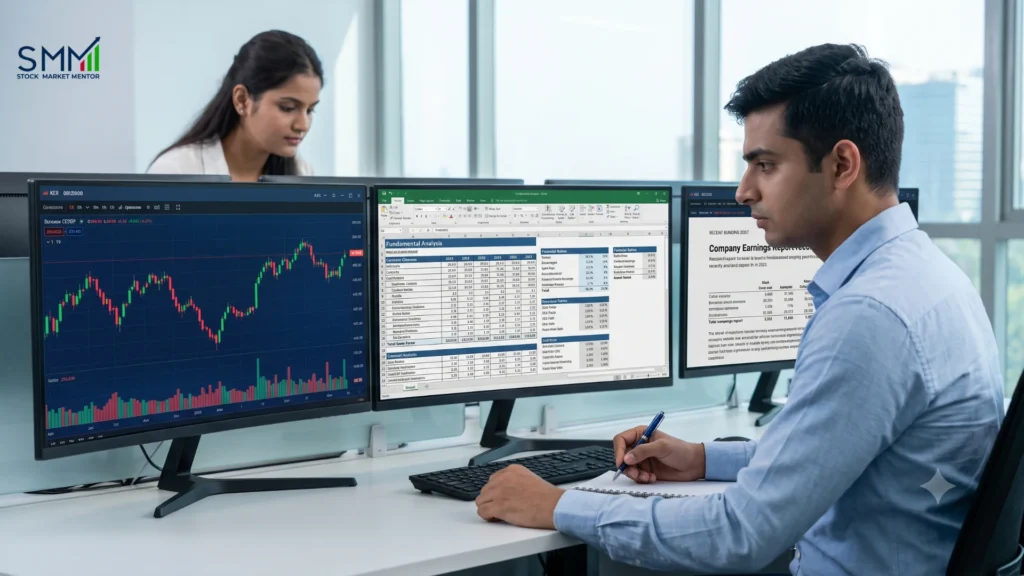
- Technical analysis is one of the first things employers look for. If you’re confused about where to begin, understanding technical vs fundamental analysis can help. You need to be able to read charts, spot trends and understand the price movements.
- If you are targeting research or long-term investing roles, then fundamental analysis is just as important.
- Companies are highly serious about risk management. It’s not just about making profits; it’s about knowing how to protect capital and handle losses.
- Basic Excel skills are still very useful. You’ll use it for analysing data, preparing reports, and tracking performance.
It also helps if you know how to use platforms like TradingView or brokerage terminals before. It shows you won’t need too much guidance once you start working. Especially if you’re planning to explore an algorithmic trading course in Noida later.
Which Certifications Improve Job Opportunities?
Certifications won’t guarantee you a job, but they definitely make your profile stronger.
- NISM certifications are popular in India, particularly for positions like investment counselor, research analyst and mutual fund distributor. In some cases they are actually required before you can start working. Details and exam calendars are available directly at nism.ac.in.
- NCFM (NSE Academy’s Certification in Financial Markets) modules, offered by the NSE Academy, cover technical analysis, derivatives, and financial markets across foundation, intermediate, and advanced levels, and each certificate is valid for five years. Full module details are available at nseindia.com and the NSE Academy portal.
- Also there are BSE Institute courses which are more focused on practical learning.
Top Companies Hiring Stock Market Professionals in Delhi NCR
Delhi NCR is home to a lot of financial companies and Noida has emerged as a major stock market education hub in NCR, so there are a lot of opportunities if you are ready.
Some well-known names include:
- Angel One
- Motilal Oswal
- ICICI Securities
- HDFC Securities
- Kotak Securities
- Sharekhan
- Axis Securities
- IIFL Securities
- Upstox
- Groww
- SMC Global.
Other than these, there are also smaller firms, fintech startups, and advisory companies who are regularly hiring.
The easiest approach to keep a tab on the latest updates is to keep visiting LinkedIn, job portals and company career pages. Opportunities in this field can open and close quickly.
Average Salary After Stock Market Course in Delhi NCR
Salaries can vary depending on your talents, credentials and the organization you join.
Job Role | Fresher Salary | Experienced Salary |
Equity Dealer | ₹2.5–4.5 LPA | ₹5–8 LPA |
Research Analyst | ₹3–6 LPA | ₹6–12 LPA |
Relationship Manager | ₹3–5 LPA | ₹6–10 LPA |
Portfolio Executive | ₹3–5 LPA | ₹6–11 LPA |
Investment Advisor | ₹4–8 LPA | ₹8–15+ LPA |
Proprietary Trader | Performance-based | High earning potential |
Trading as a Career vs Investing as a Skill
A lot of people mix these two up, but they’re quite different.
Trading as a Career | Investing as a Skill |
Full-time profession | Assists in creating long-term wealth |
Income is based on salary, incentive or trading performance. | Helps make better financial decisions personally. |
Requires regular market monitoring. | Needs less frequent monitoring. |
Certifications usually required for regulated jobs. | Certifications are typically optional. |
For finance professionals. | Useful for students, employees and business owners. |
How to Improve Your Chances of Getting Jobs After Stock Market Course?
Getting into this field isn’t impossible, but you do need to put in some effort.
- Try to get internships, even if they’re short. They give you real exposure and make your resume stronger.
- Maintain a trading journal. It might sound basic, but it shows that you actually think through your decisions instead of guessing.
- Select certifications such as NISM that align with your career goals.
- Keep up to date with the latest market developments. Often, interviewers will ask you about what’s going on in the news, or what current trends are.
- Using trading platforms and improving your Excel skills
- Also do not forget networking. A good LinkedIn profile and the right connections can open doors you didn’t expect. If you’re planning further learning, review these questions to ask before taking a stock trading course before enrolling.
Common Mistakes Freshers Make After Completing a Stock Market Course
- Assuming that taking a course means a good-paying job.
- Ignoring the significance of NISM or other relevant certifications.
- Not getting hands-on experience through real or simulated trading.
- Applying for jobs without knowing actual market realities.
- Lack of interview prep specifically on current market trends.
- Focus primarily on profits and not think about loss management measures.
- Not keeping up with the financial news and market trends.
- Neglecting networking and professional profile building (LinkedIn, resume).
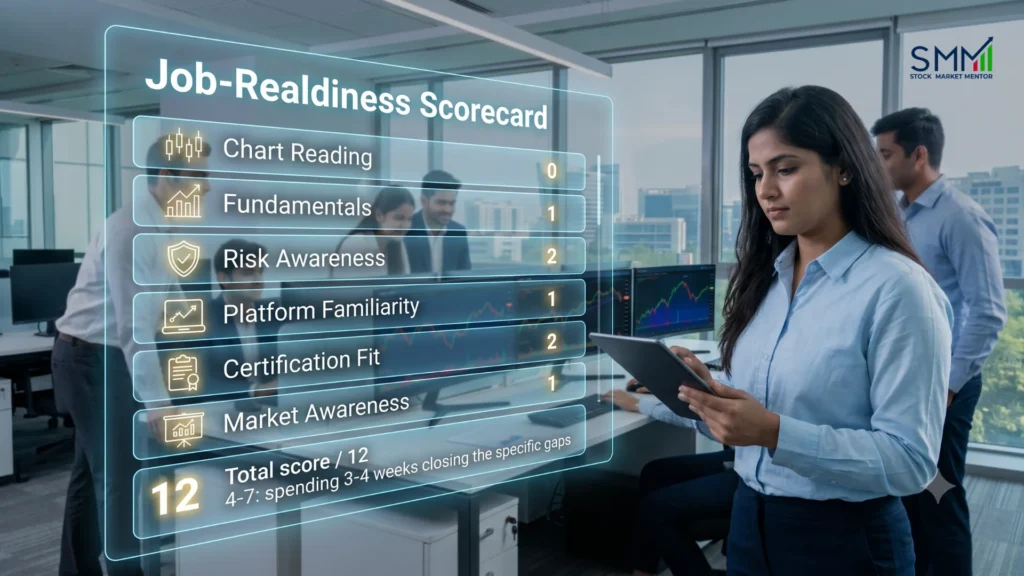
Your Job-Readiness Scorecard: A Quick Self-Check Before You Apply
Use this quick scorecard. Score yourself 0–2 on each (0 = not started, 1 = some exposure, 2 = confident) before you start applying:
- Chart reading: can you explain a stock’s recent move using a candlestick chart, unprompted?
- Fundamentals: can you read a company’s quarterly result and explain if it’s good or bad news?
- Risk awareness: can you explain stop-loss and position sizing in your own words?
- Platform familiarity: have you used a demo account or brokerage terminal for at least a few weeks?
- Certification fit: do you know whether your target role needs NISM X-A/X-B, XXV-B, or an NCFM module (see the SEBI section above)?
- Market awareness: can you name one thing that moved the Nifty or Sensex in the last week?
8-12: You’re close to interview-ready. Focus on polishing your resume and applying.
4-7: You have a foundation; spend 3-4 weeks closing the specific gaps before applying widely.
0-3: Go back to structured, mentor-led practice before interviews. A course alone won’t carry you through a technical round.
Jobs After Stock Market Course: Build the Right Skills with Stock Market Mentor
After you complete a stock market course, the major question is what next? Of course just getting a certificate will not get you the job in this field. It’s the knowledge of the market and the confidence in using that knowledge that matters most.
There are many chances out there but they usually go to people who keep studying, practicing and keep up to date. The stock market is always changing and you have to keep up.
If you feel like you still need to polish your skills or want more practical experience, you can always continue learning via platforms like Stock Market Mentor. Just take it one step at a time, keep consistent and strive to improve a little bit each and every day. That’s how most people actually build a career in this field.
Disclaimer: This article is intended for educational and informational purposes only and does not constitute investment, legal, tax, or career advice. Stock Market Mentor is an education provider and is not a SEBI-registered investment adviser or research analyst; nothing in this article should be treated as a recommendation to buy, sell, or hold any security, or as a guarantee of any job, salary, or certification outcome.