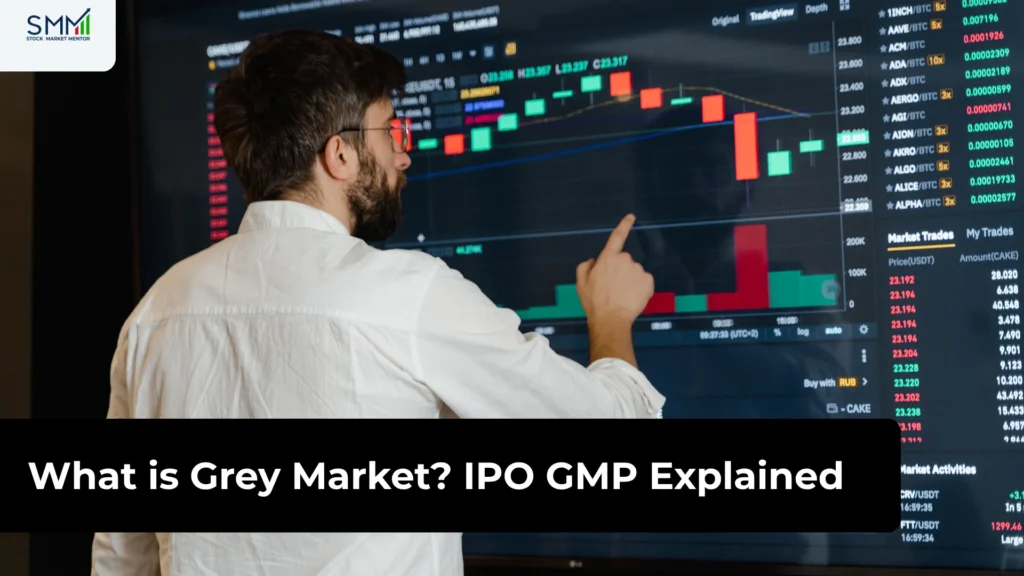
So you’ve been checking IPO news, and you keep running into this term: GMP. Everyone says it around like you’re supposed to already know what it means. So, what is the gray market, really?
In simple words, the grey market is an unofficial space where people trade IPO shares and applications before the stock is actually listed on NSE or BSE. It’s called “unofficial” because SEBI, the regulator that oversees India’s stock exchanges, has no hand in it, no exchange, no clearing house, no rulebook governing these specific trades. Just buyers and sellers making informal deals, based mostly on trust.
And that’s where GMP comes from. GMP, or Grey Market Premium, is the extra amount reported in this unofficial market for an IPO share before it lists. It’s a quoted figure, not a promise. Keep that in mind as you read on: GMP is a sentiment signal, not a guarantee of what the stock will actually list at.

What Is a Gray Market?
Grey Market Meaning in Simple Terms
Picture this: a company is about to launch its IPO. Before the shares are even allotted, some traders start quoting prices on what the stock might be worth once it starts trading. These quotes happen outside the stock exchange, in an informal setup, typically through dealer networks.
That’s the grey market.
Now, “grey” doesn’t mean illegal. It means the trading happens in a space that sits outside the formally regulated system, but not authorised or overseen by SEBI either. So think of it as a shade of gray in between a properly regulated trading and something that is plainly banned. That is what makes it different from a recognized stock market, where all trades happen through SEBI-registered brokers, exchanges and legitimate clearing and settlement procedures.
How Does the Grey Market Work?
A buyer contacts a dealer, they agree on a price, and the deal settles informally once the stock lists. That’s the transaction in one line. If you’re building your foundation through stock exchange learning, it’s important to understand that ‘grey’ doesn’t mean illegal.”
What’s actually being priced can vary. Sometimes it’s the shares themselves, once they’re expected to be allotted. Sometimes it’s just the entitlement tied to an application that hasn’t been allotted yet. Either way, none of it runs through an exchange, so there’s no formal paper trail, no contract, and no clearinghouse behind it, just cash, trust, and repeat dealing between the same dealer networks. Multiple market reports describe these transactions as largely cash-based and undocumented, held together mostly by reputation rather than any written agreement.
What Is Gray Market in an IPO?
Between the day an IPO’s subscription closes and the day it actually lists on the exchange, there’s typically a short gap, currently around three trading days under SEBI’s T+3 listing timeline. During this window, an informal market develops because traders want to gauge sentiment before the stock properly starts trading.
Demand during this period gets expressed as a quoted premium (or, sometimes, a discount) over the issue price. It’s worth separating this clearly from an actual allotted share: a grey-market quote is an informal, reported price point. It isn’t a transfer of a real, tradable share sitting in your demat account.
What Is IPO GMP?
IPO GMP (Grey Market Premium) is the premium reported in the unofficial market at which an IPO is said to be trading before its official listing.
Say an IPO is priced at ₹500 and dealers are quoting a GMP of ₹100. That means, in this unofficial market, the reported price for that share works out to ₹600.
What Does IPO GMP Tell Investors?
GMP gives a rough sentiment read, a hint at how much informal demand a dealer network is picking up on. But here’s the distinction that matters most in this whole topic:
- GMP = a quoted, informal figure reflecting dealer-level sentiment.
- Actual listing price = the price genuinely discovered once official trading opens on the exchange.
Quick framing worth holding onto: GMP tells you what a small, informal dealer network is willing to bet on, without any settlement risk actually changing hands until the stock lists. The listing price tells you what thousands of live, enforceable orders were willing to pay the moment real money and real shares had to change hands, in public, on an exchange. One is an informal opinion with a number attached to it. The other is price discovery. Most GMP-driven mistakes come from treating the first like the second.
Want to Understand IPOs Better?
How Is IPO GMP Calculated?
IPO GMP Calculation Formula
The formula is straightforward:
GMP = Grey Market Price − IPO Issue Price
And from that:
Indicative price = IPO Issue Price + GMP
Example: if the issue price is ₹500 and the reported GMP is ₹100, the indicative price works out to ₹600.
What Does GMP Percentage Mean?
GMP % = (GMP ÷ Issue Price) × 100
Using the same numbers: ₹100 ÷ ₹500 × 100 = 20%.
That 20% is simply the reported premium on that day.
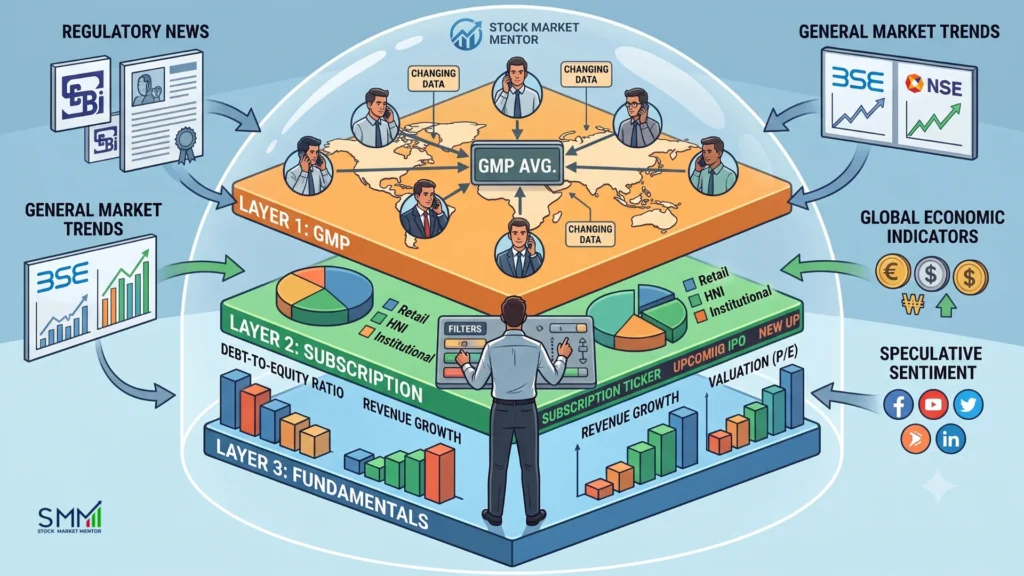
Why Does IPO GMP Change?
A few things drive movement in GMP:
- IPO subscription demand: As a rule, higher demand across the board pushes the mentioned premium up.
- General market conditions: The GMP of a fundamentally sound IPO can be affected by a volatile broader stock market, while a bullish climate can support it alongside broader technical analysis of the Indian stock market.
- Company fundamentals: Business performance, valuation, and growth expectations all feed into how dealers price the informal quote.
- Sector and investor sentiment: A sector that’s in favour that quarter tends to draw stronger grey-market interest, regardless of the specific company’s numbers.
- Time until listing: GMP a week before listing and GMP the night before can be two different numbers entirely. A quote today doesn’t guarantee the same quote tomorrow, let alone the actual listing price.
Is IPO GMP Reliable?
Why Investors Look at GMP?
To be fair, GMP isn’t without value. It gives a quick, informal read on:
- What dealer-level sentiment currently looks like around an IPO.
- Whether there’s apparent demand building up.
- What some market participants seem to be expecting going into listing.
Why Can GMP Be Misleading?
But there are real gaps here too:
- Quotes come from a small, informal network, not a broad, verifiable pool of trades.
- Figures can shift within hours and are hard to independently confirm.
- It says nothing about the company’s intrinsic value or business quality.
- It offers no guarantee of listing gains.
- Genuine market conditions on listing morning can move in an entirely different direction.
This difference in numbers is not a debate, but regulatory data. According to SEBI’s analysis of 144 mainboard IPOs that listed between April 2021 and December 2023, investors other than anchor investors offloaded 54% of their allotted shares by value within a week of listing. This “flipping” soared to 67.6% when listing day returns were above 20% and 23.3% when returns were negative. A claimed premium turned into a bookable gain and many investors moved on to business quality.
Expert Insight, from the SMM trading desk at Stock Market Mentor: “We tell our students the same thing we tell them about tip-based trading. Don’t build a position on a number you can’t verify. GMP can tell you where the crowd’s mood is, but crowd mood isn’t a strategy. Look at subscription data and the company’s fundamentals with your own eyes before you decide anything. This lines up with how Stock Market Mentor structures its own courses, prioritising risk management and independent analysis over chasing tips or informal chatter.”
GMP vs Actual Listing Price
Metric | Example |
IPO Issue Price | ₹500 |
Reported GMP | ₹100 |
GMP-based Indicative Price | ₹600 |
Actual Listing Price | ₹560 |
Why the gap between ₹600 and ₹560? Because the reported GMP comes from a thin, informal, dealer-driven network, while the actual listing price is set by real buy and sell orders hitting the exchange the moment trading opens, institutional flows, broader market mood that morning, and genuine supply-demand at scale. The grey market simply doesn’t capture all of that.
Is Grey Market Trading Legal in India?
Traditional grey-market dealing, informal, dealer-to-dealer trading of IPO applications and shares before listing, sits outside SEBI’s regulatory framework. Neither the SEBI Act, the Securities Contracts (Regulation) Act, nor SEBI’s ICDR Regulations (which govern the IPO process itself) specifically define or ban it. The safest way to put it: the grey market describes trading outside the recognised exchange system, and its treatment depends on the specific transaction; don’t assume an informal deal is authorised or protected just because it’s commonly called “grey market.”
Unauthorised online platforms selling unlisted shares are a separate, more directly flagged concern. In a June 17, 2026 press release (PR No. 32/2026), SEBI cautioned investors against transacting in unlisted public company securities through electronic platforms and websites, noting only recognised stock exchanges can facilitate securities trading, and that users of such platforms get no access to SEBI’s investor-protection or grievance-redressal mechanisms, its third such advisory, after December 2024 and August 2016.
Separately again, SEBI has been developing a “when-listed” platform since a January 2025 announcement, a proposal to let investors trade IPO entitlements in a regulated setting between allotment and listing. As of 2026, it remains a proposal, not a live platform; current Chairman Tuhin Kanta Pandey has referenced continuing work on it. Check SEBI’s press releases page for the latest status before relying on any single article, including this one.
What is Gray Market vs Stock Market?
Feature | Grey Market | Stock Market |
Nature | Unofficial | Official |
Trading | Outside recognised exchange mechanism | |
Price | Informally quoted | Market-discovered |
Transparency | Limited | Higher |
Regulation | No dedicated regulatory framework | Formal regulatory framework under SEBI |
Investor protection | More limited | Established protections |
What Are the Risks of Relying on IPO GMP?
- GMP comes from an informal, undocumented network: It isn’t exchange data, and there’s no audit trail behind any single quote.
- GMP can change quickly: A quote that looks strong today can fall sharply by the time listing actually happens.
- GMP doesn’t reflect company value: Just because a stock trades at a high multiple doesn’t indicate the company is reasonably valued. That basically means dealers are pricing in higher demand now.
- GMP is not a promise of listing gains: This is the most misunderstood point of all. Plenty of IPOs with strong reported GMP have still listed flat or below issue price once real market forces took over on listing day.
- Figures can be hard to verify: Not every statistic you see on tracking sites or in message groups is a legitimate transaction that has actually occurred. Some are just talk and sometimes the number of reported cases can be overstated to generate attention, which is why backtesting strategy and evidence-based analysis matter when evaluating market signals.”
- It can distract from fundamentals? When a GMP number looks exciting, it’s easy to skip checking the company’s actual financials, valuation, and business quality, and that’s usually where the real risk sits.
A Quick GMP Sanity-Check: 4 Questions Before You Trust a Number
Here’s a short checklist worth running through before a reported GMP figure influences your decision at all:
- Which source is quoting it, and do two or three independent trackers agree? A number only one obscure site is showing is worth far less than one that several trackers converge on.
- Has the number moved sharply in the last few hours with no news to explain it? Sharp, unexplained jumps are a common sign of thin, easily-moved sentiment rather than genuine broad-based demand.
- Does the GMP direction match the actual subscription trend? If subscription numbers are weak but GMP is climbing, that mismatch is a flag, not a bullish sign.
- Would you still be comfortable holding the stock post-listing if the “guaranteed” listing gain didn’t show up? GMP-chasing works only as an exit strategy, never as an investment thesis.
What Are Kostak Rate and Subject-to-Sauda?
If you’re following Indian IPO talk, you’ll run into these two terms alongside GMP.
What Is Kostak Rate?
Under the informal agreement, a seller earns the Kostak rate for transferring their whole IPO application to a buyer, regardless of whether the application acquires shares. It’s a way to fix the outcome before the allotment. Unlike a share-linked quote, the amount is fixed at the time of the deal and doesn’t vary with GMP.
What Is Subject-to-Sauda?
Subject-to-sauda is a conditional type. It’s only paid if the application gets an allotment. Without an allotment, the deal doesn’t happen, and no money is exchanged. Riskier than a Kostak trade, but only pay off if you get an allocation.
How Should Investors Interpret IPO GMP?
Instead of treating GMP as a green light or a red flag, use it as one input inside a bigger picture. Here’s a simple way to structure that.
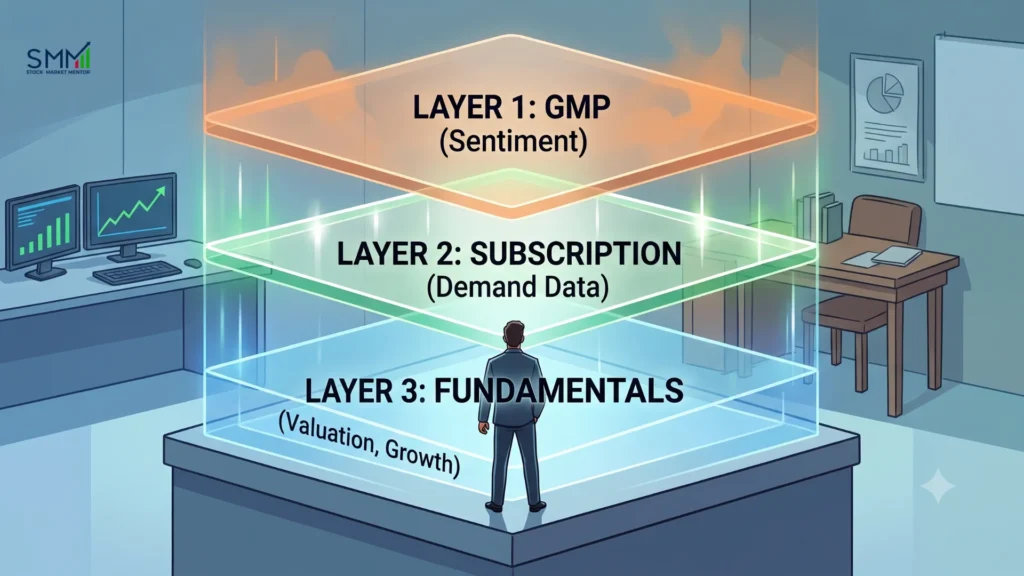
The 3-Layer IPO Signal Framework
Layer 1: GMP – What’s the informal, dealer-level sentiment saying right now?
Layer 2: Subscription – How strong is the actual, verifiable demand across retail, HNI, and institutional categories?
Layer 3: Fundamentals – Does the company’s business, growth trajectory, and valuation genuinely support what the market seems to expect? This is where understanding technical vs fundamental analysis can help put different market signals into context.”
GMP alone tells you what a small, informal market currently expects, much like technical indicators for trading provide one signal rather than a complete market view. It can’t tell you whether that expectation is justified; that’s what the other two layers are for. Weigh all three together, and you’re working from a far more grounded position than chasing a single quoted number.
Expert take, from Stock Market Mentor: SMM’s trading desk teaches a principle worth borrowing here, don’t build a decision around a single external signal, whether that’s a tip, a call, or a GMP number. The institute’s own courses emphasise independent analysis and risk management over chasing conjecture. Applied to IPOs, that means treating GMP the way you’d treat any one indicator among several: useful context, never the whole basis for putting money in.
The Key Takeaway for IPO Investors
So, what is the gray market really telling you? It can give you a useful read on pre-listing sentiment, but it should never be treated as a guaranteed listing price or return. GMP is only one part of the IPO picture. Subscription data, valuation and the company’s fundamentals matter too. If you want a better grasp of IPOs and other market topics, Stock Market Mentor is one resource you can refer to. The grey market is worth watching, but your investment decision should go beyond one unofficial number.
Disclaimer: The grey market is unregulated and operates outside SEBI’s oversight. This page uses samples of GMP, Kostak, and subject-to-sauda numbers, which are unofficial and subject to change.