How Delhi Investors Can Use Market Cycles Amid 2026 Volatility & Global Uncertainty?
It is a Tuesday morning in April 2026. By 9.30 AM, a 38-year-old Delhi-based IT expert, sitting with his chai, sees his mid-cap portfolio fall by 2.3% in value. His WhatsApp chats are ablaze; some of them are selling everything, others buy the dip, and the majority are just increasing panic. He is unsure of which voice to listen to.
As in April, the Sensex is at 25x forward earnings following a sharp fall in the Sensex. Brent crude has broken the $100 a barrel mark. FPI outflows have reached an all-time high of $19.69 billion in FY2026- the highest level of foreign withdrawal in the history of the Indian market. Nifty IT, a popular investment choice among the Delhi-NCR investors has not performed well since February, whereas the Auto and Realty indices are at almost 15 percent of the recent levels. The din is incessant.
However, this is what most investors might not be getting: this mess is structured. The markets have been cyclical. And just now, the cycle is not indicating collapse – it is indicating transition. What they will do is not just safeguard wealth, as those who comprehend that difference in 2026 will create it.
How To Understand Market Cycles for Delhi Investors?
Market cycles are the repetitive cycles of growth, high point, decline, and recovery of asset prices over a period of time. Although the concept is global, the local policies of Delhi in terms of capital inflows, domestic policy, and the behaviour of urban investors have a unique impact on its application to Delhi investors.
In general, a market cycle takes the form of four steps:
- Accumulation Phase: Smart money is bought in at a low sentiment.
- Markup Phase: Prices are increasing due to the more general involvement
- Distribution Phase: Institutional investors start to withdraw.
- Markdown Phase: Markdowns set in, and panic selling can be a result of these markdowns.
As per the records of the NSE and BSE indices, Indian markets have exhibited cyclical corrections after every 3-4 years, and the drawdowns are usually between 12-25%, after which the markets have recovered. To investors in the city of Delhi, where retail investment has increased by more than 68% since 2020, according to the NSDL data, it is no longer a choice to understand these stages; it has become a tactic.
Stock Market Volatility 2026: What’s Driving the Swings?
A complicated combination of triggers increasing volatility has been introduced by the year 2026. Contrary to the solitary alterations of the past, the changes being experienced today are interrelated both among global and local ecologies.
Key Drivers for Current Volatility in the Indian Stock Market Include:
- Uncertainty in the Interest rate: The US Federal Reserve and the RBI have kept the benchmark rates at 5.25-6.50%, which has affected the flow of liquidity.
- Geopolitical Tensions: Tensions in Eastern Europe and the Middle East have caused crude oil prices to go above 85-95 per barrel.
- Tech Sector Rebalancing: Nasdaq declines of close to 10-12% in the past cycles are affecting the mood all over the world.
- Retail Investor Surge: India has seen the number of new demat accounts increase to over 35 million between 2020 and 2025 (CDSL data).
A recent Morgan Stanley report suggests that short-term corrections of 10-15 years are possible in emerging markets such as India, even in the long term, in a bullish trend.
To Delhi investors, volatility is not something to be worried about; it is the nature of the market atmosphere at the moment.
Learn How To Make Decision in Volatile Markets
Our structured courses help you make strategic decisions on your own with strong fundamentals
How Global Market Trends Impact India in 2026?
There is no longer insulation in the markets of India. The global market trends that have affected India have ceased to be a mere theory, but a reality.
FIIs (Foreign institutional Investors) tend to withdraw funds out of the emerging markets when the US Federal Reserve gives an indication that it will increase the rates. Likewise, any change in the prices of crude oil has an immediate impact on the inflation and fiscal balance of India.
Once think of considering these correlations to make investment decisions in the Stock Market –
- History has shown that 1% rise in the US 10-year bond yields has resulted in FII outflows of about 1.52 billion of Indian equities.
- Increased oil prices to more than 90/barrel will raise the inflation in India by 30-40 basis points.
- A 1% depreciation of the INR will increase revenues in the IT sector by 0.5-1% owing to the benefits of exporting.
Investors in Delhi, particularly those in industries such as IT, banking, and real estate, need to monitor global indicators as well as domestic indicators. By neglecting global signals in 2026, it is like trading with incomplete information.
Strategic Approaches: Turning Cycles into Opportunities
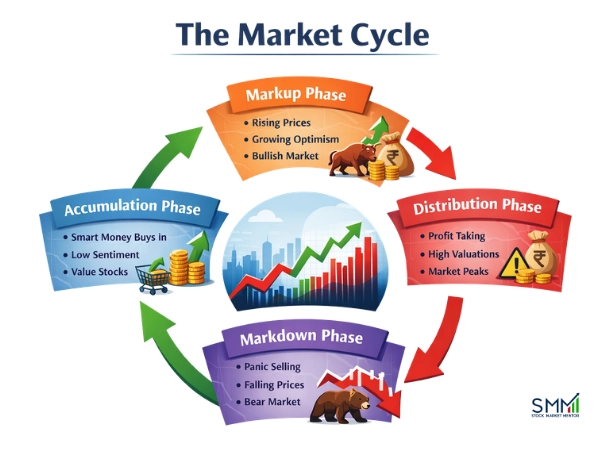 Cycles do not take place in one step. The actual benefit is in coordinating the strategies of investments with every stage. To ensure this, you must learn & get trained with market updates. Our Value Investor Program for Delhi trade learners can be a great addition, which helps you understand the market volatility & to make the right decisions during these times.
Accumulation During Fear
- Quality stocks tend to be undervalued when markets rectify the situation drastically.
- Concentrate on fundamentally strong firms.
- Staggered investments or use SIPs.
- Do not time the bottom.
Markup Phase Riding
- As sentiment improves, momentum builds.
- Expand into growth areas.
- Monitor growth in profits (Nifty EPS growth averaging 12–15% annually)
- Rebalance portfolios periodically
Distribution with Discipline
- When things are at their highest hopes, care is paramount.
- Book partial profits
- Cut down on the overvalued stocks (PE ratios more than 25-30x in some industries)
- Diversify into defensive investments.
Markdown Phase management.
- Investor psychology is put to the test with corrections.
- Avoid panic selling
- Assess fundamentals, rather than price action.
- Determine entry points in the long term.
Historically, disciplined investors who remained invested during crashes earned 2-3% more returns than those who pulled out early, according to SEBI and AMFI data. With the help of our Stock market courses in Delhi, you will be able to manage risk, take confident decisions & invest in the right areas even at the time of volatility.
Sectoral Insights for Delhi Investors - Special Guide Curated By Our Mentors
The investor base of Delhi tends to be biased towards certain sectors based on the economic exposure of the region.
- Real Estate & Infrastructure: This is expanding by 8-10%/year, and is backed by government capex of more than 10 lakh crore.
- Banking & Financial Services: 14-16% YoY credit growth (RBI data) is high.
- IT & Tech: Export revenues are over $250 billion in a year, but are susceptible to slowdowns in the world.
- Consumer Goods: The consumer goods are generally stable, and the demand has been growing at a steady 6-8 per cent. per year.
Behavioral Edge: The Real Differentiator
 Data and strategies are important, but the behavior of investors can often be the determinant. Some of the common errors in volatile stages are:
- Following the momentum at the market highs.
- Exiting during corrections
- Excess exposure to one industry
An Indian market version of a DALBAR-type behavior study suggests that investors in India underperform the performance of benchmark indexes by 3-5% per year because of emotional decision-making and inappropriate timing.
To the investors of Delhi, a lasting advantage can be developed through the establishment of a disciplined framework, which is supported by research, diversification, and patience.
Final Thoughts
Delhi investors do not think of market cycles as barriers-they are guides. With a year characterized by volatility and uncertainty in the world, people who know these cycles would enable them to shift their trading habits towards a strategic approach to investment.
The veteran trader in Connaught Place does not overlook volatility-he deciphers it. And in 2026, such interpretation might be the distinction between missed opportunities and continued wealth creation.
Learning the fundamentals of the stock market can be highly beneficial for you to study the market & make investment decisions. With Stock Market Mentor’s structured courses, you will find it easy to analyse the market behavior & trade successfully. You can consult our mentors to know the complete syllabus of our stock courses available.
Learn Basics & Fundamental of Stock Market from Expert Mentors
Book a call with our mentors, explore more suitable courses based on your interest & enroll for a certification course.