You’ve probably seen this happen. You find a trading strategy online, maybe on YouTube or Instagram, and it looks solid. The person explaining it sounds confident, the charts look clean and the results seem great as well. So you go ahead and give it a shot. But once you put your money in, things don’t go as expected. The market moves against you, and suddenly you’re left wondering if the strategy was ever reliable to begin with.
That’s exactly why people want to know what is backtesting in the stock market. Backtesting lets you see how a strategy would have done in the past using real market data, rather than taking someone’s word for it. It’s not about predicting the future, but it does offer a better indication of whether a plan has truly held up over time, or just got lucky on a screen recording.
This isn’t a hypothetical concern. According to SEBI’s own research, nearly 91% of individual traders in the equity derivatives segment made a net loss in FY 2024-25, with aggregate losses widening 41% year-on-year to over ₹1.05 lakh crore. A large share of that comes down to traders following strategies, often shared as “backtested”, that were never properly stress-tested against real, varied market conditions.
In this blog, we’ll break down what backtesting really means, how it works, why it matters, what you should look at while testing a strategy, common mistakes people make, and some tools you can use to do it properly.
What Is Backtesting in the Stock Market?
If you’ve ever asked yourself what backtesting actually means, think of it like a trial run. Before putting real money into the market, you take your idea and see how it would have worked in the past.
Simple Definition Of Backtesting
In simple terms, backtesting means taking a trading or investing strategy and applying it to past market data to see how it would have performed.
The idea is to move away from “I think this might work” to “Let me see how this has actually behaved over time.”
For example, say you decide to buy a stock whenever its 50-day moving average crosses above its 200-day moving average. Instead of jumping in with real money, you go back and check how this rule would have played out over the last few years.
You won’t get perfect answers, but you’ll start to see patterns, where it works, where it struggles, and how consistent it really is.
How Does Backtesting Work?
First, you need historical data: prices, highs, lows, volume, all that basic stuff. The more data you have, the better you can understand how your strategy reacts in different conditions. For Indian markets, the most reliable place to source this is directly from the exchanges: the NSE India historical data archives and the BSE India market data section, rather than third-party scraped datasets, which can contain gaps or adjustment errors around corporate actions like splits and bonuses.
Then you define your rules. You need to be clear about:
- When you enter a trade.
- When you exit.
- Where your stop-loss goes.
- How much you’re risking per trade.
Once that’s done, you apply those rules to past data exactly as they are.
What Can You Backtest?
A lot of people think backtesting is only for advanced traders or people who code. That’s not really true. If your strategy has clear rules, you can test it. Some common things people backtest include:
- Moving average strategies.
- RSI-based setups.
- MACD signals.
- Breakout trades.
- Swing trading ideas.
- Intraday setups.
- Momentum strategies.
- Options strategies.
- Even long-term investing approaches.
Expert Insight: In our Algo Trading Decoded course, we tell every batch the same thing before we let them touch a single line of code, a strategy you can’t explain in one sentence is a strategy you can’t backtest properly. If you can’t state your entry, exit, and risk rule in plain language, the backtest is just decoration on a guess.
Why Backtesting Matters Before Investing Real Money In Stock Market?
A lot of people enter the market after watching a video or hearing a tip from someone. Sometimes it works for a while, but there’s no real way to know if it’s reliable.
That’s where backtesting helps.
It answers a basic question: has this idea actually worked before?
When you see a strategy perform across different time periods, you start to trust it more. You’re not reacting to every price move; you’re following a plan.
It also helps with emotions. Money can make trading stressful. Having a strategy you have tested makes it easier to keep calm and stick to your rules.
Another big advantage is that it shows you the weak spots.
Maybe your strategy works great in a bull market but struggles when things slow down. Maybe the losses are bigger than you expected. These are things you’d rather know early.
Backtesting also gives you a sense of risk. You can see how deep the losses can go and whether you’re comfortable with that.
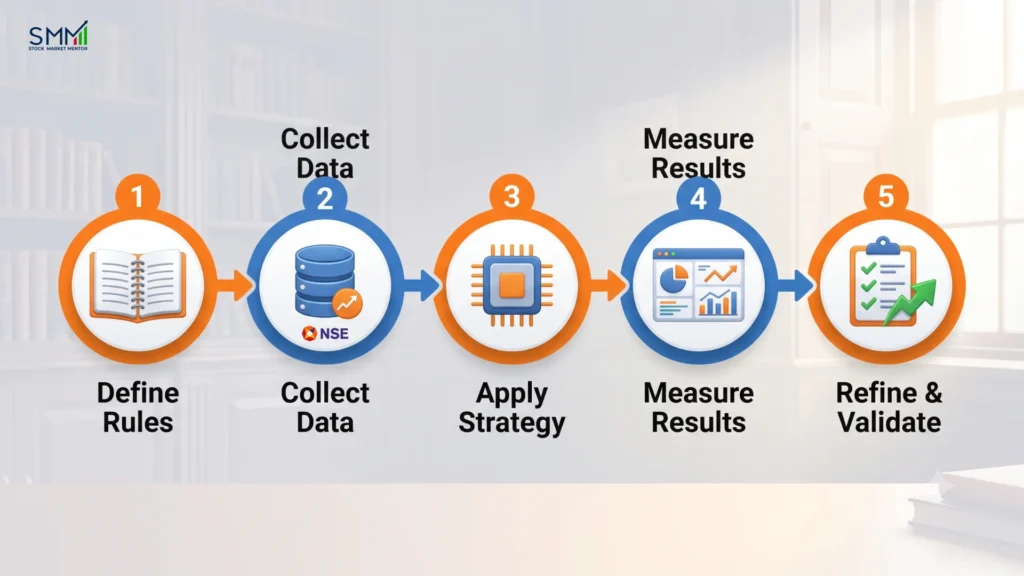
How to Backtest a Trading Strategy in the Stock Market: Step-by-Step
If you are wondering how to do this exactly, it is simple. The trick is to remain honest and consistent.
Step 1: Define Your Trading Rules
Start by writing down your rules clearly. Know exactly when you will get in, when you will get out, where your stop loss is, and how much you will invest.
Step 2: Collect Historical Market Data
And then you get the reliable data from the historical data of your trading strategy. If you’re trading Indian markets, use good-quality data from NSE or BSE. Try to include different market phases, rising markets, falling markets, and sideways periods.
Step 3: Apply the Strategy to Historical Data
This is where the actual testing begins. Stick strictly to your own rules, don’t leave out any trades and make no adjustments simply to improve the outcomes.
Step 4: Measure the Results
Once you have completed it, have a look at the result. Look at consistency, risk and how the approach behaved in general.
Step 5: Refine and Validate the Strategy
If you see obvious problems, make the changes. But don’t keep tinkering forever only to enhance past results. If you change your approach, try it out again with new data, not the same set. That way you know if it is a real improvement. It takes time to build a good strategy. Rushing typically leads to blunders and loses you money.
What Are The Key Metrics to Track When Backtesting a Trading Strategy?
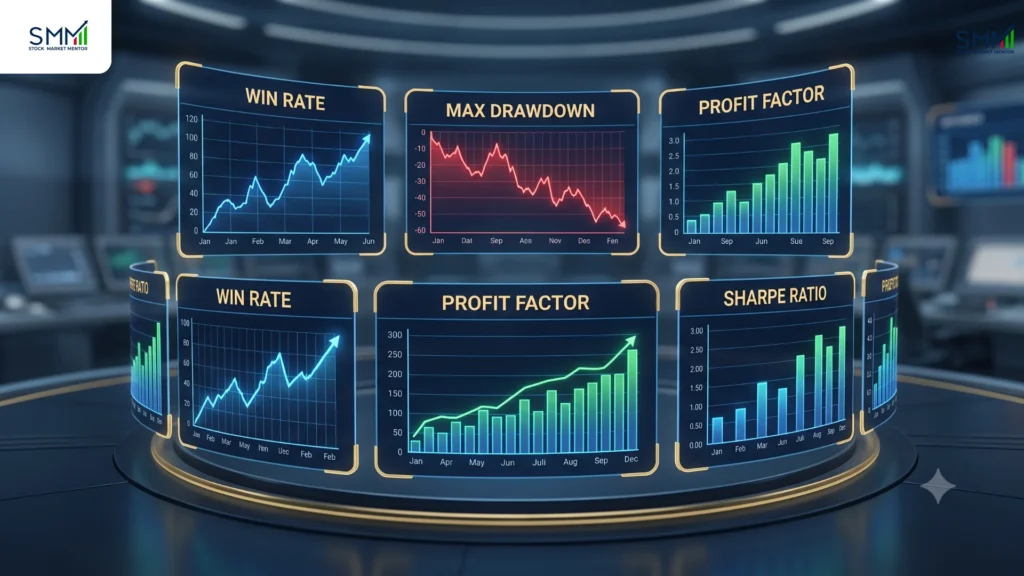
Just because a strategy makes money on paper doesn’t automatically mean it’s a good one. To really tell if a strategy is working you will want to look at a few key metrics.
Metric | Why It Matters |
Win Rate | Percentage of trades that ended in profit |
Maximum Drawdown | Largest decline in portfolio value during testing. |
Profit Factor | Gross profit divided by gross loss. |
Risk-Reward Ratio | Compares potential profit with possible loss. |
Sharpe Ratio | Measures return relative to the risk taken. |
CAGR | Shows the compound annual growth rate for the testing period. |
Expectancy | Estimates the average profit or loss per trade. |
Now let’s break these down in simple words.
Win Rate tells you how often your trades are profitable. Sounds great if it’s high, right? But here’s the catch. A high win rate doesn’t guarantee profits. You could win 7 out of 10 trades and still lose money if the 3 losing trades are much bigger.
Maximum Drawdown shows the worst drop your portfolio went through during testing. This is important because it tells you how much pain you might have to sit through. If a strategy drops 40% before recovering, you need to ask yourself honestly: can you handle that?
Profit Factor compares total profits to total losses. If it’s above 1, the strategy made more than it lost. It’s better when it’s high, but don’t just go after very high numbers.
Risk-Reward Ratio helps you understand if the reward is worth the risk.
Sharpe Ratio is basically about how smooth your returns are.
CAGR (Compound Annual Growth Rate) is useful for long-term strategies. It tells you how your investment would have grown each year on average.
And then there’s Expectancy, which is one of the most practical metrics. It tells you what you can expect to make (or lose) per trade over time.
Common Backtesting Mistakes Every Trader Should Avoid
Even if your strategy looks solid, bad testing can give you false confidence. And that’s dangerous.
- Overfitting a strategy is the most common pitfall. Overfitting happens when you keep tweaking your strategy until it looks perfect on past data. Every trade looks great, every dip is avoided, it feels like you’ve cracked the code.
“Overfitting is more likely among traders who know the measures well enough to chase them. After determining a “good” Sharpe Ratio or win rate, it’s tempting to modify parameters until they reach that aim, even unintentionally. Stock Market Mentor’s rule is that if you modify a rule more than twice after seeing the outcomes, the backtest is testing your ability to reverse-engineer the history, not your approach.”
- Next is ignoring costs, brokerage, taxes, slippage. These might seem small, but over time they eat into your profits, especially if you trade frequently.
- Another mistake is testing on too little data. If your strategy only works in a bull market, what happens when the market turns sideways or bearish?
- Some traders also focus only on profits and ignore risk. That’s how people end up with strategies that look great on paper but are impossible to stick with in real life.
- Skipping out-of-sample testing is another issue. Once you build a strategy, test it on different data, not the same dataset you used to create it.
- And finally, survivorship bias. If you only test stocks that are still around today, you’re ignoring all the ones that failed or got delisted.
SEBI's 2026 Algo Trading Framework: What It Means for Backtesting (New for 2026)
For a long time, “backtested strategy” was more or less an unverifiable marketing claim. Anyone is able to post a chart with great numbers and call it backtested, and there is no way for a retail investor to verify if the statistics are true, cherry-picked, or run on a curve-fitted dataset. SEBI’s retail algorithmic trading framework, first issued on February 4, 2025 and made fully mandatory for all stockbrokers from April 1, 2026, aims to close exactly this gap.
This is what changes, and why it important for backtesting directly:
- Each algo order has a strategy ID provided by the exchange. So a broker’s API algorithm sold to regular investors could be hooked up to a registered strategy, not a “trust me” chart.
- The algorithms of today are either “white-box” or “black-box.” Research analysts must register and evaluate black-box algorithms and logic. Selling a plan without explaining its basis is now a regulatory red flag.
- Algo providers are agents, brokers are principals. Brokers are obligated to get backtest data before connecting with providers as they are responsible for the algo products on their platforms.
- Brokers that missed registration deadlines could not onboard new retail API-based algo trading clients after January 5, 2026. Framework compliance was compulsory from 1 April 2026.
What you should do: So when you’re looking at a strategy, whether it’s algo-based or not, you’ve now got a valid inquiry to ask any provider or broker, is this algorithm registered with the exchange, and can you provide me the strategy ID? If the answer is no, it is a meaningful signal, outside of your own backtest, that you are looking at an unverified black box rather than a responsible, auditable plan.
Free vs Paid Backtesting Tools for Indian Investors
The tool you choose really depends on how serious you are and how deep you want to go. There are plenty of backtesting tools in India that offer some free and some paid.
Free Backtesting Tools:
Tool | Best For |
TradingView (Free Plan) | Chart-based strategy testing |
Chartink | Stock screening and simple strategy validation. |
Backtrader (Python) | Algorithmic traders and developers. |
Investing.com Historical Data | Manual backtesting |
Paid Backtesting Tools
Tool | Best For |
AmiBroker | Professional traders |
Zerodha Streak | No-code strategy testing |
MetaTrader 5 | Forex and multi-asset testing |
QuantConnect | Quantitative and algorithmic investing |
Paid tools are faster, but subscription-based. They are more powerful and give you deeper insights. If you’re testing regularly or managing serious capital, they’re worth considering.
Backtesting vs Paper Trading: What's the Difference?
A lot of beginners mix these up, but they’re not the same.
Backtesting | Paper Trading |
Uses historical market data | Uses live market data without real money. |
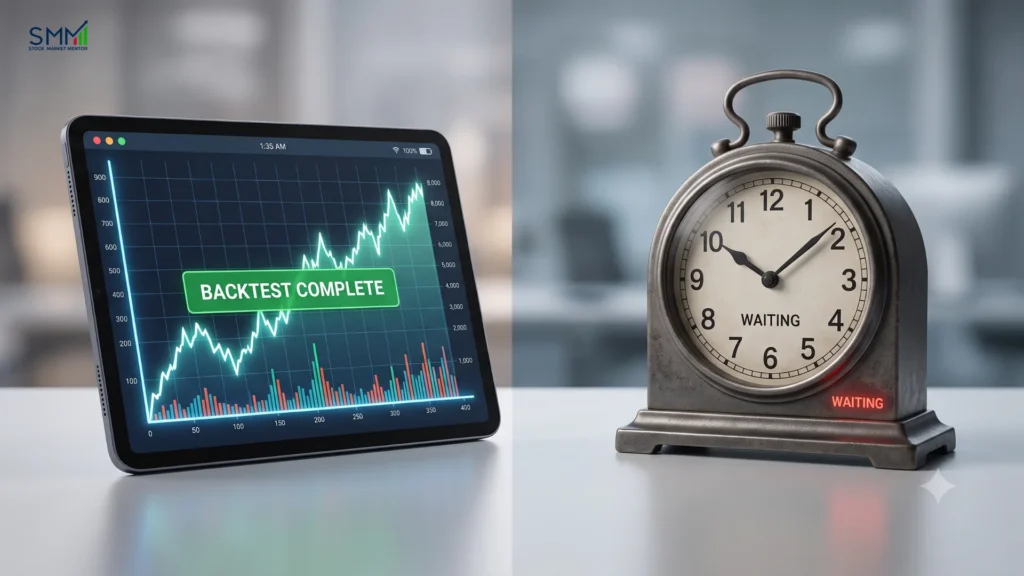
Results are available quickly | Requires waiting for real-time market movement. |
No emotional pressure | Simulates the emotions of live trading. |
Best for evaluating strategies | Best for practising execution. |

Best Practices for Backtesting a Trading Strategy
Backtesting isn’t about making your strategy look perfect. It’s about making it realistic.
- Test your strategy in different market conditions: bull, bear, sideways. Markets change, and your strategy should be able to handle that.
- Always include costs like brokerage and slippage. Ignoring them gives you inflated results.
- Use enough data. The more market cycles you cover, the better your understanding.
- Keep your rules clear and consistent. If your decisions depend on “gut feeling,” you can’t really test them properly.
- Don’t keep tweaking endlessly. Make changes only when there’s a solid reason backed by data.
- Once you’re happy with the results, try paper trading before putting real money in.
- And one underrated habit: keep a journal. Write down why you took trades, what worked, what didn’t. Over time, this becomes incredibly valuable.
Expert Insight: Every course we run, from Pro Trader to Algo Trading Decoded, includes back-tested strategies as a core module, not an optional add-on, because we’ve seen what happens when traders skip straight to live capital. The traders who stick around long enough to become consistent are almost always the ones who treated backtesting as a discipline.
What Is Backtesting in the Stock Market? Final Thoughts from Stock Market Mentor
If you’ve ever wondered whether a trading idea actually works before risking real money, that’s exactly where backtesting comes in. Simply said, it’s taking historical market data and seeing how your strategy would have performed. It’s not perfect and it’s definitely not going to tell you the future, but it can help give you a better sense of what you’re getting into.
And if you’re serious about leveling up your skills, learning from the appropriate sources counts. This is where a Stock Market Mentor can help, providing practical guidance to help you become a more confident and consistent trader in the market.
Disclaimer: This article is for educational purposes only and does not constitute investment advice. Stock Market Mentor is an education-focused brand and does not provide tips, advisory, PMS, or account management services.