A trader once told me how confident he felt after months of building his portfolio. Everything was going right, the market was rising, and his profits kept growing. He thought he had figured it out at last. But then, in the space of one night, everything changed. A sudden global event hit the markets, and by the time he checked the next morning, a big chunk of his gains had already vanished. What hurt most was not the loss itself, but the fact that he never saw it coming. His portfolio had no safety net.
That’s exactly why so many traders today are looking at an F&O hedging strategy course in Noida. Because the truth is simple: markets will always be uncertain. You can’t control what happens outside, but you can definitely learn how to protect what you’ve built.
The number that should worry you: According to SEBI’s own official study, 91% of individual traders in the equity derivatives segment lost money in FY 2024-25, with aggregate net losses widening 41% year-on-year to ₹1,05,603 crore.
Futures and options are more than just trading instruments; when used properly they may help you manage your risk and stay level-headed, even when the market goes volatile. If you’re just getting started, understanding the basics of the stock market before learning advanced hedging strategies can give you a much stronger foundation.
In this blog we’re going to lay out exactly what F&O hedging is, why it’s so important to protect your portfolio, the basic tactics traders really use, and how understanding it the proper way can make you more confident in real market circumstances.

What is an F&O Hedging Strategy?
An F&O hedging strategy is simply a way to reduce your losses using Futures and Options. You’re not trying to predict every market move here. You’re just trying to make sure that if the market behaves unexpectedly, your entire portfolio doesn’t take a big hit.
If you’re planning to join an F&O hedging strategy course in Noida, this is where everything begins.
Understanding Hedging in the Stock Market
Hedging basically means taking a second position in the market to reduce the damage from your first one.
It’s very similar to insurance. You don’t buy insurance because you expect something bad to happen. You buy it because if it does, you don’t want to suffer alone.
In the stock market, this is usually done through Futures and Options. These tools help you to hedge losses when the market works against your position.
Imagine you have invested a lot of money in banking stocks and suddenly there is an RBI policy announcement coming up. You just don’t know how the market will respond. You can hedge against market volatility by buying Put Options or using futures instead of selling everything in a panic.
Trading vs Hedging: What’s the Real Difference?
Here’s a simple comparison:
Trading | Hedging |
Focus is profit | Focus is protection |
Takes directional bets | Reduces existing risk |
Higher reward potential | Lower but safer outcome |
Emotion-driven sometimes | More structured approach |
Why Portfolio Protection Matters in Today’s Market?
One global headline, one policy change, or one earnings surprise, and prices can swing sharply. That’s why portfolio protection has become a core part of investing.
Managing Market Volatility
Volatility simply means fast price movement. Sometimes up, sometimes down. Many investors react emotionally during this time. A better approach is to prepare in advance.
With Futures and Options, you can reduce the impact of sudden moves without selling your investments. You stay invested, but you’re not fully exposed.
Protecting Against Market Corrections
Without protection, even a healthy portfolio can go into deep drawdown during a correction. And that’s when most investors make mistakes: they sell at the wrong time. Hedging helps reduce that pressure.
Preserving Long-Term Wealth
At the end of the day, investing is not just about making money. It’s about keeping it. That’s why professionals focus so much on capital preservation. Steady growth over time comes from controlling losses, not chasing big wins every time. Hedging gives you that control.
Why Portfolio Protection Matters in Today’s Market?
Downside protection simply means, how much damage can you avoid when the market falls?
Let’s say you’ve built a strong portfolio over time. Everything is going well. Suddenly, global news triggers a sharp fall. You don’t necessarily want to sell everything. That would defeat your long-term plan.
So instead, you use options. Buying a Put Option gives you the right to sell at a fixed price. If the market declines, the value of that option normally goes up, helping to balance your losses.
Futures can also be used in a similar way. You take a position that benefits when the market goes down, balancing your portfolio.
This is what institutional investors do all the time, especially when managing large funds.
Types of F&O Hedging Strategy Course Noida Participants Will Learn
A proper Futures and Options training program teaches you when to use what.
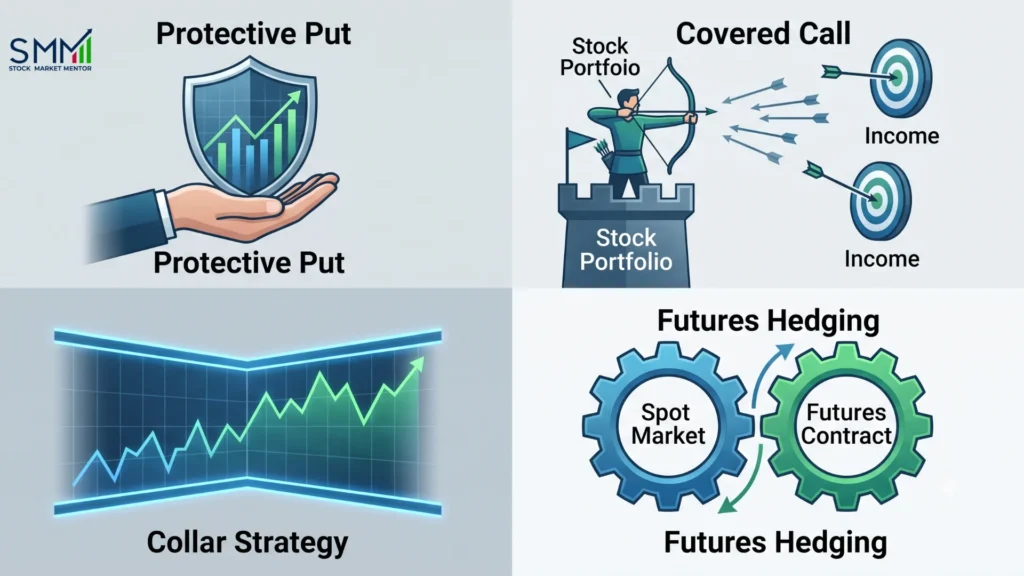
Protective Put Strategy
You hold a stock and buy a Put Option for protection. If the stock falls, the Put Option helps reduce your loss. If the stock rises, you still benefit, just minus the cost of the option.
It is often used ahead to events like earnings or big announcements where there is uncertainty.
Covered Call Strategy
In this strategy, you already own shares, and you sell Call Options on them. Why? To earn extra income.
That premium acts like a small cushion if the stock doesn’t move much or falls slightly.
Collar Strategy
You buy a Put Option for protection and sell a Call Option to reduce the cost. In simple terms, one side pays for the other.
That’s why many long-term investors prefer this strategy when markets feel uncertain, but they don’t want to exit their holdings.
Futures Hedging
Futures hedging is something traders and investors use when they don’t want market ups and downs to mess with their portfolio too much.
A futures contract is a way to commit to purchasing or selling something at a set price in the future. There are two basic ways people use it:
- Long hedge: You use this when you think prices might go up. So you lock in today’s price to avoid paying more later.
- Short hedge: You use this when you feel prices might fall. So you protect the value of what you already own.
For example, let’s say someone has a portfolio that moves with the Nifty 50. If they feel the market might fall in the short term, they can sell Nifty futures. If the market actually drops, the portfolio loses value, but the futures position makes money and helps balance things out.
Index Hedging
Sometimes you don’t want to hedge one stock at a time. Instead, investors just hedge the entire portfolio using index futures or index options like Nifty or Bank Nifty.
Since most stocks move in the same direction as the market, this works pretty well in real life.
So instead of selling good stocks during uncertainty, investors simply hedge the index and stay invested. That way, they don’t panic-exit; they just reduce the damage if the market falls.
Delta Hedging
Delta tells you how much an option price will move if the stock moves by 1 point.
So if you’re holding options, your exposure keeps changing every time the market moves. Delta hedging is just the process of adjusting your position so that your risk stays under control.
Big traders and institutions do this regularly. They don’t just buy options and forget about them; they keep adjusting positions to stay balanced.
What Are The Practical Hedging Techniques Covered in the Course?
A good F&O hedging strategy course in Noida should show you how to actually use these ideas in real trading.
- One of the first things you learn is equity portfolio hedging. Instead of protecting one stock, you learn how to protect your entire portfolio using index futures or options.
- Then there’s swing trading hedging. Swing trades usually run for a few days or weeks, so overnight news can hurt. Hedging helps reduce that risk so you don’t have to exit good trades too early.
- You also learn intraday hedging, which is useful when markets suddenly become volatile during the day. Even intraday traders face sharp moves, and hedging helps control damage in fast markets.
- Another important area is event-based trading, things like earnings, RBI announcements, Budget day, inflation data, etc. These events can move the market sharply. Hedging helps you prepare instead of reacting emotionally after the move.
- Then comes volatility hedging. Sometimes the market doesn’t even need to go up or down; just increased volatility can hurt positions.
- And finally, you get introduced to the Option Greeks: Delta, Gamma, Theta, Vega, Rho. You don’t need to calculate them manually, but you do need to understand what they are doing to your position.
2026 SEBI Regulatory Changes Every Hedger Must Factor In
strengthened the equity index derivatives framework. Three of the rules changed your hedging math in phases between 2025 and 2026:
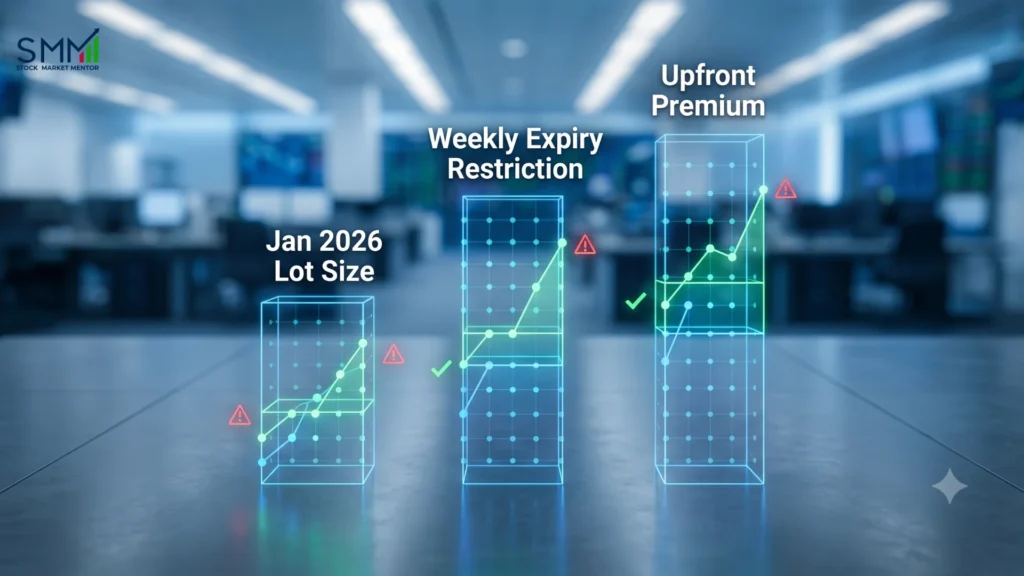
- Lot sizes were adjusted again for January 2026. The NSE has decreased the Nifty 50 lot size from 75 to 65 and Bank Nifty from 35 to 30 for all weekly, monthly and quarterly contracts with effect from January 2026, in an official circular. Change your hedge quantity and margin. Your old lot size index hedging ratio is now out of date.
- Only one benchmark index can now settle weekly on the exchanges. After the adoption of this rule in November 2024, NSE provides weekly options only on Nifty 50 and BSE on Sensex. Weekly expiry for Nifty Midcap Select, Bank Nifty and Fin Nifty is gone. No more short term event protection with Bank Nifty weekly options. You have to hedge using monthly contracts or Nifty weeklies.
- Option premiums are paid upfront and calendar-spread margin benefit is eliminated on expiry. An otherwise capital-efficient hedge (netting margin against an offsetting position) now requires full margin on expiry day, and options buyers pay the premium immediately rather than using intraday leverage. Make this part of your cost-of-hedge estimate before trading.
This matters for your hedging strategy course: a plan is only as good as its latest regulatory assumptions. Using pre-2025 lot sizes, expiry calendars, or margin assumptions leaves traders under-hedged (wrong quantity) or over-margined (money tied up unnecessarily), defeating the objective of hedging.
Common Hedging Mistakes Retail Traders Make
- Over-hedging until profits disappear: a hedge should reduce risk, not cancel your entire upside.
- Hedging after the news breaks, not before: by the time a headline hits, implied volatility has already priced it in.
- Ignoring recalculation after lot-size or margin changes: see the SEBI reforms table above.
- Treating hedging as a one-time setup: delta (and real exposure) changes every time the market moves.
- No exit plan for the hedge itself: knowing when to unwind a hedge once the risk event has passed matters as much as knowing when to put it on.
Expert Insight: Across our Pro Trader and FNO Champion programs, the single biggest shift we see in students isn’t a new indicator or a ‘secret strategy’, it’s the move from tip-based trading to independent, risk-first decision-making. We build our curriculum around backtested strategies and live, historical-data walkthroughs specifically so students learn to size positions and manage risk before they ever learn to chase returns. That mentorship-driven, small-batch approach is what actually builds the discipline to hold a hedge through a volatile session instead of panic-exiting it.
Who Should Join This F&O Hedging Strategy Course in Noida?
This course is for anyone who wants to stop guessing in the market and start understanding risk properly, including students and working professionals learning trading.
- If you’re a beginner,
- If you’re already trading.
- If you’re a long-term investor.
- And if you’re a finance student or working professional.
Why Choose Our F&O Hedging Strategy Course in Noida?
The idea is simple.
- You see live market examples. You see how hedging is actually done in real time, not just on slides.
- You work on real case studies, earnings, crashes, volatile markets, not imaginary examples.
- You also get practice assignments so you don’t just listen; you actually apply.
- And because batch sizes are small, you can actually ask questions and get proper guidance.
If you’re serious about learning hedging in a practical way, learning from experienced mentors and real market setups, like the approach followed at Stock Market Mentor, can really help you connect the dots and build confidence step by step.
Career Opportunities After Learning F&O Hedging in Noida
Once you understand hedging and risk, a lot of doors open if you’re planning to build a stock market career in India.
- You can become a trader managing your own capital more professionally.
- You can work as a risk analyst, helping firms manage exposure. Learning about careers after stock market training can help you understand the opportunities available in trading, research, and portfolio management.
- You can move into portfolio or wealth management roles.
- Or you can work as a derivatives analyst, studying market behaviour and supporting trading decisions.
F&O Hedging Strategy Course in Noida | Learn Practical Risk Management with Stock Market Mentor
Honestly, no one can really predict the market day to day. That’s exactly why hedging matters. It’s not about being perfect with predictions; it’s about being prepared when things don’t go your way.
If you’re planning to join an F&O hedging strategy course in Noida, don’t just go for something that stays stuck in theory. You’ll learn much more when you actually see how strategies work in real market situations and why they’re used in the first place.
That’s where institutions like Stock Market Mentor help, because the focus is more on practical learning rather than textbook topics. Seeing how hedging is used in real trades makes it much easier to understand and confidently use in your own trading.
Disclaimer: This article is for educational purposes only and does not constitute investment advice. Futures and Options trading involves substantial risk of loss and is not suitable for all investors.