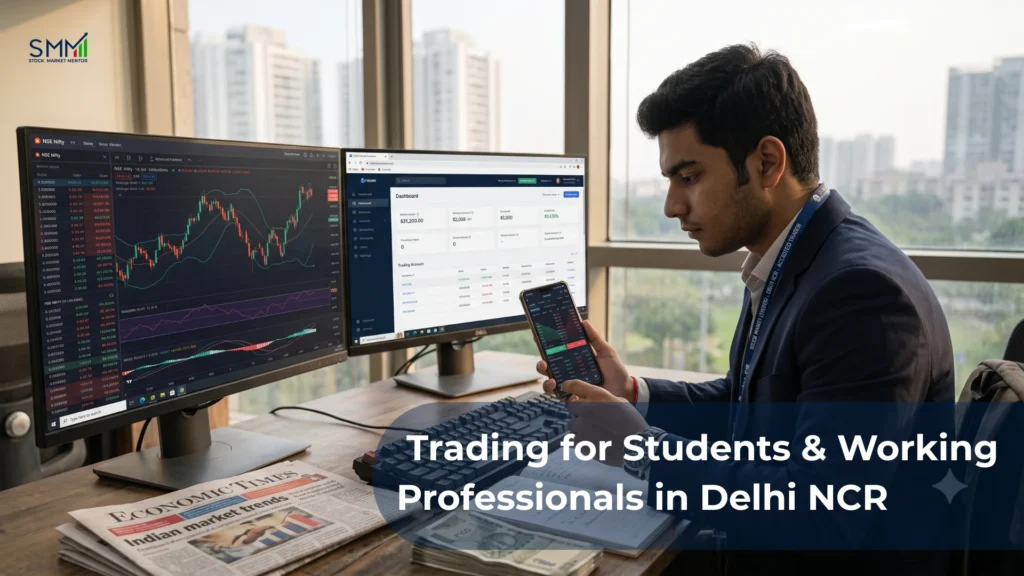
Let’s be honest, most people learn about trading from some flashy post on the Internet. Maybe it’s a college student scrolling Instagram who sees someone bragging about making ₹8,000 in a few hours. Or maybe it’s a working professional, tired after a long day, wondering if there’s a better way to grow money than just waiting for the next salary credit. Different situations, same thought: “Is this something I can actually do without messing up my studies or my job?”
That’s exactly where trading for students and trading for working professionals in Delhi NCR comes in. The real problem isn’t starting; figuring out how to learn through a stock market course for beginners without wasting time or losing money in the process. Most beginners either overcomplicate things or expect quick results, and that’s where things go wrong.
The truth is, you don’t need to sit in front of charts all day to get into trading. If done correctly and with realistic expectations, it can fit into your everyday routine. In this blog, we’ll tell you how you manage trading with education or a job, choose a style that fits your schedule, develop the proper skills, and get started with trading without feeling overwhelmed.
Data: Delhi NCR is leading this story. In FY25, Delhi-NCR added 12.2 lakh new investors, more than Mumbai and Bengaluru, according to NSE data. Nearly 40% of NSE’s registered investors are under 30, and the median investor age has dropped to 33 from 38 a few years ago. Why “trading for students” and “trading for young professionals” aren’t niche searches anymore is because the market’s stats reveal the audience is now younger, and Delhi NCR is leading that change.
Why More Students & Working Professionals in Delhi NCR Are Learning Trading?
If you look around today, whether it’s in colleges, offices, or even casual conversations, you’ll notice one thing: more people are talking about the stock market than ever before. In Delhi NCR especially, this shift is pretty obvious. There are students who are interested in how money grows and working professionals are beginning to look beyond their monthly salary.
A big reason for this is access. Trading apps are easy to use now, information is everywhere, and learning resources are no longer limited to finance graduates. Anyone with interest and a bit of patience can start understanding the market.
The data backs this up. In 2026, CDSL, one of the two official securities depositories in India, crossed 18 crore demat accounts, but only 10% of the population of India invests. So there is still a huge runway of first-time investors. In Delhi NCR classrooms, a lot of first-jobbers and final-year students ask about where to start, which matches the share of that growth in persons under 30.
Why Are Students Interested in Trading?
For students, trading isn’t just about making quick money (even though that’s what attracts many at first).
When you start studying early, you naturally become more aware of how money works, how companies grow, how markets operate and how decisions affect outcomes. They can experiment, learn from their mistakes and develop their understanding, without the pressure to produce fast results.
A student stock market course gives students a clearer, more structured starting place than picking up recommendations randomly from Instagram or YouTube.
Why Are Working Professionals Turning to Trading?
Build your trading skills with expert guidance.
For professionals, the mindset is usually different. Most people aren’t trying to quit their jobs and become full-time traders overnight. They just want an additional source of income and to grow wealth over time.
With rising expenses, EMIs, and long-term responsibilities, relying on just one income stream doesn’t feel enough anymore.
The good part is, you don’t need to sit in front of charts all day. Many people are now exploring part-time trading in India because it fits into their routine without disrupting work.
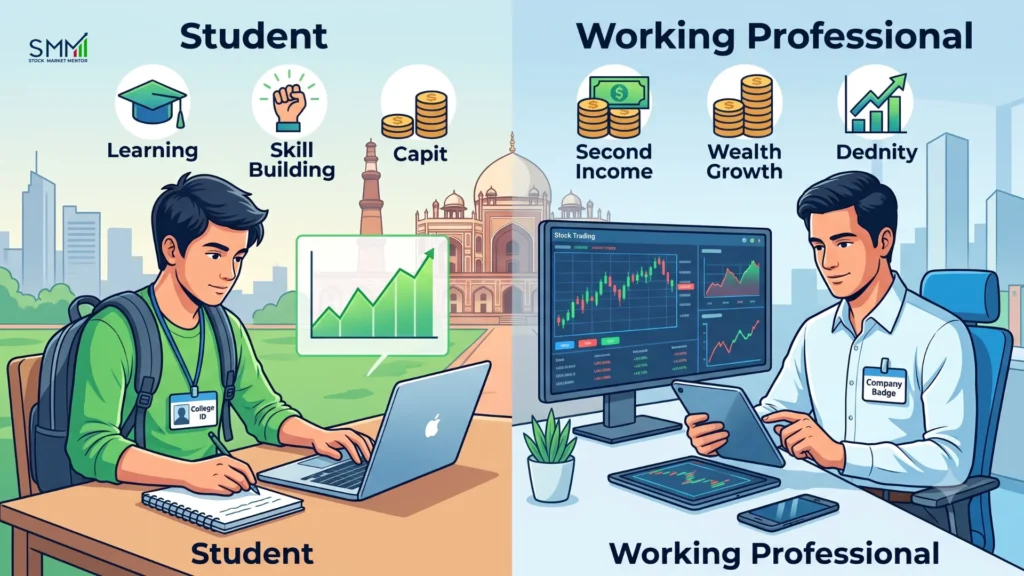
Trading for Students vs Trading for Working Professionals in Delhi NCR
Even though both students and professionals are getting into trading, their approach is naturally different.
Comparison | Students | Working Professionals |
Primary Goal | Learning & Skill Development | Secondary Income & Wealth Creation |
Daily Time Available | 2-4 Hours | 1-2 Hours |
Learning Schedule | Weekdays + Weekends | Evenings + Weekends |
Starting Capital | Lower | Moderate |
Recommended Trading Style | Swing & Positional | Swing & Positional |
Risk Appetite | Conservative | Moderate |
Balancing Trading with College or a Full-Time Job in Delhi NCR
One of the most common doubts people have is: “Do I even have enough time for this?” The truth is, you don’t need hours and hours every day. You just need consistency.
How Much Time Do You Really Need?
There’s this myth that traders sit in front of screens all day. That’s not necessary, especially when you’re just starting.
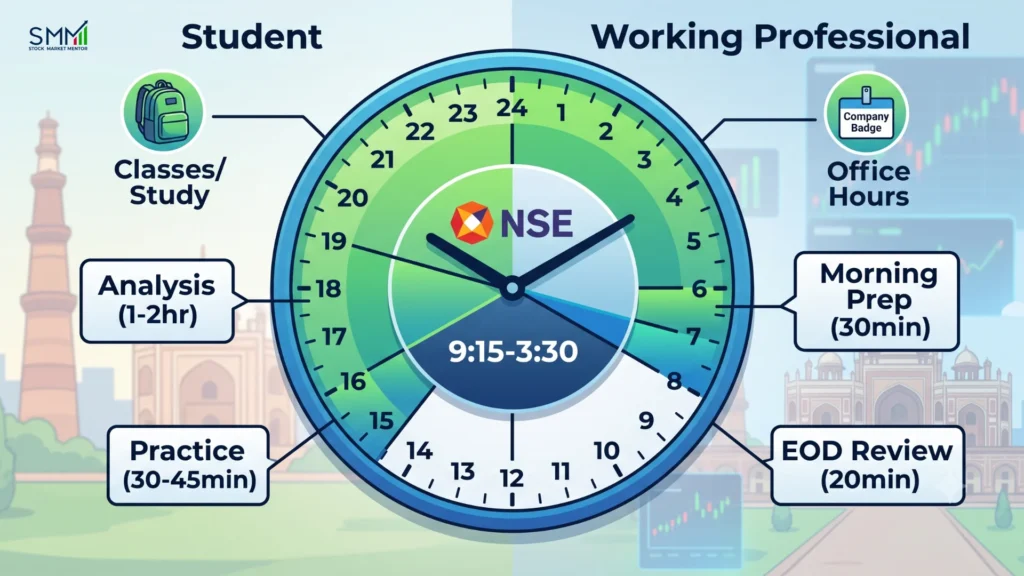
A realistic time-commitment breakdown for students vs working professionals looks something like this:
For students:
- 1-2 hours daily for learning concepts and analysing charts.
- 30-45 minutes for practice or paper trading.
- Weekends for in depth study, identify and fix faults.
For professionals who work:
- News & planning in the morning for 30-45 minutes.
- 20–30 minutes after market hours for review.
- Weekends for strategy building and learning.
Trading while working a job is actually more doable than most people think.
Understanding Indian Stock Market Hours (9:15 AM-3:30 PM)
The Indian stock market runs from 9:15 AM to 3:30 PM on weekdays, with a short pre-open session before that.
Yes, these hours match college and office timings but that does not mean you can’t trade.
Understanding how to balance market hours (9:15 AM- 3:30 pm) with college/office schedule comes down to planning:
- Students can prepare before classes and review later.
- Alerts, planned entries and end of day analysis are tools to be used by professionals.
You need to build a routine that works for you without affecting your studies or job.
Which Trading Style Works Best If You Have Limited Time?
Not every trading style will work if you’re busy. You should choose the right one.
Trading Style | Screen Time Required | Best For |
Scalping | Very High | Experienced Full-Time Traders |
Intraday Trading | High | Active Traders |
Swing Trading | Low | Students & Working Professionals |
Positional Trading | Very Low | Busy Professionals |
If you’re looking at the best trading styles for limited screen-time (swing/positional vs intraday), swing and positional trading are usually the most practical.
- Swing trading lets you hold trades for a few days or weeks, making it easier to analyse after college or office hours.
- Positional traders are looking at longer-term trends and require even less daily monitoring.
But intraday trading requires continuous attention. If you’re in meetings or classes, it can get stressful and lead to rushed decisions.
That’s why trading for beginners with a job is generally better suited to swing or positional trading.
What we call the “weekend edge”: most people treat Saturday and Sunday as market-off, dead time. Positional traders in Delhi NCR who actually pull ahead use those two days for the real work, reviewing the week’s setups, planning entries, sizing positions, so weekday screen time becomes execution, not decision-making. It’s a small shift, but it’s the difference between reacting to the market and having a plan for it.
What Are The Essential Skills Every Beginner Trader Should Learn?
Without having the right skills, it’s very easy to lose money. So before you jump into your first trade, take some time to understand how things actually work.
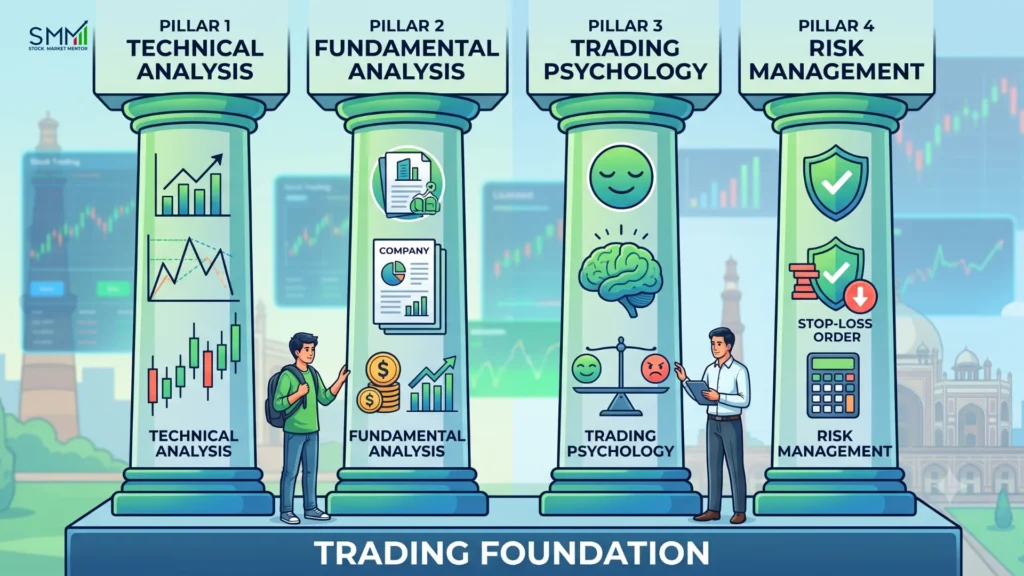
Technical Analysis
This is basically learning how to read charts. You’ll notice price fluctuations, patterns, support and resistance levels and plenty of indicators. Monitor pricing, track patterns, and gradually develop your knowledge. Over time, things start making more sense.
Expert Insight: Daily and weekly charts matter more than 5-minute candles because your setups usually take days. For time-constrained swing traders, the 20/50-day moving average crossover, RSI, and identifying recent swing highs/lows as support-resistance zones instead of guessing help determine trend direction. A 20-30 minute study after market closure usually provides enough information to arrange the next day’s entries.
Fundamental Analysis
While charts tell you what’s happening, fundamentals tell you why it’s happening. Things like a company’s earnings, its growth, industry success, and the overall market circumstances.
Trading Psychology
Trading is about how you react. Fear can make you exit too early. Greed can make you hold too long.
Learning to stay calm, stick to your plan, and accept losses without panicking? That’s what really separates beginners from consistent traders.
Risk Management
Before entering any trade, decide how much you’re okay losing if things go wrong. Use stop-losses. Don’t risk too much on a single trade. One bad decision shouldn’t wipe out your account.
Position Sizing
This just means how much money you put into one trade.
A common beginner mistake is going all-in on one opportunity. It feels exciting, but it’s risky. Instead, keep your positions small, especially when you’re still learning.
Capital Allocation
You don’t need to use all your money at once. In fact, you shouldn’t.
Keep some capital aside. Spread your trades. Give yourself room to learn and recover from mistakes.
Free Official Resources Worth Using Before (or Alongside) Any Paid Course
This will genuinely help beginners get an idea about the topics before learning from the advanced course and live sessions.
- SEBI’s Saarthi app and investor website, launched by the regulator specifically for investor awareness and education, offering free study material for NISM certifications, a “Spot a Scam” checker, a financial health checkup tool, and 24 financial calculators.
- The SEBI Investor Certification Examination (SICE) is run through NISM (SEBI’s own training institute). It’s a free, 50-question exam with no negative marking, and the certificate is valid for two years, a solid first checkpoint before you enrol in any paid course, just to confirm the basics have landed.
Using these alongside a structured course for a more realistic path. Free resources are good for foundational awareness; a course with live sessions and mentor feedback is what actually builds the skill of reading a live chart and managing a real position.
Choosing the Right Trading Course in Delhi NCR
There are so many beginner-friendly trading coursesout there out there that it’s easy to get confused. Don’t just go by ads or big promises. Focus on how they actually teach.
If you’re looking for a student stock market course, make sure it starts from the basics. You shouldn’t feel lost in the first few classes.
A lot of people prefer weekend trading classes in Delhi NCR because they can manage them along with college or work.
Also check if they offer weekend/evening batch options in Delhi NCR and whether they include live market sessions.
A good trading course should offer:
- Live market sessions for real-time learning.
- Mentors who have experience in explaining concepts in simple words.
- Hands-on practice instead of only theory.
- Flexible timings for students and professionals.
- Recorded sessions for revision.
- A supportive learning community.
For example, some of the institutes like Stock Market Mentor try to have classroom learning with live market exposure and flexible batches, which works well for both the students and working professionals in Delhi NCR. In the end, the main goal isn’t just to finish a course; it’s to actually understand what you’re doing and feel confident when you step into the market.
Common Mistakes Students & Working Professionals Make While Trading Part-Time in Delhi NCR
Balancing trading with college or a job isn’t easy. And because of that, beginners often make similar mistakes.
- Choosing intraday trading without having enough time to monitor the market properly.
- Trading while multitasking could result in rushed and premature conclusions.
- Random social media advice without knowing the logic behind the trade.
- Ignoring risk management, not using stop-losses, taking huge positions.
- That need for instant results and anger when they don’t come instantly.
- Not maintaining or reviewing a trading journal, which slows down learning and improvement.
Trading for Students & Trading for Working Professionals in Delhi NCR: Final Thoughts from Stock Market Mentor
But in both of these cases, one thing stays the same: trading isn’t about quick wins.
A lot of people jump in expecting fast results, and that’s where things usually go wrong. The better way is to get the basics right, watch the market, and practice without rushing upwards.
If you’re in Delhi NCR and want to learn stock market from scratch in a more systematic fashion, you can check out Stock Market Mentor. They provide you with practical sessions, actual market exposure and flexible schedules which might be helpful if you are managing studies or job along with learning.
Disclaimer: This article is for educational purposes only and does not constitute investment advice, a recommendation, or a solicitation to buy or sell any security. Stock Market Mentor is an education-focused academy and does not provide tips, advisory, portfolio management, or investment services of any kind.