
A friend messages you in the morning with a sure-shot stock tip. You don’t think much; you just buy it because everyone in the group is talking about it. By afternoon, the stock starts slipping. Now you’re confused. Do you hold? Sell? Or buy more to average it out?
So you start doing what most people do. You open Telegram, scroll WhatsApp groups, check X, watch a couple of YouTube videos, hoping someone will tell you what to do next. But instead of clarity, you get ten different opinions, and all of them sound confident.
This is where it gets difficult. It’s not that they don’t understand the market. It’s that they don’t have a proper trading strategy in India that traders can actually rely on when things get messy. So every decision becomes emotional, based on tips, fear, or FOMO, rather than a clear plan.
And the numbers back this up. SEBI’s latest analysis on the equities derivatives industry, issued in July 2025, showed about 91% of individual traders lost money in FY 2024-25 and aggregate net losses widened 41% year-on-year to about ₹1.05 lakh crore. This is the third successive SEBI study to suggest the same pattern; tip-driven, undisciplined trading is not a minor concern, it is the norm for the majority of participants
The truth is it’s not that difficult. Once you break it down into simple steps, it becomes an easy process you can follow. In this blog, we’ll go through how to build a trading strategy from scratch, set clear entry and exit rules, manage your risk properly, test your ideas using past data, and avoid the common mistakes most Indian traders end up making.
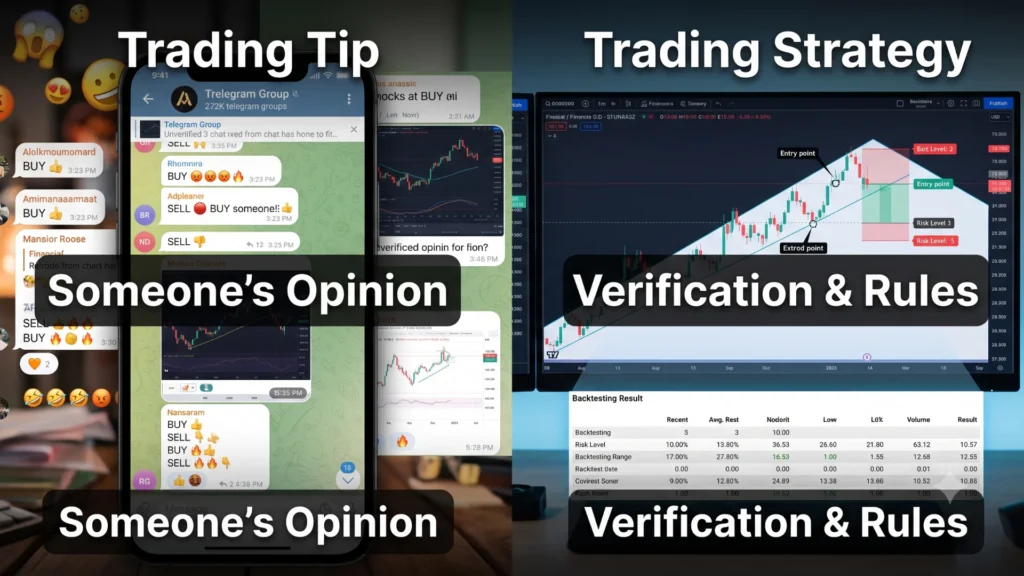
What Is a Trading Strategy vs a Trading Tip?
If you’ve ever been in a trading group, you already know how it goes.
“Buy this stock now.”
“The Nifty will go up today.”
“Don’t miss this breakout.”
Many new traders fall into the same traps before developing a structured approach. Understanding the common stock trading mistakes beginners make can help you avoid costly errors early in your trading journey. But the real issue is, you’re just following someone else’s call without knowing why it was made.
A proper trading strategy in India that traders can actually rely on is very different. It tells you:
- when to enter
- when to exit
- how much to risk
- and what conditions must be present before you even take the trade
Why Does A Strategy Work Better?
It gives you:
- structure
- discipline
- repeatability
- and something you can actually improve over time
Most importantly, it can be tested before you risk real money.
|
Trading Strategy |
Trading Tip |
|
Clear rules |
Someone’s opinion |
|
Can be tested |
Cannot be verified |
|
Entry + exit + risk defined |
Usually only entry |
|
Repeatable |
Changes every day |
|
Improves over time |
Depends on luck |
Not sure which trading style suits your schedule?
Key Components of a Trading Strategy
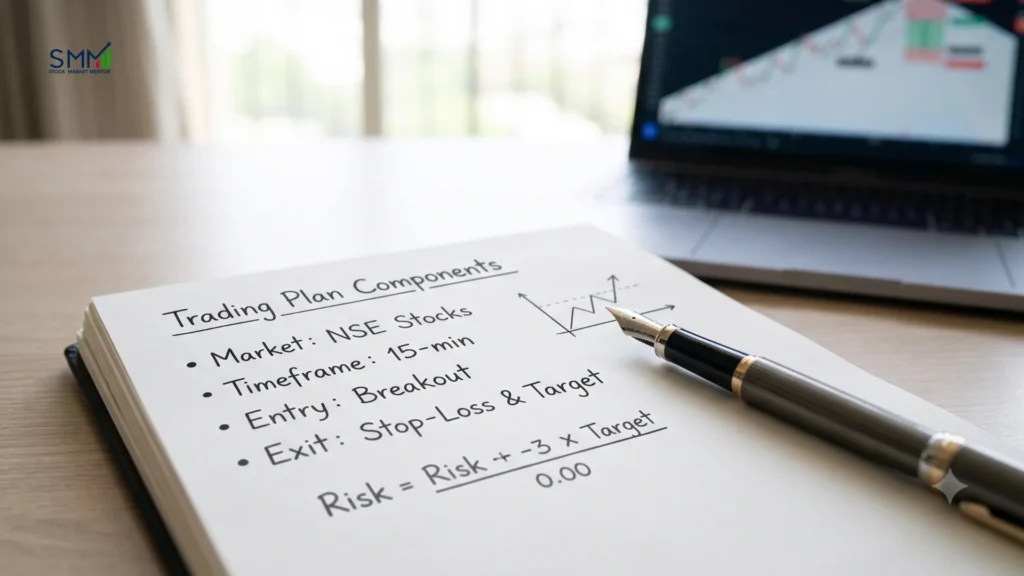
A good strategy doesn’t need to be complicated. In fact, the simpler it is, the easier it is to follow.
1. Market selection
First, decide what you’re even trading. Don’t try everything at once. Pick one:
- Stocks
- Futures
- Options
- ETFs
- Commodities
- Currency
2. Timeframe
Pick one timeframe and stick to it.
- 5-15 min → intraday
- 1 hour daily → swing trading
- Daily-Weekly → positional trading
3. Entry rules
This is your “go” signal. It should be simple, like:
- Price breaks resistance.
- Moving average crossover.
- RSI above a level.
- Volume spike.
If you’re unsure which tools to use, explore some of the best intraday indicators for stock trading and learn when each indicator works best.
4. Exit rules
You should always know this before entering:
- Where your stop-loss is.
- Where your target is.
- or when you’ll exit if nothing happens.
5. Risk management
This is what keeps you in the game. Even a good strategy will have losses. That’s normal.
What matters is:
- How much you lose per trade.
- Not how often you lose.
6. Position sizing
This decides how big your trade is. Not every trade should be the same size. It should depend on your stop-loss distance and risk limit.
7. Trade review
Write it down:
- Why did you enter?
- What happened?
- What you did right/wrong.
How To Create A Trading Strategy in India Traders Can Actually Stick To In Real Markets?
Step 1: Define Your Market & Timeframe
One of the biggest beginner mistakes is trying to trade everything at once. Stocks in the morning. Options in the afternoon. Crypto at night. Start small. One market. One timeframe.
Choose Your Market
Let’s keep it simple.
- Stocks: Best starting point. Easy to understand and not as aggressive as derivatives.
- Futures: More leverage, quicker, dangerous. Not for beginners.
- Options: Very popular in India yet complicated. Volatility and time value matter a lot.
- ETFs: They have a more consistent structure that is easier to grasp.
- Commodities: Gold, crude oil, silver, very responsive to international news.
- Currency: this varies based on macroeconomic situations and policy.
Choose Your Trading Style
Your trading style should also match your daily schedule. Whether you’re a full-time trader or exploring trading for students and working professionals, choosing a realistic timeframe makes it easier to stay consistent.
- Intraday: Fast. Stressful. Requires screen time.
- Swing trading: Most practical for working people. Hold for a few days.
- Positional trading: Slow. Based on bigger trends. Less noise.
Pick Your Timeframe
Your style decides your chart.
|
Style |
Timeframe |
Best for |
|
Intraday |
5–15 min |
Active traders |
|
Swing |
1 hour daily |
Working professionals |
|
Positional |
Daily-Weekly |
Long-term traders |
Step 2: Define Clear Entry & Exit Rules
Most traders lose because they don’t know when to exit. Before every trade, you should already know:
- Why am I entering?
- Where am I wrong?
- Where am I booking profit?
Entry Rules
Most rule-based strategies are built on technical analysis in the Indian stock market, using price action, chart patterns, and indicators to identify high-probability setups.Examples:
- Price breaks resistance.
- RSI shows momentum.
- Moving average crossover.
- Volume confirms breakout.
That’s enough. You don’t need a “perfect setup.” You need a repeatable one.
Exit Rules
You can exit using:
- stop-loss (non-negotiable).
- target (pre-decided).
- trailing stop (to protect profits).
- time exit (if nothing happens).
Simple Example
One of the most widely traded breakout setups is the Cup and Handle pattern, which combines consolidation with momentum confirmation before a breakout.. RSI is also strong. You enter the next day.
- Stop-loss below breakout level.
- Target based on risk-reward.
Now the important part: You don’t change the plan mid-trade just because it “feels like it will go higher.”
That discipline is what separates a random trader from someone building a real stock trading plan in Indian markets that can actually reward over time.

Step 3: Set Your Risk-Reward Ratio (Minimum 1:2)
Along with maintaining a healthy risk-reward ratio, using proven risk management tools every trader should use can help preserve capital during volatile market conditions. You don’t need to win every trade. You just need your winners to be bigger than your losers.
What Is Risk-Reward?
It simply means: How much you risk vs how much you expect to make.
Example:
- Risk ₹500
- Target ₹1,000
→ Ratio = 1:2
Even if you lose more than half your trades, you can still make money.
Formula: Risk-Reward = Profit ÷ Loss
Simple example
You buy a stock at ₹1,000.
- Stop-loss: ₹980 → risk = ₹20
- Target: ₹1,040 → profit = ₹40
So:
- ₹40 ÷ ₹20 = 1:2
Why 1:2 Matters
Because it gives you breathing room.
|
Risk |
Reward |
Ratio |
|
₹500 |
₹1,000 |
1:2 |
|
₹1,000 |
₹2,000 |
1:2 |
|
₹1,500 |
₹4,500 |
1:3 |
Before every trade, ask yourself one simple question:
“Is the reward worth the risk?” If the answer is no, just skip it. No trade is also a decision.
And honestly, this one habit alone can completely change how you build a profitable trading strategy in 2026. By not chasing more trades, but by choosing better ones.
Step 4: Decide Your Position Size
Most beginners think trading is all about finding the “right” entry. Like if you just get that one perfect entry, money will follow. But honestly, that’s not how it works.
What really decides whether you survive in trading long-term is something much less exciting, how much you put on each trade.
This is called position sizing.
Position sizing simply means deciding how many shares or lots you should take based on your capital and how much you’re okay losing on a single trade. It sounds boring, but this is what keeps traders in the game.
A lot of experienced traders follow a simple rule: don’t risk more than 1-2% of your capital on one trade.
So if you have ₹1,00,000 in your account, 1% risk means you should not lose more than ₹1,000 on any single trade. Doesn’t matter if it’s a big stock or a small one; the risk stays the same.
Now here’s how you actually calculate the position size:
Position Size = Maximum Risk ÷ (Entry Price − Stop-loss Price)
Let’s make it simple.
Say you buy a stock at ₹500 and your stop-loss is ₹490. That means you’re risking ₹10 per share.
If your total risk allowed is ₹1,000, then:
₹1,000 ÷ ₹10 = 100 shares
Here’s how it looks across different capital sizes:
|
Trading Capital |
Max Risk (1%) |
Max Risk (2%) |
|
₹50,000 |
₹500 |
₹1,000 |
|
₹1,00,000 |
₹1,000 |
₹2,000 |
|
₹5,00,000 |
₹5,000 |
₹10,000 |
One thing people don’t talk about enough. Position sizing also saves your mental peace.
If your position is too big, even a small dip will make you panic. You’ll start second-guessing everything. But if your size is controlled, you can actually follow your plan without freaking out every 5 minutes.
Step 5: Backtest Your Strategy Using NSE Historical Data
So you’ve built your strategy. Now comes the uncomfortable question:
Does it even work? You don’t guess the answer. You test it. That’s what backtesting a trading strategy in India is.
If you’re new to the concept, this detailed guide explains how to backtest a trading strategy using historical market data before risking real capital. It’s not perfect, but it gives you a reality check before you risk real money.
For Indian markets, avoid random third-party data dumps. The best source for backtesting Indian equities and derivatives is the NSE’s Historical Reports webpage, which publishes cash, F&O, and SME price, volume, and delivery-position archives. The key thing is, don’t “adjust” your rules while testing. That defeats the whole purpose.
If your rule says enter at X and exit at Y, stick to it. Even if one trade looks bad in hindsight.
Try to test at least 100-200 trades. Anything less and you’re basically guessing.
And here’s where most beginners go wrong: they only look at win rate. Win rate alone doesn’t mean much.
A strategy with a 40-45% win rate can still make money if your winners are bigger than your losers. So instead, look at things like:
- Win rate: How many trades actually worked?
- Average profit: How much do you make when you win?
- Drawdown: How bad it gets when things go wrong?
- Expectancy: What do you make (or lose) per trade on average?
What Actually Makes A Strategy Usable?
A decent strategy should:
- Work over a decent number of trades.
- Not destroy your account during bad phases.
- Be simple enough that you can actually follow it.
- Not behave completely differently in every market condition.
Also, don’t ignore costs. Brokerage, STT, GST, slippage… all of it adds up. A strategy that looks amazing on paper can quietly turn bad once real costs are included.
Common Mistakes During Backtesting
A few things that mess up most backtests:
- Curve fitting: tweaking rules until past data looks perfect.
- Look-ahead bias: accidentally using future information.
- Survivorship bias: only testing “good” stocks that survived.
- Ignoring real trading costs.
Step 6: Paper Trade Before Going Live
Even if your backtest looks great, don’t rush into real money. The next step is paper trading.
Paper trading is just trading in real market conditions without risking actual money. It shows you one important thing: can you actually follow your own system when emotions kick in?
Because that’s where most people fail. Do this for a few weeks at least. Treat it like real money. Write everything down: entry, exit, stop-loss, reason for trade.
Before going live, ask yourself:
- Am I following my rules properly?
- Am I managing risk the same way every time?
- Do my paper results look similar to backtest results?
If yes, then start small. Don’t jump in with full capital on day one.
What Changes If You Plan to Automate Your Strategy?
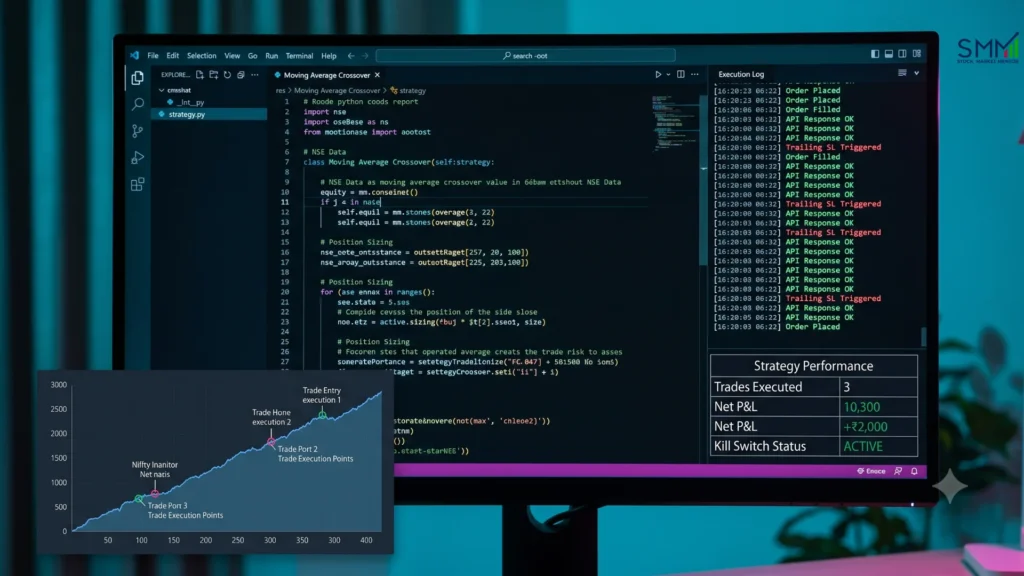
Coding or renting algo-driven methods instead of clicking buy/sell is growing among Indian retail traders. If that’s your goal after mastering the manual procedure, you’ll need to know about a new regulatory layer.
- Agents are algo suppliers, brokers are principals. If you connect an algo via API, your broker oversees it legally.
- Different algorithms are “white-box” or “black-box.” Certified SEBI Research Analysts must register and audit black-box strategies.
- A “tech-savvy retail investor” places fewer than 10 orders per second without algo registration, but crossing that barrier requires individual and immediate family registration.
- In order to stop runaway strategies from destroying accounts, brokers giving algo access must provide static-IP API access and a “kill switch”.
Trading Strategy Readiness Self-Check (2026)
If you can’t answer “yes” to at least four, you’re not ready to go live, no matter how good the backtest numbers look.
Question | Why it matters |
Can I write my entry, exit, and stop-loss rules in one sentence each, with no “it depends”? | Vague rules can’t be tested or repeated. |
Have I tested this on at least 100 official NSE/BSE data trades, without adjusting rules mid-test? | Anything less is a guess, not a backtest. |
Do I know my exact position size before I place the order, not after? | Sizing decided in the moment is emotional sizing. |
Have I paper-traded this for at least 2-3 weeks and matched my backtest results? | Confirms you can follow your own system live. |
Am I risking 1-2% or less of capital per trade, regardless of how “sure” the setup looks? | This is what keeps one bad week from ending your account. |
Expert Insight: After 15 years of educating traders in Bangalore and Delhi NCR the pattern is always the same. The traders that last are the ones that can follow an average strategy without breaking their own rules. SEBI research reveals that 9 out of 10 traders lose money because they trade on a reactive basis instead of a systematic basis. In our Pro Trader and F&O Champion programs the students build & backtest a plan before learning an indicator. That sequence is more important than most people realize.
Common Trading Mistakes Indian Traders Should Avoid
Most people don’t lose money because they don’t follow rules.
- One big mistake is trading without a plan. Just taking trades because someone on YouTube or Telegram said so usually ends badly.
- Another is constantly switching strategies. People try something for a week, it doesn’t work immediately, and they move on. No strategy survives that kind of treatment.
- Stop-loss ignoring is another classic one. Hope is not a strategy. It just turns small losses into big ones.
- Then there’s over-sizing. Taking huge positions because you want fast profits. It works… until it doesn’t, and then it wipes out weeks of gains.
- And finally, blindly following tips from social media. Ideas are fine. But every trade should still go through your own rules.
Building a Reliable Trading Strategy in India Traders Can Actually Follow
A good trading strategy in India isn’t something you copy from a video or pick up from a hot tip on social media. Most traders figure this out the hard way. What actually works is much simpler, but not easy. Having a set of rules you follow, knowing how much you’re willing to risk, and not letting emotions take over when the market moves against you.
If you’re serious about getting better at this, a Stock Market Mentor can help you build that foundation. It’s all about getting to know the real markets and learning. Because, at the end of the day, it’s not about trading more but trading right, even when it’s boring.
Ready to Trade With a Plan?
The Stock Market Mentor Pro Trader & F & F&O Champion programs contain strategy building frameworks, backtested methods, live trading sessions and position size & risk management before a single indicator. Doubt Clearing sessions, Multi Market Cycle Trader Coaching & Lifetime Access to Course Content. Book your free demo class to find the right course for you.
Disclaimer: This article is published for educational and informational purposes only and does not constitute investment advice, a trading recommendation, or a solicitation to buy or sell any security.