
Imagine you’ve finally decided to start trading. You open YouTube, watch a couple of videos, maybe scroll through Instagram, and suddenly everyone seems to be saying something different. One person swears forex is the fastest way to make money. Another tells you stocks are much safer, especially if you’re just starting out.
If you’ve been searching for forex vs stock trading India, chances are you’re really trying to figure out one simple thing: which market should you actually start with?
The honest answer is, there’s no perfect choice that fits everyone. Forex and stock trading are very different in how they work, how they’re regulated, and the kind of people they suit. Picking one without really understanding the basics can easily lead to mistakes you didn’t see coming.
So in this blog, we’ll tell you how both markets work, what makes them different, what’s actually allowed in India, and most importantly, how to figure out which one fits your goals, your budget, and the way you want to trade.
What Is Forex Trading?
Forex trading ( foreign exchange trading ) is essentially exchanging one currency for another with the intention of making a profit from price changes.
In simple words, you are not buying a company or a product; you are betting on how one currency moves against another.
Unlike stocks, where you buy shares of a business, forex always comes in pairs like:
- USD/INR
- EUR/USD
- GBP/JPY
Here, one currency is always compared to another. The first one is called the base currency, and the second is the quote currency.
To put this market in perspective, the global foreign exchange market processes close to $9.6 trillion in average daily turnover worldwide, according to the Bank for International Settlements’ 2025 Triennial Central Bank Survey, making it by far the largest financial market on the planet, exceeding global equity trading volumes combined.
How Does Forex Trading Work?
Let’s keep it very simple. Say USD/INR is at ₹86.00.
Now you feel the dollar will go up against the rupee. So you buy it.
If the price moves to ₹86.80, you close the trade and make a profit (minus charges, of course).
That’s the basic idea. But why do prices move at all? A lot of reasons, actually:
- Interest rate changes by central banks.
- Inflation data.
- Job reports.
- Government policies.
- Political tension or stability.
- Global demand for currencies.
Types of Forex Markets
Spot Market
This is the easiest. You purchase and sell currencies at the current price, and the trade is resolved almost immediately.
Futures Market
Here you agree now to buy or sell a currency at a fixed price on a future date. They are exchanged on regulated exchanges and are often used by traders and businesses to hedge risk.
Options Market
Options give you a choice, but not an obligation, to buy or sell a currency at a set price before expiry.
Currency Derivatives (India)
In India, retail traders don’t directly trade global forex like in other countries. Instead, they trade currency derivatives on exchanges like NSE and BSE. Since 2008, NSE has processed about ₹609 lakh crore in currency derivative transactions, offering futures and options for seven pairings, including four INR pairs (USD/INR, EUR/INR, GBP/INR, JPY/INR) and three cross-currency pairs. This shows India’s extensive and liquid controlled currency market, which varies from the worldwide spot forex market.
Still unsure whether Forex or stock trading is right for you?
What Is Stock Trading?
Stock trading is much more familiar to most people. It just means buying and selling shares of companies like Reliance, TCS, Infosys and so on.
When you purchase a share, you are, in fact, buying a tiny piece of that company. As the company expands, so can your investment. During the day, stock prices change depending on:
- Performance of companies.
- Earnings reports.
- News and announcements.
- Market sentiment.
- Economic conditions.
How Does Stock Trading Work?
Before you start trading, it’s important to understand the stock market for beginners and how the market functions.. Let’s say you buy a stock at ₹1,000. If it goes up to ₹1,150, and you sell it, you make a profit (before charges and tax). Simple idea, but the analysis behind it can get deep.
Unlike forex, where you study currency pairs, stock trading is about studying companies, how they perform, how they grow, and what future they might have.
Types of Stock Trading
Intraday Trading
You purchase and sell on the same day. No overnight holding. Fast and intense.
Swing Trading
You hold for a few days or weeks, trying to catch short- to medium-term trends.
Delivery Trading
You buy and hold for months or years. This is closer to investing.
Positional Trading
You hold for weeks or months based on broader market direction. Choosing the right trading strategies in India depends on your risk appetite, trading style, and financial goals.
Major Indian Stock Exchanges
NSE (National Stock Exchange)
India’s largest exchange in terms of trading volume. Most active trading happens here.
BSE (Bombay Stock Exchange)
One of the oldest exchanges in Asia. Many major companies are listed here.
Expert Insight: Every year, new students are thrilled by a forex ad offering tremendous leverage, register an offshore account, and then question if it’s legal. With the 2026 rule changes, our honest advice has only become more relevant: trade what you understand, trade where Indian regulation protects you, and use leverage for risk management, not profit. Five-year traders usually choose a market that fits their temperament and commit to a method.
Forex vs Stock Trading India: Comparison Table
Feature | Forex Trading | Stock Trading |
Market | Currency pairs | Company shares |
Trading Hours | 24 hours (weekdays) | 9:15 AM – 3:30 PM IST |
Liquidity | Very high | Depends on stock |
Leverage | Higher | Lower |
Capital Needed | Lower entry possible | Varies by stock |
What Moves Price | Global news & economy | Company performance |
Regulation | RBI, FEMA, SEBI | SEBI |
Style | Active trading | Trading + investing |
Key Differences Between Forex and Stocks
Market Hours
Forex runs almost 24 hours from Monday to Friday because global markets keep opening one after another.
Stocks in India are limited to 9:15 AM to 3:30 PM IST.
Liquidity
Forex is extremely liquid. That means you can enter and exit trades quickly.
In stocks, the big companies like TCS or Reliance are liquid, but smaller stocks can be slow and unpredictable.
Leverage
Forex typically offers larger leverage, allowing you to trade bigger positions with less money.
But the truth of the matter is this: more leverage means more risk. Leverage is often safer when it’s less in stocks for new investors.
Capital Requirement
Forex often feels easier to start because you don’t need a large amount upfront.
Stock trading can also start small, but building a proper portfolio usually needs more capital over time.
What Drives Profits
Forex depends on global events: interest rates, inflation, politics, and economic data. Stocks depend on company performance: profits, growth, news, and future expectations. Whether you trade forex or stocks, understanding technical vs fundamental analysis helps you make informed trading decisions.
Is Forex Trading Legal in India? Everything You Need to Know (2026)
A lot of beginners think forex trading is as simple as opening an account with any international broker and starting right away. In fact, there are certain regulations, and if you ignore them, you can quickly get into problems.
So, before you even consider making a trade, it’s important to understand how legal forex trading in India actually works.
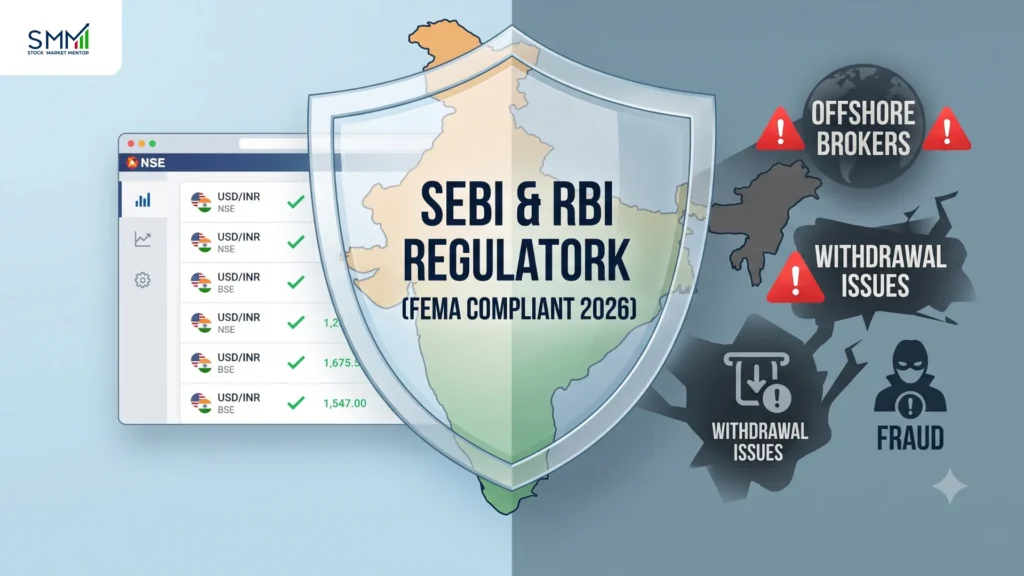
RBI & FEMA Guidelines
The foreign exchange in India is mostly managed by the Reserve Bank of India (RBI) and the Foreign Exchange Management Act (FEMA).
These rules have a purpose – to manage the flow of currency and protect the country’s financial system.
What this means for you is simple: You can’t just trade any currency pair you see on global forex platforms. A lot of those trades are not allowed for Indian residents if done through unregulated foreign brokers.
Role of SEBI in Forex Trading
Now, when it comes to trading legally inside India, the Securities and Exchange Board of India (SEBI) plays a key role.
SEBI doesn’t allow random forex trading as you see on international apps. Instead, it permits currency trading only through recognised exchanges like NSE and BSE, and only through SEBI-registered brokers.
So if you want to stay on the safe side, this is the route you should take.
Offshore Forex Brokers – Are They Legal?
Offshore brokers often look very attractive. High leverage, bonus offers, easy profits, everything sounds perfect on paper.
But here’s the truth: most of them are not regulated in India.
And that creates a real problem. If something goes wrong, like withdrawal issues, account blocking, or even fraud, there’s usually no one in India who can help you recover your money.
So before you deposit anywhere, ask yourself one simple question:
Is this broker actually allowed to operate in India?
Taxation in Forex vs Stock Trading India: What Traders Should Know
Whether you trade forex or stocks, the government will take its share. But the way it’s taxed is not the same.
Stock Trading Taxes
Stock trading taxes depend on how you trade.
- If you are holding shares for a short time and you sell, it’s Short-Term Capital Gains (STCG).
- If held for a longer duration, you become eligible for Long-Term Capital Gains (LTCG).
- If you are doing intraday trading, it is generally recognised as speculative business income, not capital gains.
- For F&O trading specifically, effective April 1, 2026, STT on futures is 0.05% and on options premiums is 0.15% (both up from 0.02% and 0.10% respectively), a cost that applies regardless of whether the trade is profitable.
- F&O losses (non-speculative business income) can be set off against other business income, rental income, capital gains, and interest income in the same financial year, and unadjusted losses can be carried forward for up to 8 years, provided ITR-3 is filed on time.
Forex Trading Taxes
In India, profits from currency derivatives are generally treated as business income.
This means your tax depends on your total income and trading activity.
In some cases, if your trading volume is high, you may also need to maintain proper books of accounts or even get audits done.
Since tax rules can get a bit technical, it’s always better to speak to a CA if you’re unsure. Explore our Forex trading courses in India to learn from industry experts and build practical trading skills.
Forex or Stocks: Which One Fits Your Trading Style?
Choosing between currency trading vs equity India becomes easier when you understand your own style.
Forex is better if you:
- Like active, fast-paced trading.
- Can follow markets regularly.
- Are okay with higher risk.
- Prefer flexible trading hours.
- Enjoy global news and economic updates.
Stocks are better if you:
- Are just starting out.
- Prefer long-term investing.
- I want to invest in real businesses.
- Have a lower risk appetite.
- Can’t watch markets all day.
If you’re still confused about the best market to trade in India, the honest answer is, there isn’t one best option. It depends entirely on you.
And for beginners wondering about forex or stocks, most people find stocks easier at the start because they are more familiar. Forex can also be learned, but it takes more understanding of global factors and risk control.
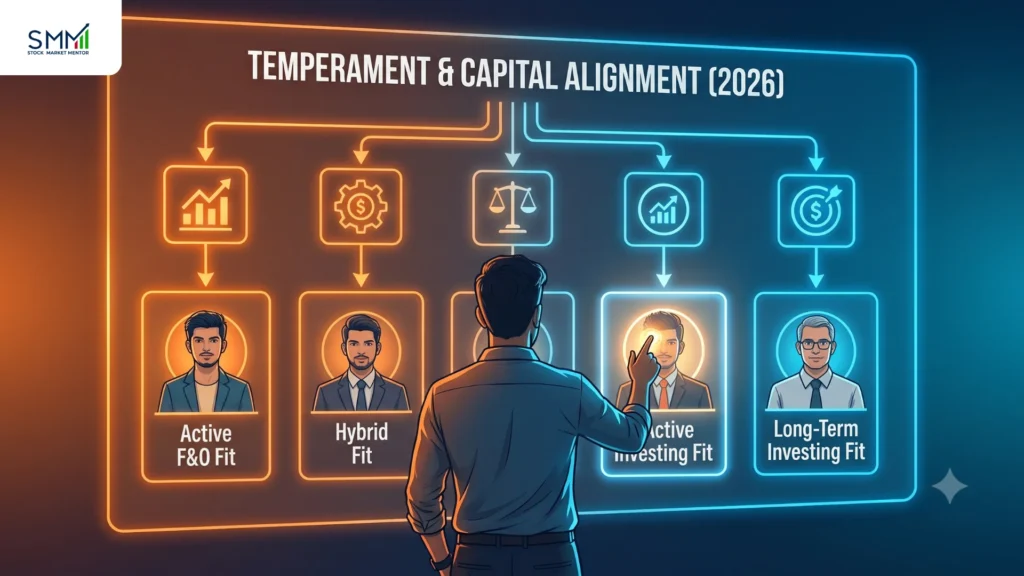
Forex or Stocks for Beginners? Take This 5-Point Self-Assessment
At Stock Market Mentor, we ask every new student the same five questions before recommending a course path, and you can score yourself the same way, right now.
Rate yourself 1 (Strongly No) to 5 (Strongly Yes) on each:
- Time availability: Can you realistically monitor a screen or your phone for several hours a day, including outside 9:15 AM-3:30 PM IST?
- Risk comfort under leverage: Are you comfortable with a position that can move 1-2% against you within minutes, without panicking or averaging down?
- Macro curiosity: Do you actively follow interest rate decisions, inflation prints, and global political developments, or does that sound like a chore?
- Capital discipline: Post the 2026 SEBI 50:50 cash margin rule, can you keep a meaningful, dedicated cash buffer aside without touching it for expenses?
- Compliance patience: Are you willing to trade only through SEBI-registered brokers and RBI-authorised platforms, even if an offshore app promises better leverage or lower fees?
Scoring guide:
- 20-25: Active-trading fit. Currency derivatives, F&O, or intraday equity trading suit your temperament, but only through recognised exchanges, with strict risk management.
- 12-19: Hybrid fit. A mix of delivery-based equity investing with limited, well-hedged exposure to derivatives is likely to suit you better than going all-in on one market.
- 5-11: Long-term investing fit. Delivery trading or SIP-style equity investing will probably serve you far better than active forex or F&O trading right now, and that’s not a lesser path, it’s the right one for your profile.

Common Forex Trading Scams Every Indian Trader Should Know
Forex has become popular, and unfortunately, scams have grown with it. Here are some you should watch out for:
- Fake offshore brokers promising guaranteed returns.
- Telegram/WhatsApp “signal groups” selling fake tips.
- Ponzi or MLM schemes disguised as trading.
- Fake apps that disappear after deposits.
- Unregulated brokers with excessively high leverage.
What Should I Do To Be Safe?
Some basic habits can protect you:
- Always make sure the broker is regulated.
- Watch out for those who promise you profits.
- Stick to SEBI-registered platforms in India.
- Never share OTPs or passwords.
- Remember: real trading always has risk.
Expert Tips Before You Start Trading
Before you jump into forex or stocks, slow down a bit. Most beginners lose money because they rush in without preparation. Keep these points in mind:
- Decide your goal: trading or long-term investing.
- Learn risk management first, not profits.
- Practice on a demo account.
- Use only regulated brokers.
- Avoid high leverage as a beginner.
- Keep a simple trading journal.
Forex vs Stock Trading India: Make the Right Choice with Stock Market Mentor
There’s really no “best” answer when it comes to forex vs stock trading in India. If you like quick moves and fast decisions, forex might feel more exciting. But if you’re the type of person who likes slow and steady development and developing money over time, stocks are usually a better idea. At the end of the day, both markets can work, but only if you actually understand what you’re doing.
If you want proper guidance instead of figuring it all out the hard way, Stock Market Mentor is a good place to start. Their Forex course is meant to keep it practical and easy to follow, so that you can learn how the market truly works, manage your risk better and trade with a little more confidence instead of guessing. If you’re serious about building a career in trading, compare a NISM certification vs stock market course to choose the right learning path.