So you’ve decided to start investing and buy your first shares? For this you opened a broker’s app, feeling pretty confident… and then it hits you, you need both a Demat account and a trading account. And naturally, the first thought is: “Wait, why do i need two accounts just to buy stocks?”
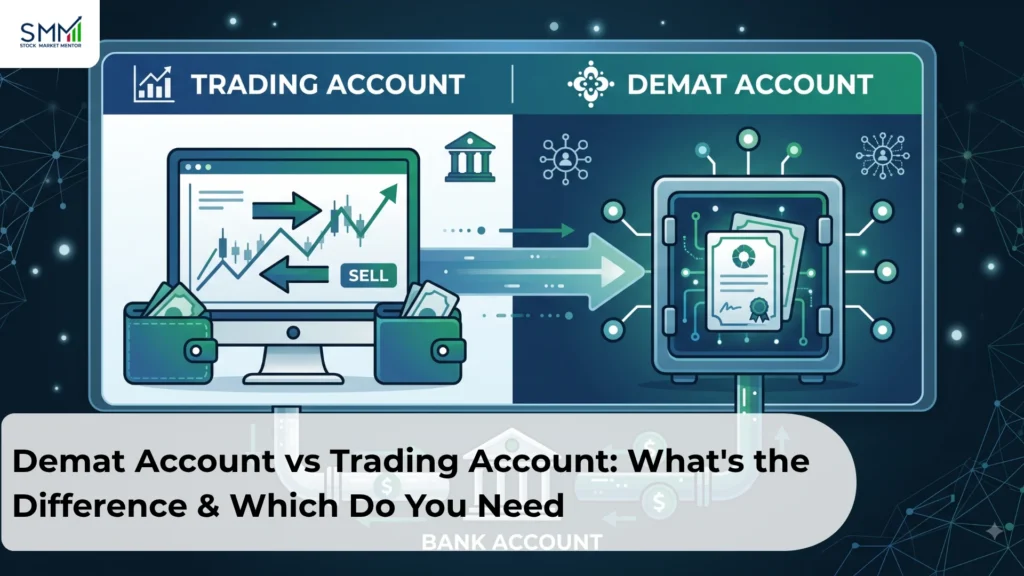
Most beginners get stuck right here. The whole demat account vs trading account in India thing sounds more complicated than it actually is. One account is where your shares are stored, and the other one is what you use to actually buy and sell them. Your bank account just sits in the middle, moving money in and out.
Once you see how they work together, it all starts to make sense. In this blog, we’ll walk through what each account does, how they are connected, what they cost, how to open them, and what you should check before picking a broker.
What Is a Demat Account?
A Demat account is basically where your shares and investments sit in electronic form. The word “Demat” comes from “dematerialisation”, which just means converting physical share certificates into digital form.
So instead of holding paper certificates (like in the old days), everything is stored electronically in your name.
For example, if you buy 20 shares of a company, those shares don’t come to you physically. Once the trade is done and closed, they are directly credited to your Demat account. And when you sell them they are deducted from the same account.
A demat account can hold securities such as shares, ETFs, and bonds in electronic form. Mutual fund units can also be held in dematerialised form, although investors can hold mutual funds through other arrangements that don’t require a demat account.
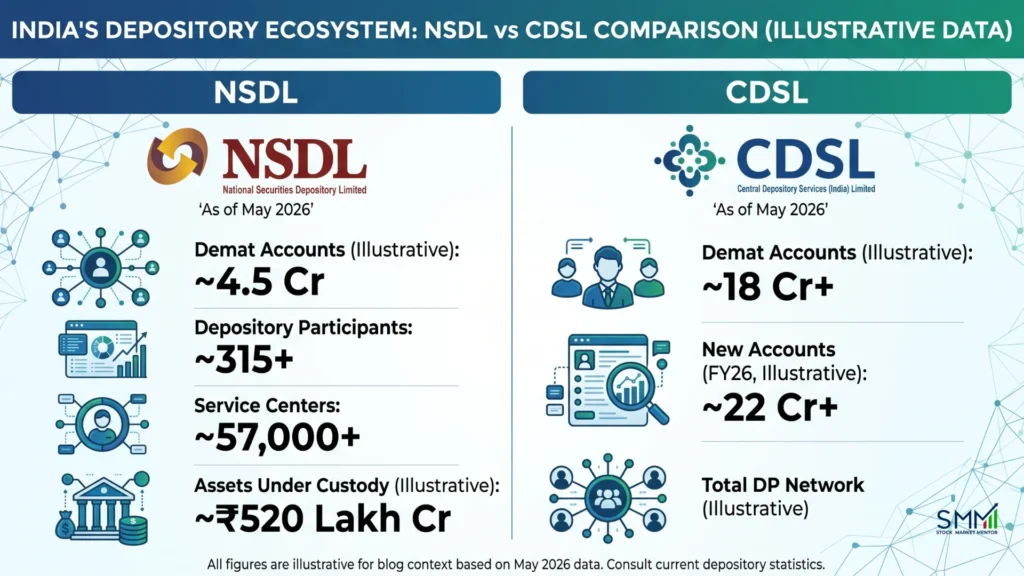
Now, what is the size of this system? As at May 2026, NSDL reported about 4.51 crore demat accounts using 315 Depository Participants, over 57,000 service centers covering more than 99% of PIN codes in India, with assets under custody of almost ₹520 lakh crore. CDSL reached 18.38 crore accounts. Together, both depositories service 23+ crore accounts – note this counts accounts across two depositories, not unique investors. (Source: NSDL & CDSL monthly statistics, May 2026).
What Is a Trading Account?
A trading account is what you actually use to buy and sell shares in the stock market.
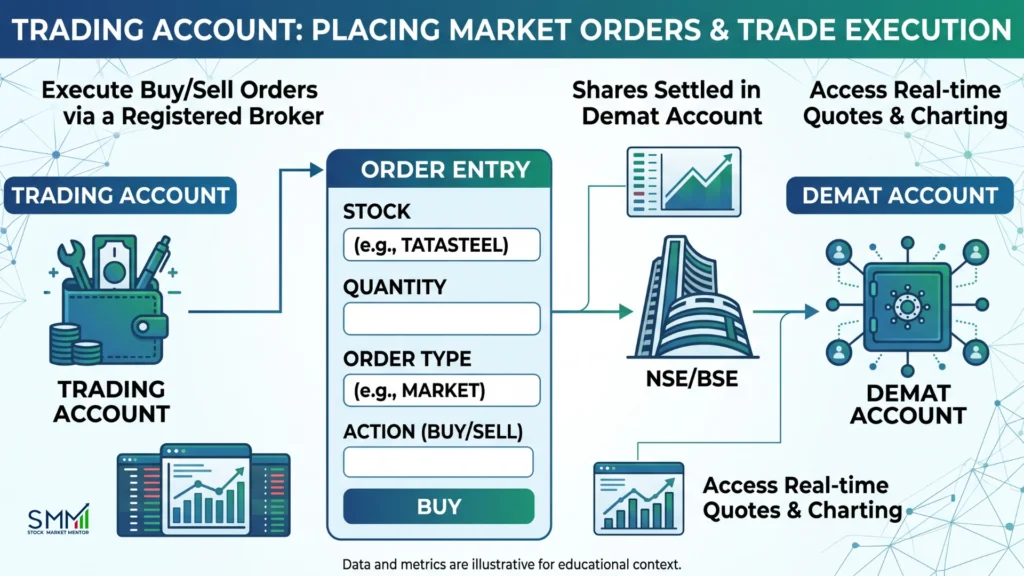
Whenever you open your broker’s app and place an order, say you want to buy 10 shares of a company, that action is done through your trading account. The broker then sends your order to the stock exchange, where it gets matched with a seller.
Once the trade is completed and settled, the shares are moved into your Demat account (if it’s a delivery trade). Selling works the same way in reverse as well.
Per SEBI’s investor guide, a trading account is one held with a SEBI-registered stockbroker to buy and sell securities on recognised exchanges.
The main thing to know for beginners is that a trading account is not a place where your shares are held. It’s the account used to place buy and sell orders through your broker.
Demat Account vs Trading Account: Key Differences
The simplest way to understand the demat account vs trading account in India is to see what each one actually does.
Feature | Demat Account | Trading Account |
Main purpose | Holds securities electronically | Buys and sells securities |
Where it exists | With a depository through a DP. | With a SEBI-registered broker |
Holds shares? | Yes | No |
Places orders? | No | Yes |
Used for delivery investing? | Yes | Yes |
Needed for intraday? | Usually no for positions closed the same day. | Yes |
Typical charges | AMC, DP charges | Brokerage, exchange charges, taxes. |
Can it exist independently? | Yes | Yes, depending on use case |
Primary institutions | NSDL/CDSL | Stock exchanges/broker |
Example use | Holding 50 shares of ABC Ltd | Placing an order to buy 50 shares. |
How Do Demat and Trading Accounts Work Together?
This is where things start to make real sense.
- Rahul invests in shares for long term ₹10,000
- Rahul has an arrangement with his bank/broker to maintain a balance of ₹10,000.
- He enters a buy order in his trading account.
- The exchange matches the order.
- Settlement and clearing occur.
- The shares are posted in his demat account after settlement.
- Later when Rahul sells shares, the shares are deducted as part of the settlement and the proceeds of the sale are paid as per the appropriate settlement process.
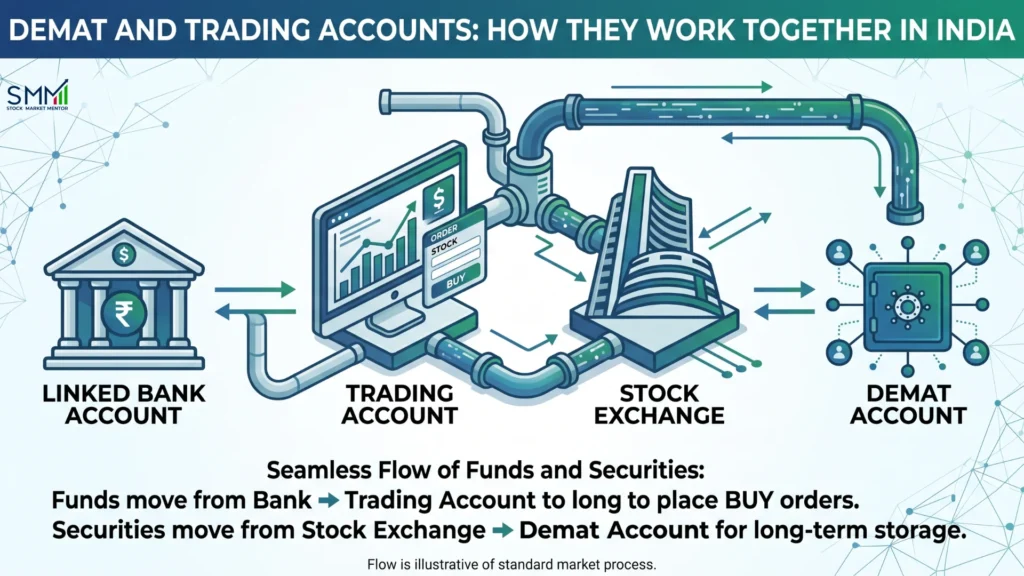
Flow is as follows:
Bank Account –> Trading Account –> Stock Exchange –> Demat Account
Each of these has a specific function:
- Bank Account: Provides funds.
- Trading account : places the order.
- Stock exchange: a place where buyers and sellers meet.
- Demat account: Holds the shares.
Selling is the same but the opposite. You put a sell order, the trade is completed and the shares are debited from your Demat account after the settlement. The money then comes back to your bank account through the settlement cycle.
How Fast Is "Settlement" Actually, in 2026?
As of January 2023, in India, the regular equity trades have a rolling settlement cycle of T+1. This means that generally, qualified transactions will be settled on the next day of settlement, except for any market or bank holiday.
But SEBI has not stopped yet. India features an alternative T+0 rolling settlement cycle along with the normal T+1 cycle. Eligible trades can be settled in T+0 (same trading day), in compliance with applicable market, broker, and settlement arrangements. But it points to where India’s market infrastructure is headed. Same-day settlement influences the capital redeployment speed for active traders.
Expert Insight: Rohit Sen, Founder, Stock Market Mentor:
Most beginners obsess over which broker has zero brokerage and completely miss the settlement cycle question. Understanding when your money and shares actually move, not just that they move, is what separates someone who trades with confidence from someone who’s constantly confused about why their holdings or funds aren’t showing up yet. This is exactly the kind of foundational concept we spend real time on in our beginner modules, because it’s rarely explained in plain language anywhere else.
Do You Need Both a Demat and Trading Account?
For most people, yes. Some people usually need both.
But it’s important to understand that they are not the same thing.
A Demat account can exist even if you are not actively trading. It simply holds your securities.
A trading account is needed when you want to actually buy or sell shares through a broker.
So the usage depends on what you are doing:
- If you are a long-term investor → you buy through trading account, hold in Demat account.
- If you are an active trader → trading account becomes more important, but Demat is still needed for holding shares. If you’re learning trading alongside college or a job, explore trading for students and working professionals.
NSE also mentions that you can have multiple Demat and trading accounts, and they don’t have to be with the same broker.
So instead of asking which one is better, it’s more accurate to say: that they are partners.
Every Investor Must Follow SEBI's New Demat Account Nomination Rule (Effective September 2026)
SEBI amended demat account and mutual fund folio nominations. From September 1, 2026, investors opening single-holder demat accounts or mutual fund folios must nominate a beneficiary or declare an objection.
The regulator wants to eliminate unclaimed financial assets and ensure safe transfers to lawful heirs. SEBI said this revamped framework overrides all previous nomination circulars and allows investors to amend, modify, or cancel their nominations.
What this means practically:
- If you open a demat account after September 1, 2026, you must nominate or opt out.
- Check your nomination status instantly if you have an account instead of waiting for a broker compliance notice.
- SEBI’s May 29, 2026 circular supersedes earlier nomination rules. Check the official circular for current requirements.
We recommend opening your broker’s app and checking your nomination status. It just takes two minutes and only becomes a problem when it’s too late to fix.
How to Open a Demat and Trading Account in India?
If you’re searching for how to open a demat account in India, the process today is actually quite simple and mostly online.
You start by choosing a SEBI-registered broker or Depository Participant. Then you complete the KYC process and account opening form.
As per the standards of NSE you would normally require basic documents like PAN, proof of identity, proof of address and photograph.
The general steps look like this:
- Choose a registered broker or DP.
- Fill the account opening form.
- Submit PAN and identity details.
- Add bank and address details.
- Complete e-KYC or video verification.
- Wait for activation.
Most brokers now open both Demat and trading accounts together in one process, so you don’t have to do it separately.
Please note: Don’t rush just because an account is “free”. Always check the demat and trading account charges and terms properly before opening it.
What Are The Documents You Need to Open a Demat Account?
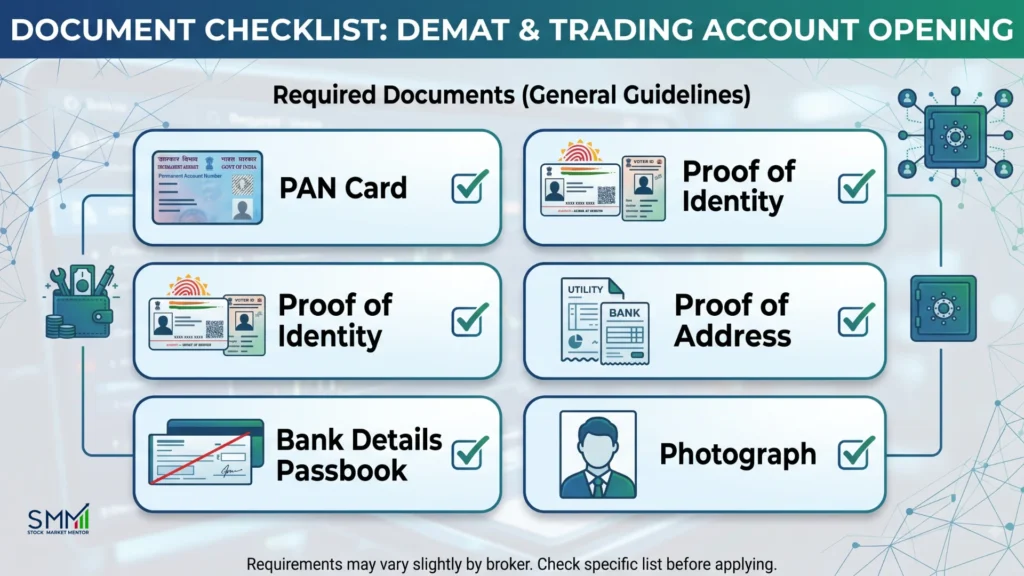
Here’s a list of the key documents you’ll need to open an account, although the type of paperwork you may need may differ depending on your stock broker:
- PAN Card PAN Card
- Aadhaar Card / ID Proof
- Proof of address (if different)
- Bank details:
- Passport size photograph (if applicable)
Depending upon the type of account like NRI, HUF, corporates etc., you may be asked to submit some additional documents.
Demat Account and Trading Account Charges
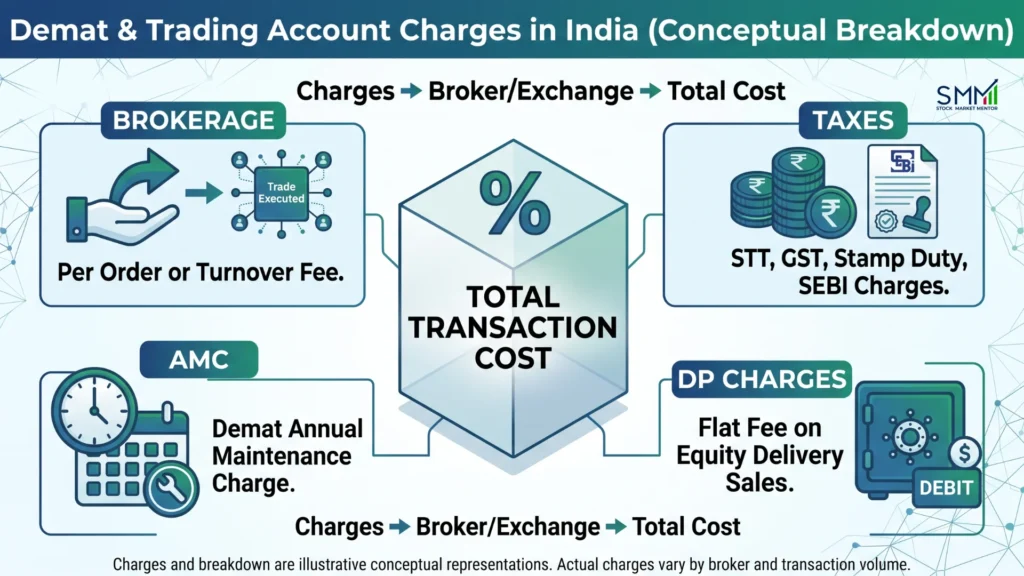
Demat-related charges usually include:
- AMC (Annual Maintenance Charges).
- DP charges (charged when you sell shares in some cases).
The trading charges are:
- Brokerage.
- STT (Securities Transaction Tax).
- Exchange charges.
- GST.
- Stamp duty.
- SEBI charges.
For example:
- Zerodha offers zero brokerage on equity delivery, and charges AMC after the first year for new accounts (as per their current structure).
- Upstox charges brokerage per order and also applies DP charges on equity delivery sales, with AMC benefits for new users in the first year.
- Alice Blue offers free account opening and zero AMC, but brokerage and other charges still apply depending on the segment.
Don’t look at just one charge. Always look at the full cost structure, DP, AMC, brokerage, and taxes together.
Best Demat Account India 2026: What Should You Look For?
There is no best demat account in India in 2026 for everyone. It truly all depends on what sort of investor you are. A beginner generally wants:
- Basic app
- Simple onboarding
- Special charges
A trader may be more interested in:
- Execution speed
- Charting software
- Complex order types
The long term investor may concentrate on:
- AMC and DP charges
- Reliability and reporting
Compare before you choose:
- Structure of brokerage.
- AMC & DP Charges.
- Platform experience.
- Customer Service.
- Easy to use.
- Security Features.
Zerodha vs Upstox Demat: What Should Beginners Compare?
The Zerodha vs Upstox demat comparison comes up a lot because both are popular and beginner-friendly.
For beginners, the real question is not “which is cheaper”, but also:
- Which app feels easier to use?
- Which pricing model suits your style?
- Which platform do you understand better?
Zero Brokerage Accounts: Alice Blue, Zerodha and Upstox
The term zero brokerage accounts, Alice Blue, Zerodha, Upstox sounds very attractive, but it needs to be understood properly.
“Zero brokerage” does not mean zero cost.
It is generally related to certain areas like equity delivery or mutual funds. However, other charges such as taxes, exchange fees, DP charges and AMC are applicable.
For instance:
- Zerodha has 0% brokerage on equity delivery.
- Upstox provides $0 brokerage on some products, including mutual funds/IPO-related services.
- Alice Blue offers brokerage based on segments with caps but other expenses apply.
SMM's Free 2x Margin + 0% Brokerage Account Offer
If you are learning trading and also exploring account options, Stock Market Mentor currently offers a free 2x margin trade account and a 0% brokerage trade account, along with one year of free access to its trading community for course participants.
Stock Market Mentor is positioned as a learning-focused trading and investing academy. It does not act as a portfolio manager or advisory service, and it does not provide tips or guaranteed returns. Before using any such offer, always check:
- Eligibility
- Broker terms
- Actual charges involved
Your Demat & Trading Readiness Checklist Before Funding Your First Trade
We’ve prepared a fast self-check at Stock Market Mentor, based on the questions most difficult for beginners:
- I am aware of the distinction between AMC, DP costs and brokerage and have verified all three for my broker.
- I accept that my deal may be settled in the typical T+1 cycle or in an applicable T+0 arrangement.
- I verified the nomination status in my demat account.
- I know that zero brokerage does not mean zero transaction costs.
- I confirmed my broker’s SEBI registration before putting money in the account.
- I will not give out my login credentials, password or OTP to anyone.
Common Mistakes to Avoid When Opening a Demat Account
One of the biggest mistakes is thinking Demat and trading accounts are the same thing. They are not, even if they appear together in one app.
Another mistake is choosing a broker only because it says “zero brokerage”. That alone is not enough.
Beginners also forget to check:
- AMC
- DP charges
- Hidden transaction costs
Security is another big one. Never share your password, OTP, or trading credentials with anyone. Before you fund your account, check if your broker or intermediary is registered with SEBI. If your complaint is still unresolved after you approach the intermediary, you can use SEBI’s SCORES portal for redressal of grievance.
And finally, don’t open multiple accounts just because of offers. More accounts often mean more confusion.
Demat Account vs Trading Account: Which One Do You Need?
It really comes down to what you want to do.
If you only want to hold securities electronically, you need a Demat account.
If you want to buy and sell shares, you need a trading account.
If you want to invest in the stock market, you will almost always need both.
That’s the simplest way to understand the demat account vs trading account in India.
Final Thoughts from Stock Market Mentor
A trading account is basically what you use to place your buy and sell orders, while your Demat account is where those shares actually sit once you’ve bought them.
If you’re just starting out, spend some time learning the basics before you get started. Stock Market Mentor is one of those sites where you can learn how things work if you are new to trading and or if you are not ready to risk real money right now.
At the end of the day it’s not about creating accounts or doing instant trades. It’s more a case of being aware of what you’re doing, aware of the costs involved and making judgments that are in line with the way you want to trade.
Disclaimer: This article is for educational purposes only and does not constitute investment advice, a recommendation, or an offer to buy or sell any security.