
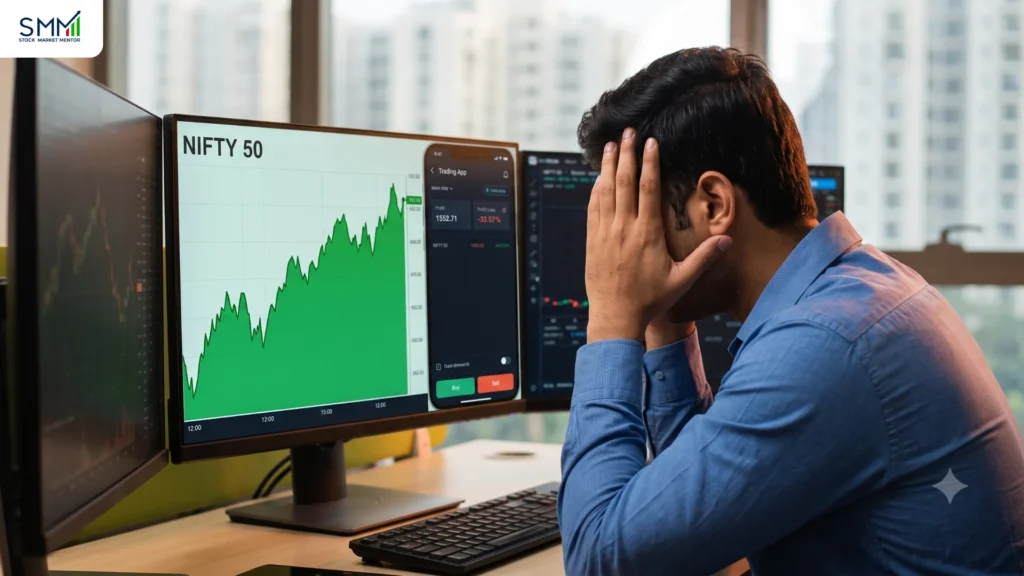
Let’s say this happens to you. You buy a NIFTY Call option just before the Union Budget because you’re pretty sure the market is going to go up. The next day, your view is right. NIFTY actually moves higher. But when you open your trading app, the profit is disappointing. Sometimes it’s even a loss.
And that’s the confusing part. You were right about the direction, so why didn’t the trade work out the way you expected?
This is something a lot of traders go through. They focus heavily on charts, levels, and market news, but miss one thing that quietly controls option prices: volatility.
Once you start understanding volatility, a lot of things in Option Trading Course Noida concepts begin to make sense. In fact, if you’re searching for an India VIX trading course in Noida, this is usually the first concept you’ll come across, because India VIX is basically the market’s way of showing fear and excitement.
In this blog, we’ll break it down in simple terms: what India VIX actually is, how it affects option premiums, what implied volatility and IV crush really mean, and how traders use all of this to make better F&O decisions.
What Is The Meaning of India VIX?
India VIX (Volatility Index) is basically the market’s way of saying: “How much movement do we expect in the next 30 days?”
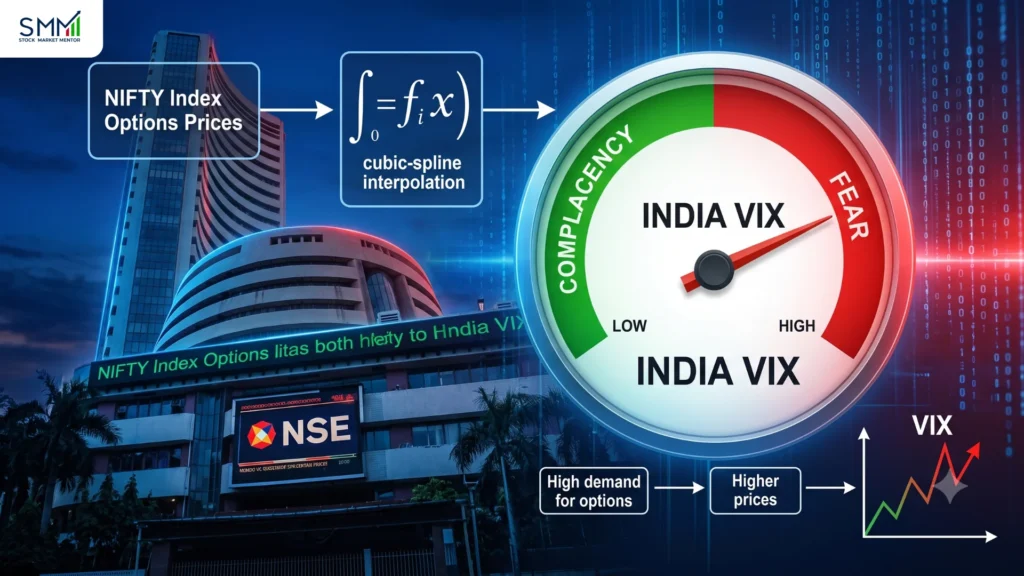
According to the National Stock Exchange (NSE), India VIX is calculated from the best bid-ask prices of NIFTY Index options and expresses the expected volatility over the next 30 calendar days as an annualised percentage. NSE uses the CBOE’s computation methodology, adapted for the NIFTY options order book using cubic-spline interpolation. The full technical methodology is published in NSE’s own white paper on India VIX.
This is also why people call it the “Fear Index.” When traders are nervous, they start buying options for protection. That pushes option prices up, and India VIX rises.
When things are calm and everyone feels relaxed, option buying slows down. Premiums cool off, and India VIX drops.
How Is India VIX Calculated (Simple Version)?
India VIX is built from NIFTY option prices. And option prices already contain what traders think will happen in the future.
So when traders expect big moves, they are willing to pay more for options.
More demand → higher option prices → higher implied volatility → higher India VIX.
That’s the chain.
Some traders even call this a VIX mechanics explainer moment, because once you see how it connects, everything starts to feel more logical.
Understanding India VIX Levels
Traders often use ranges just to understand the environment better.
India VIX Range | Market Condition | What It Usually Feels Like |
Below 12 | Low volatility | Calm, slow market |
12–18 | Normal volatility | Regular trading conditions |
18–25 | High volatility | Fast moves, wider swings |
Above 25 | Very high volatility | Fear, uncertainty, expensive options. |
Tip: Before trusting any of these bands for a live decision, check the current India VIX value directly on NSE’s live index page.
Expert Insight: A “VIX above 18 means high volatility” rule is useful, but experienced desks use the index differently. A VIX climbing from 11 to 16 over three sessions tells a different tale than a VIX that has sat at 16 for a month. In live Pro Trader sessions, the focus is on how VIX is moving relative to its recent range. One of the most common beginner mistakes in live-market walkthroughs is treating the band as a ruler.
Understanding The India VIX Mechanics
Once you understand what India VIX is, the next question is simple:
Why does it move at all? India VIX doesn’t move randomly. It moves because traders keep changing their view of the future.
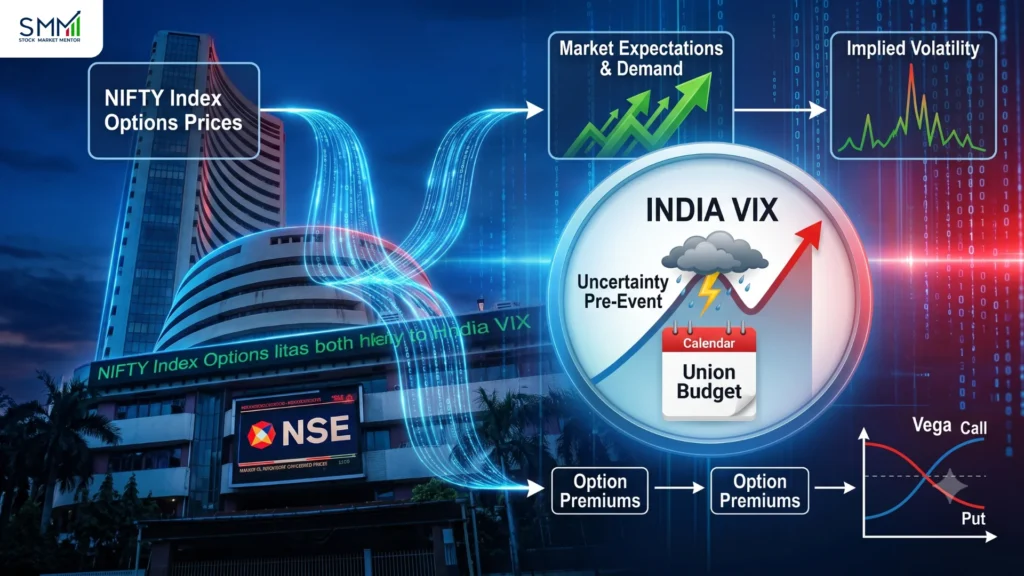
How India VIX Reflects Market Expectations?
Every option price carries a story.
If traders think the market might move a lot, they start buying options. That pushes prices higher.
And when option prices rise, implied volatility rises too.
India VIX captures that shift.
For example, imagine RBI policy is tomorrow. Even before the announcement, traders expect movement. So they start positioning early.
Option demand increases → premiums rise → India VIX starts climbing even before the event.
How Option Prices Influence India VIX?
Option premiums are not random. They depend heavily on volatility.
When uncertainty increases, options become expensive. When uncertainty drops, options become cheaper.
It also directly affects VIX options premiums, because when India VIX rises, options across strikes usually become more expensive.
And when India VIX falls, premiums shrink, even if the market doesn’t move much.
Turn market volatility into opportunity with our India VIX Trading Course in Noida
Why India VIX Spikes During Uncertainty?
India VIX usually doesn’t rise randomly. It rises when the market starts expecting trouble or big movement. Common situations include:
- Union Budget
- RBI policy announcements
- Elections
- Major earnings seasons
- Global news shocks
- Sudden geopolitical events
Why Every F&O Trader in Noida Should Understand Volatility?
If you’re just getting started with the Stock Market for Beginners, most traders focus only on one thing: “Will the market go up or down?” in options trading, that’s only half the story. The other half is volatility.
Price Direction Alone Isn’t Enough
Let’s say you buy a Call option because you expect NIFTY to rise. And it does rise.
But your profit is still small… or sometimes even negative. Why?
Because volatility dropped.
So even though you were right about direction, the option didn’t behave the way you expected. A proper volatility trading strategy always considers both direction and volatility together.
Volatility and Option Premiums
Here’s a simple relationship:
- Volatility goes up → option premiums go up.
- Volatility goes down → option premiums fall.
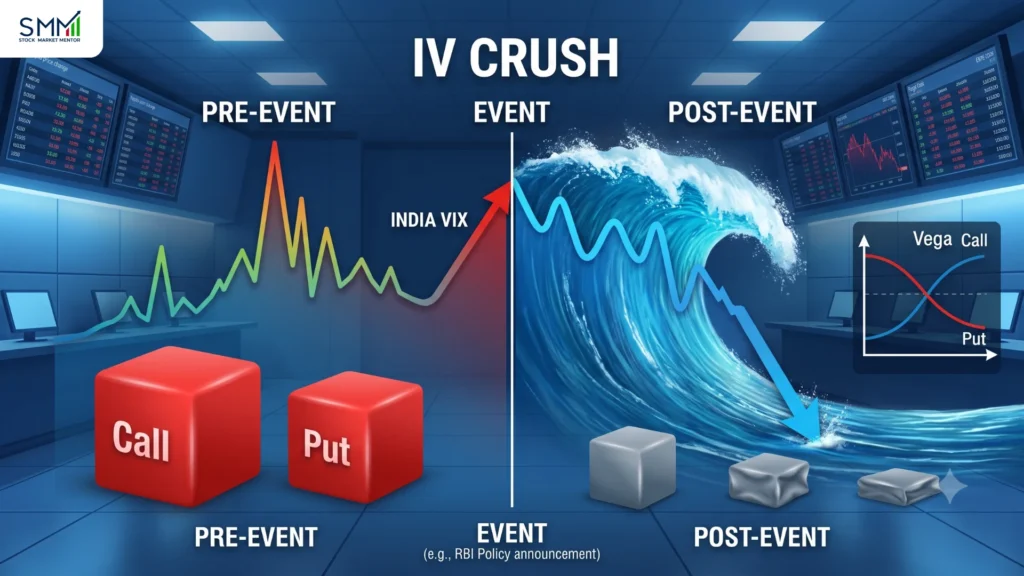
After events, premiums fall sharply because uncertainty disappears. This sudden drop is called implied volatility crush.
IV Crush Explained: What Every Options Trader Must Know
If you’ve ever bought an option before a big event and still ended up in loss, even when the market moved in your direction, you’ve already met IV Crush the hard way.
What Is IV Crush?
IV Crush is basically a sudden drop in implied volatility after a major event is over.
Before the event, nobody knows what will happen. So traders pay extra for options, just for the uncertainty. That pushes premiums up.
But once the event is done, uncertainty disappears in seconds. And with it, implied volatility collapses. So even if the market moves, option prices can fall sharply because the “fear premium” is gone.
How IV Crush Affects Option Buyers?
Option buyers feel IV Crush the most.
Let’s say you buy a NIFTY Call before the Budget expecting a strong rally.
The budget comes. The market moves up slightly.
But your option barely moves, or even goes red.
Why? Because the drop in implied volatility eats away the premium faster than the price move can help you.
And honestly, it’s where most early losses come from.
How IV Crush Affects Option Sellers?
Now here’s the other side. Option sellers often benefit from IV Crush because they sold expensive premiums before the event. After the event, those same options become cheaper quickly, helping sellers profit.
But don’t get this wrong: this is not free money. If the market makes a big move, losses can still be serious.
Managing Vega Risk During IV Crush
Vega is the part of the option that reacts to volatility. Think of it like this:
- If volatility rises → option price increases
- If volatility falls → option price drops
Before big events, Vega becomes extremely important. If you’re holding positions, you’re basically exposed to a volatility shock.
That’s why many experienced traders don’t wait till the last moment. They either:
- Reduce position size.
- Hedge their trades.
- Or avoid trading completely before major events.
Expert Insight: Position-sizing and strategy are the FNO Champion curriculum’s first and second approaches to event-driven Vega exposure. In class’s back-tested case studies, traders lose money because they held the same size position into an event as they would on a usual trading day. Cutting size before a known occurrence (Budget, RBI policy, outcomes) is the default risk-management strategy.
How Professionals Track India VIX Day-to-Day: A Quick Reference
This is a short checklist worth bookmarking:
- Check the live value on NSE’s India VIX page before market open. Don’t rely on a cached number from a broker app that updates less frequently.
- Compare it to its own recent history (IV Percentile), not just an absolute number. A VIX of 14 can be “high” in an unusually calm month and “low” in a turbulent one.
- Cross-check against the RBI’s published MPC calendar and known event dates (Budget, major earnings, elections) so a VIX spike is contextualised rather than treated as a surprise.
- Look at the option chain alongside VIX: OI build-up and PCR on the NSE option chain tell you where the market expects the move, while VIX tells you how much.
- Size the position to the regime, not to the strategy alone: The same iron condor that works at VIX 13 can be undersized or oversized at VIX 24.
Strategy Shifts in High vs Low VIX Regimes
This is where most traders go wrong. They use the same strategy everywhere. That doesn’t work.
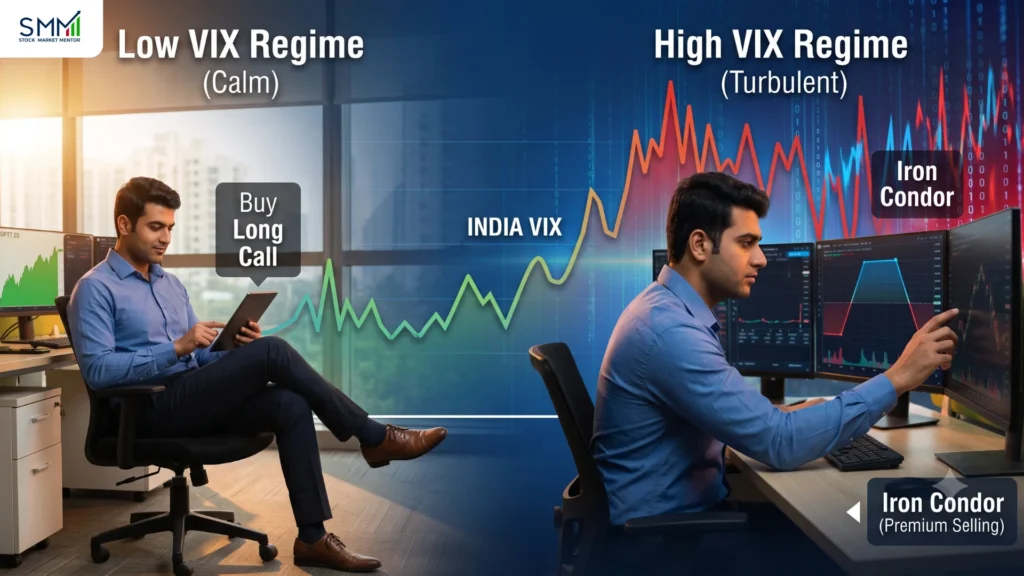
Low VIX Market
- Options are cheap
- Moves are slow
- Breakouts are rare
So traders often look for:
- Long options
- Breakout setups
- Event anticipation trades
High VIX Market
- Options are expensive
- Moves are fast
- Risk is high
So traders shift towards:
- Premium selling
- Defined-risk strategies
- Smaller position sizes
Position Sizing Matters More Than Strategy
In high volatility, even a good strategy can fail if size is too big.
Low India VIX | High India VIX |
Cheap options | Expensive options |
Slow market | Fast market |
Directional trades | Premium selling focus |
Normal sizing | Reduced sizing |
Common Mistakes Traders Make Without Understanding India VIX
Most losses in options trading are not because of the wrong direction. They are because of wrong assumptions about volatility. Common mistakes are:
- Buying expensive options without checking IV.
- Ignoring IV Crush before events.
- Thinking VIX predicts direction.
- Overleveraging in high volatility.
- Selling options without risk control.
- Choosing strikes only based on cheap premium.
- Trading without understanding market conditions.
Where This Is Headed: NSE's Next Volatility Index
It is worth mentioning that India VIX may not be the exclusive volatility measure for long. Apart from India VIX, NSE was allegedly exploring a new volatility index based on a redesigned methodology by mid-2026. NSE told journalists it had filed a draft red herring prospectus (DRHP) with SEBI but did not comment on the new index. India VIX futures were scrapped in 2017 due to inadequate liquidity. Any new derivatives product based on a future generation index shall require SEBI clearance.
Nothing is definite or dated, so traders shouldn’t plan around it. Those concerned about volatility trading should remember that the “fear gauge” is not static. New methodologies and products are tested, and traders who understand why India VIX is structured the way it is (rather than just memorizing its bands) will adapt faster if a second volatility benchmark arises. A trader who just memorized “18 is high VIX” has to relearn everything if the reference index changes, whereas a trader who understands options-implied volatility doesn’t.
Who Should Join an India VIX Trading Course in Noida?
Whether you’re exploring Trading for Students & Working Professionals or looking to improve your F&O skills, this is where structured learning helps. An India VIX trading course in Noida is useful for:
- Beginners in F&O.
- Intraday traders.
- Swing traders.
- Option buyers and sellers.
- Working professionals.
- Anyone struggling with losses in options or planning a Stock Market Career in India 2026 can benefit from learning volatility concepts.
What You Will Learn in Our India VIX Trading Course?
You’ll learn:
- Futures & Options basics.
- India VIX interpretation.
- Implied volatility in real trading.
- Option Greeks (Delta, Gamma, Theta, Vega).
- Risk management techniques.
- Live market analysis.
- Trading psychology.
Along with volatility concepts, traders often combine these principles with techniques taught in the Order Flow Trading Course Noida to better understand market participation.:
- Read volatility in real time
- Adjust strategies during market shifts
- Manage risk instead of chasing profits
- Avoid emotional trading decisions
With live market sessions, real examples, and step-by-step guidance, you don’t just learn strategies. You also slowly start figuring out when not to use them, which honestly is just as important.
That’s kind of the whole idea at Stock Market Mentor. It’s less about memorizing setups and more about actually learning how the market is behaving in real time.
India VIX Trading Course Noida: Understanding Market Volatility
If you’ve ever watched the market move sharply and wondered “why did that happen so suddenly?”, that’s exactly where India VIX starts to make sense. It’s not really about predicting the market, but more about understanding how much uncertainty is already priced in before you even place a trade.
For anyone trying to get serious about F&O trading, joining an India VIX trading course in Noida by Stock Market Mentor can actually help you connect these dots in a practical way instead of just learning theory, while also preparing you for Careers & Jobs in NCR After Stock Market Training.
Disclaimer: F&O trading involves substantial risk of loss and is not suitable for all investors. This article is for educational purposes only and does not constitute investment advice. Past patterns in India VIX or option pricing do not guarantee future outcomes.