
Have you ever taken a trade where everything seemed right, the market moved in your direction, and still, somehow, you ended up losing money?
Most people start with simple calls and Puts. It feels straightforward: if the market goes up, you make money; if it goes down, you make money. But after a few trades, reality hits. Premiums start melting because of time decay, volatility shifts without warning, and suddenly a trade that looks perfect doesn’t work out.
That’s usually the point where traders realise there’s more to options than just guessing direction. Many then start searching for an iron condor strategy course in Delhi because they want to understand what they’re missing out on and how experienced traders actually see the market. If you’re still deciding where to begin, our guide on how to choose the best option trading course Delhi can help you evaluate the right learning path before enrolling.
Strategies like Iron Condor, Straddle, and Strangle are not fancy things. They’re about knowing when the market is likely to stay quiet, when it might move sharply, and how to structure trades so you’re not just relying on luck.
In this blog, we’ll break these strategies down in a simple way: how they work, when to use them, what role volatility and Greeks play, and what you can expect if you’re considering advanced options trading classes in Delhi to improve your trading.
According to SEBI’s July 2025 study, “Comparative Study of Growth in Equity Derivatives Segment vis-à-vis Cash Market After Recent Measures”, 91% of Indian F&O traders lost money in FY 2024-25, with losses reaching ₹1.05 lakh crore, up from ₹74,812 crore the year before. Losing traders averaged ₹1.1 lakh in losses. SEBI saw a similar scenario again this year.
This report finding isn’t unique. SEBI requires brokers to show this statistic, that 9 out of 10 traders lose money in F&O, at login on every trading platform as part of its investor risk disclosure guidelines.

Understanding Market Volatility Before Trading Options
Before you use techniques like the Iron Condor, Straddle or Strangle, you need to know how volatility affects option pricing. Otherwise, you’ll end up forcing trades that don’t fit the market. Before moving into advanced options strategies, it’s equally important to understand technical vs fundamental analysis so you know how different forms of market analysis influence trading decisions.
What Is Implied Volatility (IV)?
Implied Volatility, or IV, is basically the market’s expectation of how much the price might move in the future.
It doesn’t tell you whether the market will go up or down. It just tells you how big the move could be.
- IV is high, and options are expensive because traders are expecting big moves.
- When IV is low, options are cheaper because the market expects things to remain calm.
There is a tendency for uncertainty to build up before key events like the Union Budget, RBI statements or profits. So IV goes up.
After the event, uncertainty drops. And usually, IV drops too, even if the price doesn’t move much.
Where to track it officially: The NSE publishes India VIX live, based on the best NIFTY Index option bid-ask prices. Market expectations of NIFTY volatility over the next 30 days are higher in India. Bookmarking the NSE India VIX page and checking it before structuring any of these trades is the fastest way to sanity-check whether you’re selling premium into a high-IV environment (good for Iron Condors and Short Strangles) or a low-IV one (better for buying strategies).
IV Rank vs IV Percentile: What’s the Difference?
- IV Rank tells you where current IV stands compared to its range over the past year.
If IV Rank is high, it means volatility is near its higher levels. - IV Percentile tells you how often IV has been lower than today’s level.
For example, if IV Percentile is 70, it means IV has been lower 70% of the time.
How IV Affects Option Premiums?
When IV is high, premiums are expensive. That’s usually good for sellers because they can collect more premiums.
That’s why option selling strategies like Iron Condor or Short Strangle are often used in high IV environments. As traders become more experienced, many also explore automation alongside discretionary trading through a no code algo trading course Delhi, allowing them to test and execute strategies more systematically.
When IV is low, premiums are cheaper. This is where buying strategies like Long Straddle or Long Strangle are more relevant if you expect volatility to increase.
Understanding Option Greeks
You don’t need to be a math expert to understand Greeks.
- Delta tells you how much the option price moves when the underlying moves.
- Theta is time decay. Every day, options lose value. This is bad for buyers but good for sellers.
- Vega tells us how much the option’s value will change with volatility.
- Gamma tells you how quickly Delta changes, especially important near expiry when things can move fast.
Choosing the Right Strategy Based on Market Conditions
The right strategy depends on what the market is doing right now.
Market Condition | Strategy That May Work |
Low Implied Volatility | Long Straddle / Strangle |
High Implied Volatility | Iron Condor / Short Strangle |
Sideways Market | Iron Condor |
Strong Trending Market | Long Straddle |
Event-Based Volatility | Straddle / Strangle |
Iron Condor Strategy Explained: Setup, Risk & Ideal Market Conditions
The Iron Condor is one of those non-directional options strategies that looks complicated at first… but once you understand it, it’s actually quite logical.
What Is an Iron Condor?
An Iron Condor uses four option contracts. Here’s how it works:
- You sell one Out-of-the-Money Call.
- You buy a higher strike Call (for protection).
- You sell one Out-of-the-Money Put.
- You buy a lower strike Put (for protection).
The options you sell bring in a premium.
The options you buy limit your risk.
Iron Condor Strategy Components
- The Short Call earns premium but carries risk if the market goes up.
- The Long Call protects you if the market rises too much.
- The Short Put earns premium if the market stays above that level.
- The Long Put protects you if the market falls sharply.
Best Market Conditions for an Iron Condor Strategy
This strategy works best when:
- The market is moving sideways.
- You want range bound trading options that benefit from minimal price fluctuation.
- Volatility is relatively high before entry.
- You expect volatility to drop.
- There are no major events coming up.
Contrary to popular belief, a slightly elevated IV going in is actually more useful than dead-calm IV, you’re being paid more to take a range bet, and IV has more room to fall in your favour.
How Option Greeks Affect an Iron Condor?
- Theta works in your favor, time passing helps you.
- Vega matters because if volatility drops, your position benefits.
- Delta starts neutral but changes if the market moves toward your strikes.
- Near expiry, Gamma becomes important because small moves can have a bigger impact.
Iron Condor Payoff Diagram
If you look at the payoff, it’s flat in the middle.
That flat area is your profit zone.
As long as the market stays within your short strikes, you make money.
If it moves outside, profits reduce and eventually turn into losses.
Live Trading Example
Let’s say Nifty is around 25,500 and not moving much. Volatility is slightly high, but there’s no big event ahead.
You might:
- Sell 25,700 Calls.
- Buy 25,900 Calls.
- Sell 25,300 Put.
- Buy 25,100 Put.
If Nifty stays between 25,300 and 25,700, you keep most of the premium.
Note: these strike levels are for demonstration only; check actual Nifty levels and India VIX before taking a transaction.
Risk Management for an Iron Condor Strategy
Even though risk is defined, you can’t just ignore the trade.
If the market starts moving strongly in one direction, you may need to adjust.
Some traders roll positions, some exit early, some reduce exposure.
Expert Insight: Position sizing is rarely the reason traders lose money, it’s the technique. Even an iron condor with a well specified range can still destroy an account if the position is sized for a trader’s confidence, rather than their capital. It’s the exact way a defined-risk strategy produces an outsized loss, after a series of winning premium-collection trades. Structured courses spend as much time on how much to risk on a trade as they do on which strikes to pick, since the second question is meaningless without a solution to the first.

Long & Short Straddle Strategy
At its core, a Straddle just means taking both sides. You either buy or sell a Call and a Put at the same strike price and same expiry.
What changes everything is whether you’re buying or selling.
What Is a Long Straddle?
In a Long Straddle, you’re buying both the Call and the Put.
Yes, it costs more because you’re paying two premiums. But the upside is, your risk is limited to what you paid.
If the market makes a strong move (up or down), one side can gain enough to cover the cost and still leave you with profit.
What Is a Short Straddle?
In a Short Straddle, you’re selling both the Call and the Put.
Here, you collect premium upfront. The idea is simple, you want the market to stay quiet so both options lose value over time.
Best IV & Market Conditions for a Straddle
- Long Straddles work better when implied volatility (IV) is low and expected to rise.
- Short Straddles are usually taken when IV is already high and traders expect things to calm down.
Greeks Impact
You don’t need to overcomplicate this. For a Long Straddle:
- You benefit when volatility increases (Vega helps you)
- You lose value over time (Theta works against you)
For a Short Straddle:
- Time decay works in your favor
- But rising volatility can hurt you fast
Payoff Diagram
If you’ve seen the chart, it looks like a “V”.
The worst-case scenario is when the market doesn’t move much and stays near the strike price.
As the market moves away, either up or down, the Long Straddle starts making money.
For a Short Straddle, it’s the opposite.
Live Market Example
Let’s say Bank Nifty is sitting just before an RBI policy announcement.
Everyone expects movement, but no one knows the direction.
A trader might take a Long Straddle here, buying both Call and Put at the same strike.
If the market moves a lot after the announcement one side can make enough to justify the trade.
Risk Management & Adjustments
Always have a plan before entering here.
Set stop-loss levels. Keep an eye on volatility after the event. Don’t just sit and hope things turn around.
If you’re running a Short Straddle, you need to be even more alert, adjusting positions or reducing exposure if the market starts moving strongly.
Long & Short Strangle Strategy
A Strangle is just a Call and a Put with different strike prices but the same expiry. Like the Straddle, you can either buy or sell it.
What Is a Long Strangle?
Here, you buy an out-of-the-money Call and an out-of-the-money Put.
These are cheaper options, so your total cost is lower than a Straddle.
But there’s a catch: the market needs to move more for you to actually make money.
What Is a Short Strangle?
In a Short Strangle, you sell both options.
Because the strikes are farther away, there’s a higher chance both expire worthless, which is good for the seller.
But again, if the market makes a big move, risk increases quickly.
Best Market Conditions for a Strangle
- Long Strangles are useful when you expect a big move but want to keep costs lower than a Straddle.
- Short Strangles are used when volatility is high and you expect the market to stay within a range.
How Option Greeks Affect a Strangle?
- Long Strangles benefit from volatility and movement.
- Short Strangles benefit from time decay, but they don’t like surprises.
Strangle Payoff Diagram
Think of it like a wider version of the Straddle. Because your strikes are farther apart, the market needs to travel more before profits kick in.
But your entry cost is lower, which is the trade-off.
Real Trading Example
Imagine the Union Budget is coming up. You expect a strong reaction, but direction is unclear.
Instead of paying a high premium for a Straddle, you might go for a Long Strangle using out-of-the-money strikes.
If the market moves sharply, one side can still perform well.
Risk Management for a Strangle Strategy
Good traders don’t just wait till expiry.
If one side starts going wrong, they adjust, maybe roll strikes, reduce position size, or exit.
The goal is simple: protect the money first.
Iron Condor vs Straddle vs Strangle: Key Differences
All three strategies use multiple options, but they’re meant for different situations.
Feature | Iron Condor | Straddle | Strangle |
Market Outlook | Sideways | Big move expected | Big move expected |
Preferred IV | High | Low | Low |
Risk | Defined | Limited (Long) / Unlimited (Short) | Limited (Long) / Unlimited (Short) |
Reward | Limited | High | High |
Margin Requirement | Moderate | Higher for Short positions | Moderate |
Probability of Profit | Generally Higher | Moderate | Moderate |
Best For | Premium income | Event-based trades | Volatility trades |
Your 2026 Event Calendar for Volatility-Based Trades
Straddles and Strangles are calendar events, so knowing the calendar is helpful. Monetary Policy Committee meets six times a year and its schedule is published under RBI Act Section 45ZI. MPC policy announcements are scheduled August 5, October 7, and December 4, 2026. Since Bank Nifty is sensitive to rate movements, put these on your calendar for event based Straddle or Strangle entry. (For dates, please visit RBI’s website closer to the event)
Watch beyond MPC dates, quarterly results season for Nifty heavyweights, monthly and weekly index expiry days (often with substantial intraday volatility) and US Federal Reserve central bank decisions that impact Indian market volatility.
Why Many Traders Lose Money With These Strategies ?
A few common mistakes:
- Ignoring implied volatility.
- Choosing wrong strike prices.
- Holding trades too long without adjusting.
- Taking oversized positions.
- Letting emotions take over.
Join Our Iron Condor Strategy Course in Delhi
If you’ve ever tried learning options strategies on your own, you probably know how confusing it can get.
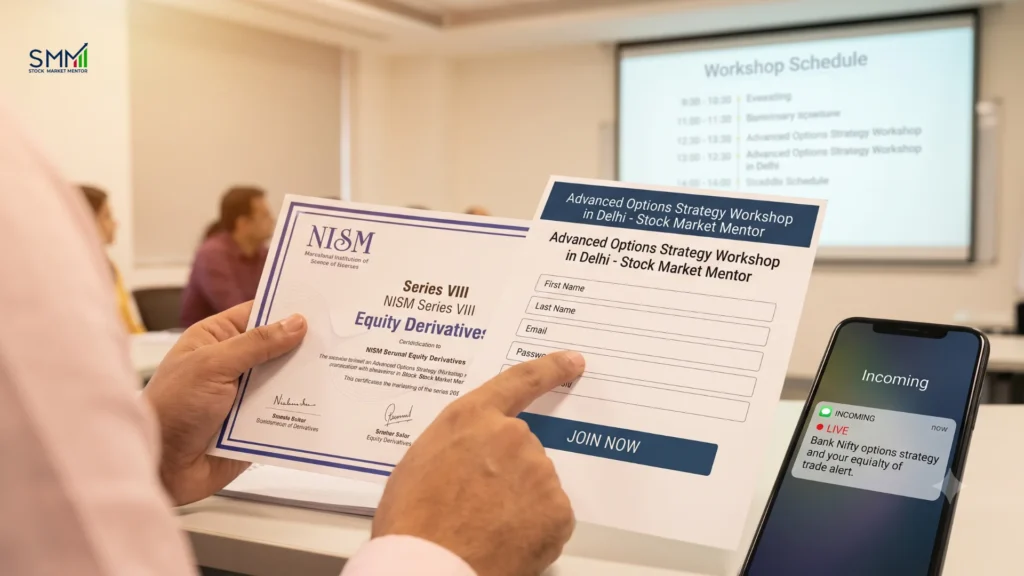
That’s where a proper iron condor strategy course in Delhi can really help. The FNO Champion course from Stock Market Mentor covers Iron Condor, Straddle, and Strangle concepts and teaches F&O trading across market circumstances rather than a single setup. Instead of just theory, you get to see how these strategies play out in live markets, what to watch for, and when it’s better to avoid a trade altogether.
Stock Market Mentor teaches you more about how to learn, than what to study. You will learn how to plan trades, how to manage risk and how to stay disciplined when the market turns against you. They will teach you about memorizing setups and more about creating a mindset that works in real trading.
You’ll cover:
- Iron Condor & Iron Butterfly
- Straddles & Strangles
- Option Greeks
- Implied volatility
- Trade adjustments
- Risk management
Who Should Attend?
- F&O traders
- Investors
- Working professionals
- Swing traders
- Full-time traders
- Beginners ready to level up
Expert Insight: Certification is a floor, not a ceiling. Course completion with a NISM certification (if passed) provides a demonstration of a baseline of regulatory and product knowledge, but the actual consistency is in screen time. Many working professionals join these programs to build a second income from trading while continuing their primary careers, although success depends on disciplined learning, practice, and risk management.
Master Your Iron Condor Strategy Course in Delhi with Stock Market Mentor
It’s more about understanding how the market behaves and choosing the right strategy for that moment, while keeping your risk under control. Whether you’re working with an Iron Condor, Straddle, or Strangle, what really matters is practice and learning from real trades.
If you’re serious about improving your skills, Stock Market Mentor focuses on practical learning instead of just theory. It is very helpful to be able to see how things really work in the market. A good iron condor strategy course in Delhi will help you trade clearly, plan your moves better, and be more profitable over time.
Disclaimer: This content is for educational purposes only and does not constitute investment advice, a trading recommendation, or a solicitation to buy or sell any security or derivative contract.