


1. Understand the Industry Structure
Start by understanding:
- What does the industry do?
- Who are the key players?
- Whether it is competitive or concentrated
As an example, the banking industry is very regulated and consolidated, whereas EV remains in its development with several players. A proper structure assists in determining the potential of stability vs growth.
2. You Must Identify Demand Drivers
Any industry develops due to the presence of good underlying factors. Here’s a sample explanation of how the industry performs with a few demand drivers.
Industry | Sample Demand Driver |
EV | Government incentives & fuel costs |
Real Estate | Urbanization & income growth |
Pharma | Healthcare demand |
IT | Global digital transformation |
- According to the Invest India report released in 2020, the EV market in India will be at a 40-45% CAGR up to 2030.
- As per the news available from DD News, the pharmaceutical industry is estimated to hit up to $130 billion by 2030.
The presence of strong demand drivers means long-term sustainable growth.
3. Track Government Policies Specific To Sectors
Entire industries can be either hastened or slowed because of government policies. Always pay close attention to the fiscal budgets of the year to understand the government’s investments in selected sectors. Government can ease the policies for those sectors it invests in, opening more growth opportunities & driving industry profitability. That news is a hot pick for investors to consider for investment.
Examples include:
- According to a Press Release by PIB Delhi on 29th January 2026, Production Linked Incentives (PLI) plans to allocate ₹1.97 lakh crore to increase manufacturing across 14 key sectors under the “Atmanirbhar Bharat” mission. These announcements become key drivers to increase investment sentiment across the nation.
- The government introduced the Faster Adoption and Manufacturing of (Hybrid &) Electric Vehicles in India (FAME India) Scheme Phase-II, offering EV subsidies to boost EV adoption in the country.
In the case of the Delhi investors, keeping up with the changes in the policy would be an advantage as an early mover.
4. Analyze Industry Lifecycle
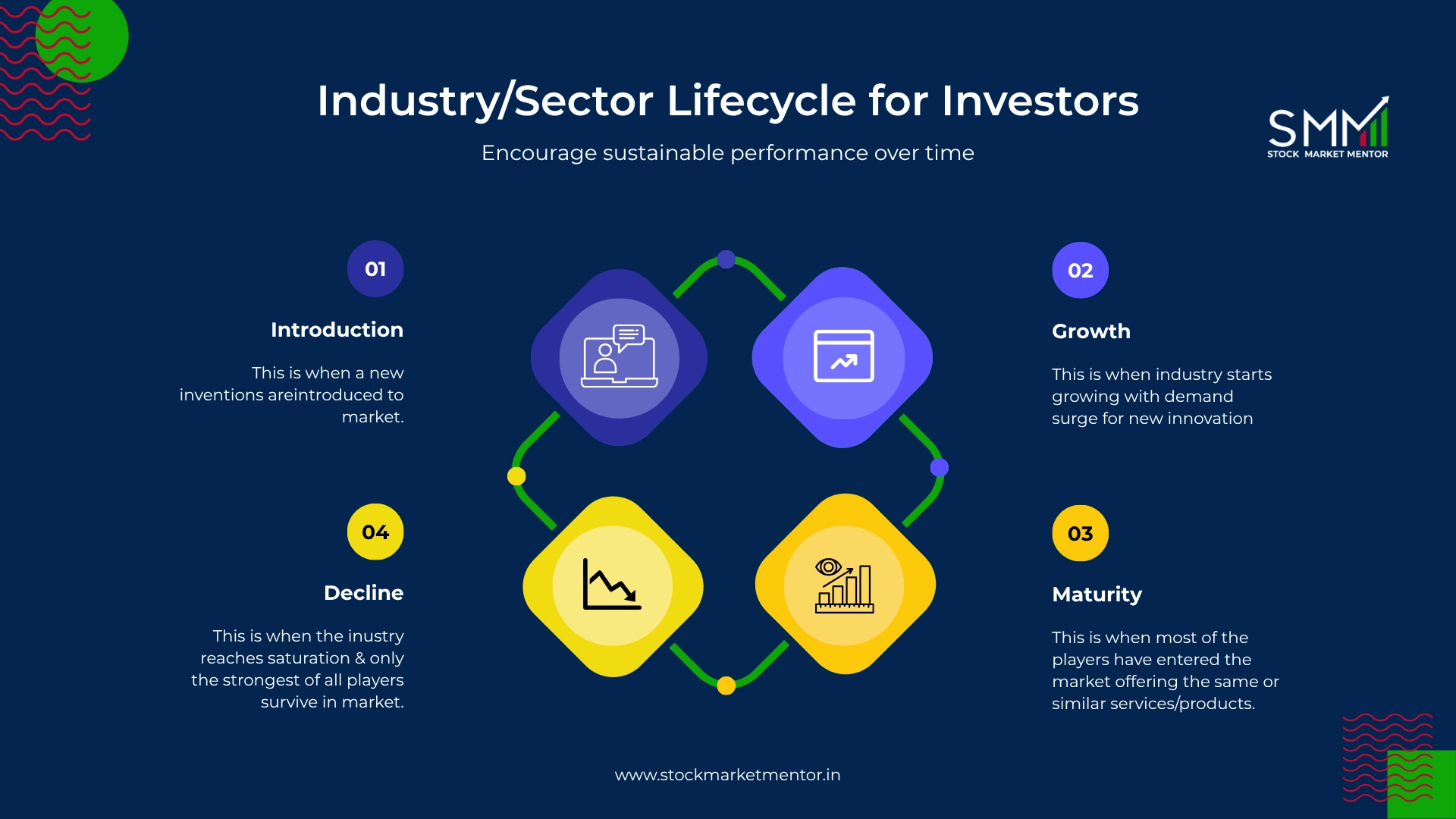
There are four stages of industry:
- Introduction
- Growth
- Maturity
- Decline
You will find the most lucrative investment opportunities in the growth stage, during which the growth is the fastest, and there is an increase in profits.
Example:
- Currently, the EV industry is in the growth stage due to increased investments, grants & incentives from the government with subsidies under various schemes.
- The FMCG industry/business is in a Mature stage as the market is completely saturated with many players with more supply than demand.
5. Evaluate Competition
Knowledge of competition will aid in the evaluation of profitability. Here’s the thumb rule to evaluation: more competition, less industry growth & profits.
Ask these questions while evaluating & before investing in any sector/industry –
- What is the number of players?
- Is the power of price good?
- Are new players on the rise?
Here are some instances of competition evaluation –
- There is pressure on margins in the telecom sector as a result of stiff competition, hence the overall industry profits are lower.
- The specialty chemicals have 15-25% EBITDA margins since there is no competition. giving more value to the investors. With fewer competitors, the returns are likely to be better.
6. Study Financial Trends
Rather than looking at individual company financials, look at industry-wide financials like –
- Revenue growth
- Profit margins
- Debt levels
7. Understand Macro Factors
Economic conditions are directly related to industries. Here’s the simple table to understand factors & impacts of macroeconomic factors on industries.
Factor | Impact |
Inflation | Affects FMCG costs |
Interest Rates | Impacts real estate & banking |
Currency | Influences IT & pharma exports |
Citation: A weak rupee will improve export-based industries such as IT.
8. Identify Future Trends
When there is a new invention in the market, making revolutionary changes, those domains are likely to boom with government recognition. An intelligent investor identifies the future trends of industries while consistently being aware of business activities & discoveries. It is in this that true wealth is created.
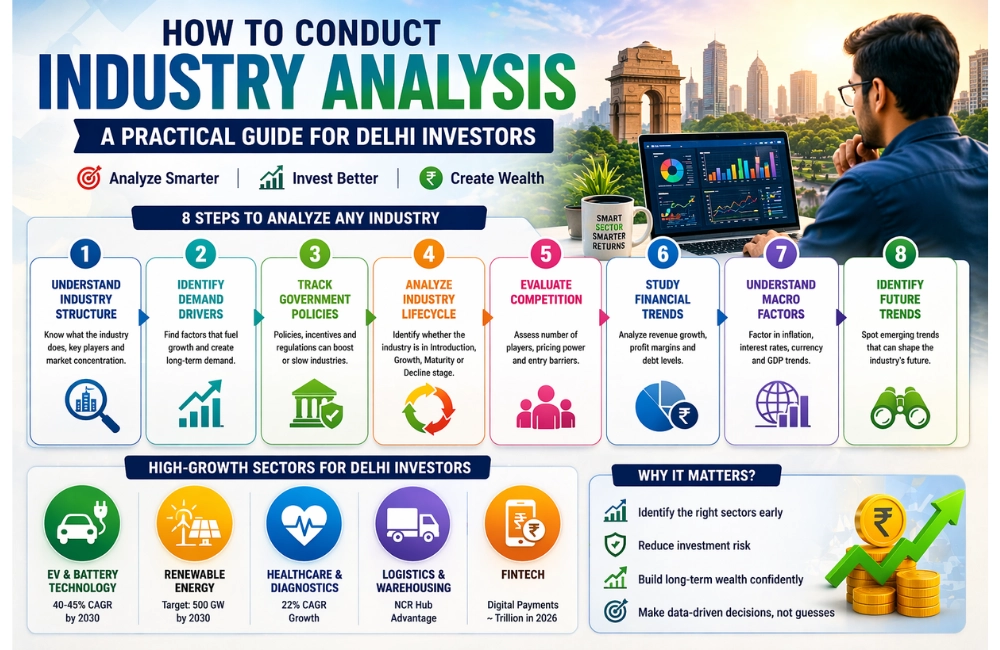
Delhi Investors can find these High-Growth Sectors to invest in –
- EVs and battery technology.
- Renewable Energy (Target: 500 GW by 2030)
- Healthcare & Diagnostics (22% CAGR growth)
- Logistics/Warehousing (NCR hub benefit)
- Fintech (Estimated digital payment amounting to a trillion in 2026)
Early identification of such trends provides investors with a huge advantage.
Follow this repeatable process:
- Choose a sector
- Identify growth drivers
- Analyze leading companies
- Study financial trends
- Evaluate risks
- Time your entry
This logical process eliminates making decisions based on emotions and enhances consistency.
Stock Market Mentor offers the Pro Trader Program course to train learners with these techniques of analysing the market based on macro-economic factors, market research, industry evaluation & understanding company financials.