
A lot of traders begin the month with a very simple idea: sell Nifty options, collect the premium, and let time do its job. On paper, it feels almost effortless. But a few days later, when Nifty suddenly moves sharply in one direction, that “easy income” idea doesn’t feel so easy anymore. The premium expands, the position goes into stress, and that’s usually when people realise that option selling in Nifty is not just about collecting decay.
The real difficulty isn’t finding something to sell. That part is actually easy. The hard part is knowing when to sell, how much risk to take on, and what to do when the market doesn’t behave the way you expected. Time decay does help option sellers, but it’s not a guarantee. One bad move, or one poorly managed position, can easily erase several small, successful trades.
So the big question is, can Nifty and Bank Nifty option selling actually be used as a monthly income strategy? The honest answer is yes, but only if you go in with realistic expectations and proper risk control. In this blog, we’ll break down how option selling really works, why time decay is so important, how strategies like short strangles and iron condors are used, how traders adjust positions when things go wrong, and what kind of monthly returns are actually realistic in the real world.
What Is Nifty Option Selling?
Option selling Nifty simply means you sell calls or put options on the Nifty 50 index and collect a premium upfront. If the option expires worthless, you keep that premium. Or you can even close the trade earlier if the premium drops and book the difference.
For example, if you sell a Nifty call at ₹100, you receive ₹100 per unit. If that same option later falls to ₹40 and you exit, you’ve made ₹60 per unit (before charges).
How Does Nifty Option Selling Work?
A call seller is basically betting that Nifty will stay below a certain level or at least not move up too fast. A put seller expects the opposite: that Nifty won’t fall below a level.
In simple terms, your profit in option selling usually comes from three things:
- Time passing (time decay working in your favour).
- Nifty is moving in your expected direction.
- A drop in implied volatility.
Nifty options are European-type and cash-settled. SEBI had issued a circular in May 2025 rationalizing expiry days across exchanges. NSE currently runs its weekly expiry of benchmark index options on Tuesdays while other equity derivatives settle on a monthly basis. This is a structural shift from the former Thursday expiry regime, so always check the live expiry calendar on NSE India before placing a trade.
Option Buying vs Option Selling
Option buying and selling are completely different games. A buyer pays a premium and needs a strong move in a short time. A seller collects a premium but takes on the responsibility of the contract.
Here’s a simple comparison:
Factor | Option Buying | Option Selling |
Premium | Paid | Received |
Time decay | Works against you | Works for you |
Main challenge | Timing the move | Managing risk |
Risk | Limited to premium paid | Can be large |
Capital requirement | Lower | Higher |
Nifty vs Bank Nifty Option Selling
Nifty is a bigger basket of big Indian companies and hence it moves more evenly.
However, Bank Nifty is largely driven by banking equities. It reacts faster and often more aggressively to news, RBI updates, and market sentiment.
That’s why a Bank Nifty option selling strategy cannot be treated the same as a Nifty setup. Also, it is good to know that contract sizes are different and change from time to time by NSE, as per January 2026 amendment, the Nifty lot size is 65 units and the Bank Nifty lot size is 30 units per the official contract specifications of the exchange. Check the current lot size before sizing a position, as these are frequently reviewed by NSE under SEBI requirements.

Why Option Selling Has a Statistical Edge?
The main reason people prefer option selling is time decay. Options lose value as they near expiration, and that decay usually advantages the seller.
How Does Time Decay Work in Favour of Option Sellers?
Every option has two parts in its price:
- Intrinsic value (real value if in-the-money)
- Time value (future uncertainty)
Out-of-the-money options are mostly time value. As expiry comes closer, that time value keeps reducing.
This is where theta comes in. Theta measures how much value an option loses every day. For a seller, this daily decay is helpful.
Probability of Profit vs Profitability
Yes, option selling can have a high win rate. Many trades expire worthless and look profitable. But profitability is a different story.
Here is an example:
- 4 Trades earn Rs.5000 each = Rs.20,000 Profit
- 1 trade loss 25,000 = lost 5,000
As you can see, you can wipe out all the gains you earned on earlier trades with one massive loss.
That’s why serious option sellers track:
- Average profit
- Average loss
- Maximum drawdown
Not just the win percentage.
The Role of Implied Volatility
Implied volatility (IV) is basically the market’s expectation of future movement.
When IV is high, option premiums become expensive. That looks attractive for sellers because you collect more premium.
But high IV usually means the market is expecting a big move. So it’s not “free money”.
Selling high IV works only when volatility later cools down. If IV expands further, losses can grow quickly.
Why Risk Management Still Matters?
Time decay may give you a statistical edge, but it does not remove:
- Directional risk
- Volatility risk
- Gamma risk
That’s why any index option selling strategy in India should start with risk control, not with “how much premium can I collect?”
What SEBI's Latest Data Tells Nifty Option Sellers?
Before you build any income-oriented strategy, let’s see how the average trader is actually doing, and this picture just changed. On August 20, 2026, SEBI released two new studies covering FY26 (2025-26): “Profitability of Individual Traders in the Equity Derivatives Segment (FY25-FY26)” and a companion trading-behaviour study. The numbers: 87.7% of individual traders lost money in FY26, down from about 91% in FY25, and aggregate losses fell to ₹91,685 crore from a revised ₹1.12 lakh crore the year before. But the average loss per losing trader actually rose to around ₹1.17 lakh, and options alone accounted for roughly 92% of total individual losses, with transaction costs eating another ₹25,000 crore across the segment.
Despite fewer traders and lower losses, the odds of staying in the game didn’t increase. Being clear about what this data shows is important: SEBI’s study covers individual equities derivative participation generically, not strategy-by-strategy; therefore, it can’t be used to forecast expected profits for defined-risk Nifty option selling. What it does confirm is that structure, position sizing, and cost-awareness matter more than ever, regardless of which side of the trade you’re on.

How to Build a Monthly Nifty Option-Selling Strategy?
A monthly strategy is not a single trade. It’s a whole process.
Step 1: Define Your Trading Capital
First, decide how much capital you are willing to risk in derivatives. Don’t start with “how much premium I want to earn”. That thinking usually leads to over-leveraging.
Step 2: Identify the Market Regime
Before placing any trade, understand the market. This requires understanding how technical vs fundamental analysis can support your broader market assessment.
- Trending
- Range-bound
- Highly volatile
- Calm
Option selling generally works better in range-bound or stable markets.
Step 3: Select the Expiry
Select expiry on the basis of your holding plan.
Nifty now offers weekly and monthly expiries, which gives flexibility. Bank Nifty, in comparison, is more limited in structure.
Step 4: Select Strike Prices
Strike selection depends on:
- Delta
- Implied volatility
- Expected move
- Support and resistance
There is no “safe distance”. Even far OTM strikes can get hit in strong moves.
Step 5: Define Entry, Exit, and Position Size
Decide before you get into the trade:
- Maximum loss you can bear
- Rules to exit
- Procedures for adjustment
That way, you won’t have to make decisions later based on emotion.
Expert Insight (Rohit Sen, Founder, Stock Market Mentor): The traders who last in option selling aren’t the ones with the fanciest strategy; they’re the ones who treat position sizing like a rule, not a suggestion. We regularly see promising monthly-income plans fail not because the strategy was wrong, but because one unhedged expiry-week trade was sized too large. Our desk’s approach at Stock Market Mentor is simple: teach the adjustment logic before the entry logic. If a student can’t tell me their exit plan before they take the trade, they’re not ready to size it with real capital.
Short Strangle on Nifty – Setup, Adjustment and Exit
A short strangle means selling:
- One OTM call
- One OTM put
- Same expiry
The idea is simple: Nifty should stay between the two strikes.
For example, if Nifty is around 25,000, you might sell a call above and a put below the current level. Exact strikes depend on live market conditions.
Maximum profit = total premium received. But risk is open-ended on both sides.
When Should a Short Strangle Be Adjusted?
You don’t adjust randomly. You adjust when:
- Price comes close to a short strike.
- Delta increases sharply.
- IV expands suddenly.
- Market structure changes.
- The pre-decided loss level is hit.
Possible actions:
- Roll the threatened side.
- Shift the entire position.
- Add a hedge.
- Reduce quantity.
- Exit completely.
Decide on these rules before entering the trade.
Iron Condor on Nifty – When to Use It?
An iron condor is basically a protected version of a strangle. It includes:
- Short call + long call
- Short put + long put
The long options act as protection. This makes it a defined-risk strategy.
An iron condor works best when you expect Nifty to stay in a broad range, and it’s not ideal during strong trends or major event weeks. Knowing your maximum loss upfront is the real payoff here. You’re trading away some premium for that certainty compared to naked selling.
Short Straddle on Expiry Day – Risks Explained
A short straddle means selling an ATM call and an ATM put at the same strike. Expiry day makes it attractive because time value collapses quickly. But the risk is equally high.
The Hidden Risk: Gamma
Near expiry, gamma becomes very sensitive.
That means even a small move in Nifty can change your position’s risk profile very fast.
So a short straddle is not “easy money on expiry day”. It can flip quickly if the market moves.
SEBI has also introduced tighter rules around expiry-day risk, including stricter margin, position monitoring, and controls on index derivatives to reduce extreme risk situations.
How Much Margin Is Required for Nifty Option Selling?
There is no fixed number for the margin required for option selling post-SEBI rules.
It depends on:
- Strategy used
- Number of lots
- Strike selection
- Volatility
- Broker margin system
- Whether hedged or unhedged
But one important point: margin is not your risk. You can have enough margin and still take a very risky position.
SEBI has strengthened upfront margin systems and risk controls in derivatives trading. NSE contract specifications also keep updating, so lot sizes and requirements can change over time.
What to Do When an Option-Selling Trade Goes Wrong?
Rule number one: don’t react emotionally. If Nifty moves against your position, first understand why. Ask:
- Has a key level broken?
- Has IV increased?
- Has Delta moved beyond comfort?
- Is there still time for recovery?
Based on that, you can:
- Roll the position
- Hedge it
- Reduce size
- Convert to defined-risk
- Or simply exit
You’re not trying to avoid the loss entirely at this point, you’re trying to stop it from becoming the loss that wipes out your month.
Risk Management Rules for Nifty Option Selling
A good option selling on Nifty is mostly about risk control. The key rules:
- Position sizing is everything.
- Know your maximum loss before entry.
- Always keep a margin buffer.
- Use hedges when needed.
- Don’t ignore transaction costs.
- Track drawdown at portfolio level.
Can Nifty Option Selling Generate Monthly Income?
Yes, monthly income options in India sound attractive. But markets don’t pay fixed salaries.
Some months will be good. Some will be average. Some will be bad. And a few can be painful.
There is no fixed monthly return in option selling.
SEBI’s FY2025-26 study also showed that a large majority of retail derivatives traders end up in losses, which is a reminder that expectations need to be realistic.
The True Cost No One Speaks About
What is often forgotten is that SEBI’s own report for FY25 calculates trader losses including transaction fees, brokerage, STT, exchange charges and slippage. STT applies only on the sell side for index options and for exercised in-the-money options. These fees build quietly during a high-frequency monthly strategy. A technique that seems successful based on premium received alone can become marginal when you subtract the costs of real-world operations.
Before you commit to a “monthly income” strategy, take your last 10 trades through real contract notes, not just theoretical premium math, and see if you’re still ahead after costs.
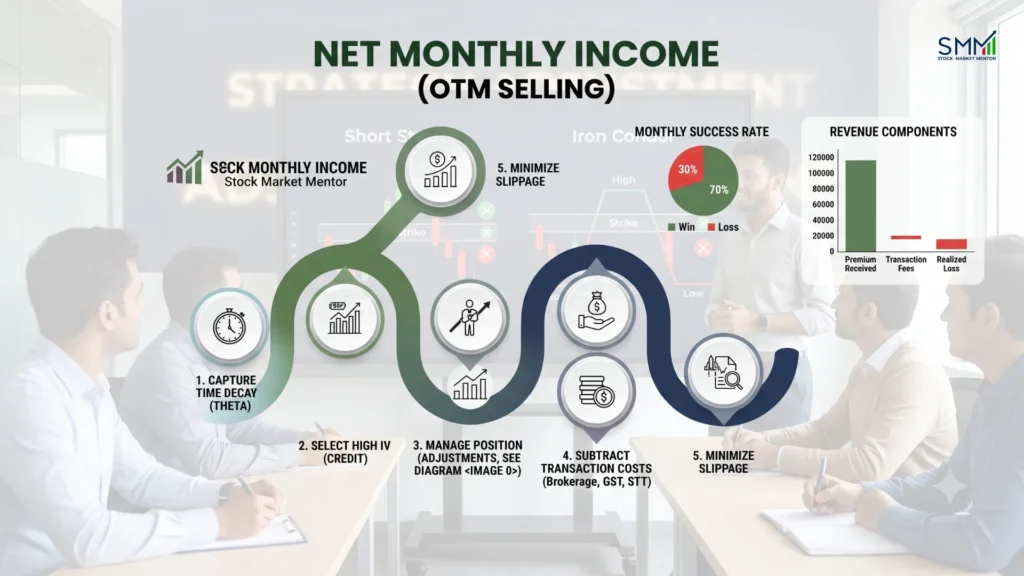
A Realistic Return Framework – With a Worked Example
A premium collected is not your return. Your actual number is:
Net return = Realised P&L − brokerage − STT − exchange/GST charges − slippage
A quick walkthrough (illustrative example, not a historical trade): say Nifty is at 25,000, and you sell a strangle, a 24,600 put and a 25,400 call, collecting ₹180 combined premium on one lot (65 units). Gross credit: ₹11,700. Nifty drifts to 25,150 by expiry; both legs decay, and you buy back the risk near expiry for ₹40 combined. Gross P&L: ₹9,100. Now subtract costs: brokerage, STT on the sell side, exchange charges, and GST. These vary by broker, turnover, and premium, but they’re rarely zero; even a modest per-lot cost can pull net P&L meaningfully below the gross number.
That gap looks small on one trade. Run four such trades a month and one adjustment-heavy losing trade, and costs plus one bad month can erase 30-40% of what the “gross premium” math promised.
This is why we tell our students at Stock Market Mentor to track net P&L from day one, not gross premium. It’s the only number that tells you whether a strategy is actually working. Instead of treating options strategies, technical indicators for trading, Greeks, hedging, expiry behaviour, and risk management as separate topics, they’re taught in a way that shows how they work together in real trading.

How to Evaluate an Option-Selling Strategy Before Trading?
Before putting real money into any trading strategy, check:
- Maximum drawdown
- Average win vs average loss
- Profit factor
- Worst losing streak
- Behaviour in volatile periods
Then do:
- Paper trading
- Forward testing
- Stress testing (what if Nifty moves 2% suddenly?)
Also maintain a proper trading journal:
- Entry/exit
- Strike selection
- IV and delta
- Reason for trade
- Adjustment decisions
Why Is Structured Learning Non-Negotiable for Option Selling?
Option selling is not just “sell a call or put and collect premium”. You need to understand:
- Greeks
- Volatility
- Option chain behaviour
- Market regimes
- Position sizing
- Adjustment logic
This is especially true for traders who search for Nifty option selling in Noida or look for nearby training options. Honestly, the city doesn’t matter as much as the quality of learning you get. What really counts is whether you’re being taught how strategies are actually built, when they tend to fail, how risk is controlled, and how adjustments are made in real market situations, not just theory.
For instance, Stock Market Mentor focuses on practical F&O learning where everything is connected. Instead of treating options strategies, Greeks, hedging, expiry behaviour, and risk management as separate topics, they’re taught in a way that shows how they work together in real trading. For instance, Stock Market Mentor focuses on practical F&O courses where everything is connected.
Option Selling Nifty Made Simple With Stock Market Mentor
Option selling in Nifty often looks very easy at first. You sell an option, collect a premium, and it feels like easy income. But anyone who has actually traded it knows the reality is very different. The moment the market starts moving sharply or volatility picks up, things can change quickly.
That’s why structured learning becomes important.Stock Market Mentor will teach you more than just the basics. We will educate you how options truly behave in the real market, how to adjust positions under pressure, and what professional risk management actually looks like in practice.
Disclaimer: This article is for educational purposes only and does not constitute investment advice, a recommendation, or a solicitation to buy or sell any security or derivative contract.