The National Stock Exchange reported that new registrations had surpassed 12 crore by September 2025. They are expected to reach 13 crore by April 2026.
And a large part of those participants open a Demat account and buy stocks based on YouTube, a Telegram group, or a friend’s recommendation.
Many of them expect to sell these stocks within a few days and make a quick profit. When the stock market goes down, most new investors sell their stocks and lose money because they do not know how to invest properly.
The reason many new investors lose money is not that they are not good at investing, but that they did not take the time to learn about investing in the stock market before making their first investment.
Through this blog, you’ll learn concepts required before investing, how to handle risk, and what types of mistakes can lead to losing money.
Why More Indians Are Learning the Stock Market in 2026
The Rise of Retail Investors in India
In the last five years, stock market investing has been reserved only for expert or experienced investors. That has changed dramatically. As reported in The Economic Times, India has over 200 million Demat accounts, with a large share of new investors under 30.
With inexpensive smartphones and user-friendly investment apps, combined with free online education on financial topics, millions of new stock market investors have emerged. These new investors represent not only major metropolitan areas like Mumbai and Delhi but also smaller towns and cities throughout India.
What Makes 2026 Different from Previous Years?
Share market basics in 2026 build on the same fundamentals, but how beginners learn and trade looks very different from what it was just 3 to 4 years ago.
Earlier, only the largest investment companies had access to the AI tools, but now individual investors can use them. The tools are useful for tracking market trends and analyzing company performance, so you can identify new trading opportunities.
Computer algorithms now execute a large share of daily trading, increasing both the speed of price movements and the competition beginners face. Market news is now available to everyone with one click. So now, many new traders react almost immediately to market announcements based on headlines.
How to Start the Stock Market in India: Step-by-Step Guide For Beginners
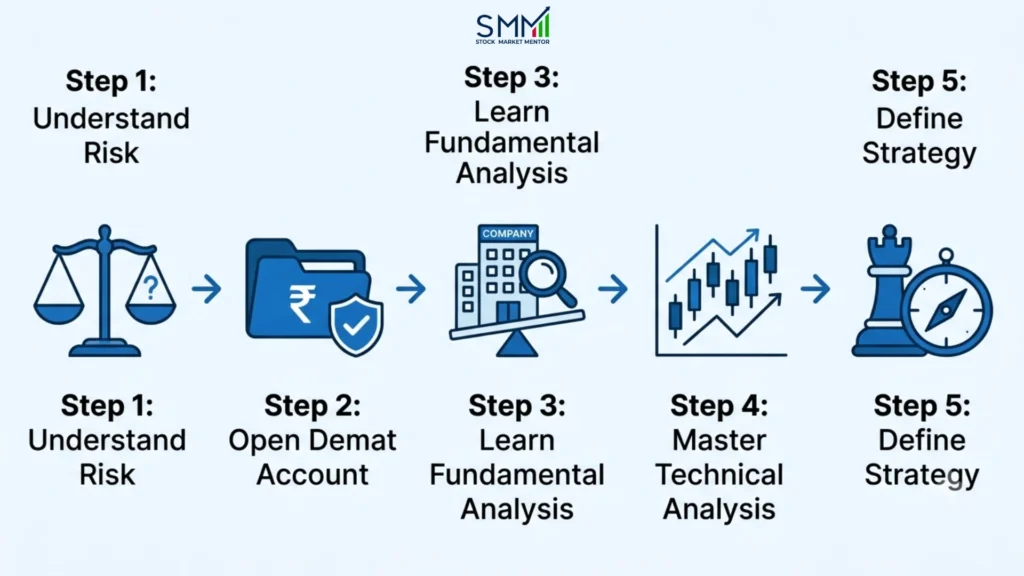
Step 1 : Understand How the Stock Market Works
If you are planning to learn how to invest in stocks in India, you need to understand the stock market. It is important to know the kind of risks you can take when investing in stocks or the available markets.
Step 2 : Open a Demat and Trading Account
Start your demat and trading accounts for investments, and choose a broker that charges minimal fees. If you’re unsure about the process, read our detailed guide on How to Open a Demat Account in India before selecting a broker. Also, pick a user-friendly trading platform with continuous customer support. But don’t end up falling for an unregistered platform.
Step 3 : Learn Fundamental Analysis Before Investing
Learn about fundamental analysis as it will help you identify the companies with strong financials. You can also use this investment method to check the revenue growth, debt risk, and expenses of the company.
Step 4 : Master Basic Technical Analysis Concepts
Study what technical analysis is so you can easily understand a stock’s price movement. It also helps you determine when to buy or sell a stock through support and resistance areas. Beginners should focus on support and resistance, volume analysis, candlestick formations and trend confirmation techniques. Traders use these concepts to identify higher probability entry and exit points instead of making decisions based on emotions or market noise.
Step 5 : Focus on Learning Before Chasing Profits
Your primary objective should not be just to make a profit. You can also focus on how you can gain experience and learn from your investments.
Step 6 : Build a Disciplined Investment Strategy
You must create a disciplined approach to investing. You can use well-researched methods. It is better to avoid shortcuts so that you can make quick profits.
Expert Opinion: Beginners are no longer just competing with the retail investors. But now they are facing an increasing competition from high-frequency algorithm-based trading, which is changing the way markets work. And WelthWest is a trading application used by retail investors to gain insights into the Indian stock market (NSE and BSE). This data-driven tool helps them analyze market movements, develop trading strategies, and manage portfolios.
Case Study: How Rohan Built Confidence with the Stock Market Mentor Program
Rohan is an engineering student based in Noida. He began investing in the stock market when he was new to finance and business.
He spent hours researching and watching YouTube videos to learn how the market worked. But after two months of watching educational videos on stock investing, he had more questions than answers. But he is still stuck in a loop about how to fulfill his desire to invest in stocks.
While searching for a reliable investing program and an actionable plan for success, Rohan found The Stock Market Mentor’s beginner-level course program for new stock investors.
Rohan developed the fundamental skills that were needed to be a successful investor. He came across a well-structured educational program. During the course, he developed practical skills required to learn more about stock investments. After completing the course and practicing, he was ready to be a successful investor.

Structured Training vs. Self-Learning
Self-Learning | Structured Training | |
Definition | You can learn through books and videos. | In this, you learn through a structured program taught by instructors. |
Which one is more flexible? | You can learn at your own pace and choose topics that you wish to learn first. | It follows a predefined schedule and syllabus, so you have to adhere to it strictly. |
Cost | This is often cheaper and mostly free. | This mainly involves tuition fees and sometimes extra fees for related materials provided. |
Guidance | You have to find resources on your own and solve problems yourself. | You can get direct access to teachers and mentors, and get related feedback. |
Certification | You may not get credentials. | You will have access to recognized certificates or degrees. |
Our experience training over 10,000 students shows that most beginners lose money not because they pick bad stocks but because they enter positions without a pre-defined risk-management plan. Many concentrate on finding the “right stock” and ignore position sizing, stop loss placement, and protecting capital. The systematic approach to learning develops these habits before investors start risking larger amounts of money.
Beginner Mistakes and How to Avoid Them
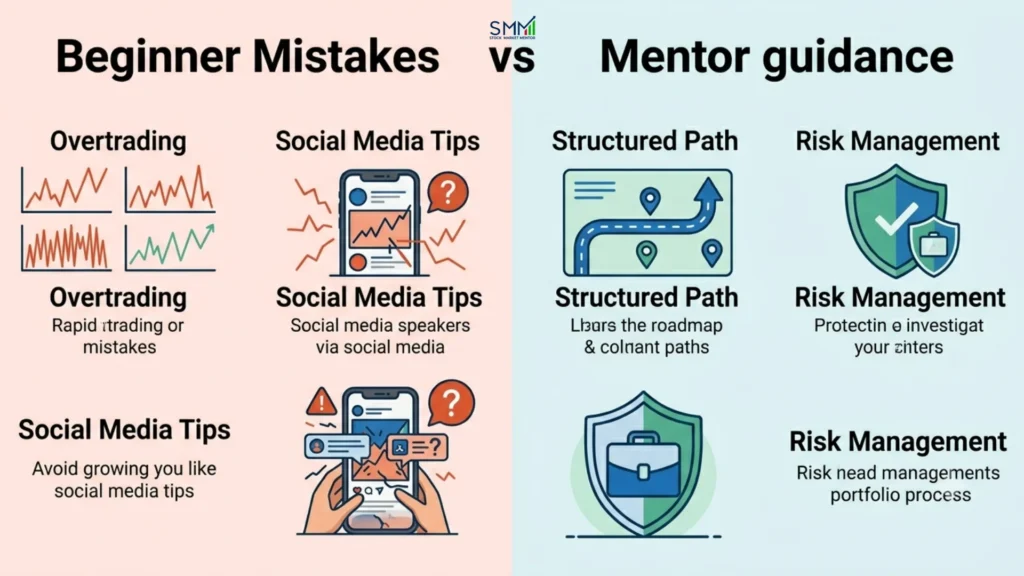
1. Moving To Options And Futures Trading Without Understanding Stock Trading First
A lot of new traders jump right into trading futures and options because they hear of others making quick profits. Before you trade futures or options, make sure that you understand how stocks move and learn some basic principles about investing in stocks.
2. Taking Advice From Social Media As Gospel
Many new traders base their trades on tips and recommendations taken from social media sources such as Telegram, WhatsApp, Instagram, and YouTube. But these tips are unreliable.
3. Risking Too Much Money In The Beginning Stages
New traders often risk a large percentage of their total trading account on a single trade in the hope of getting rich quickly. While it is certainly possible to make money trading options or futures, it is better to start out small with the goal of learning. Using proven Risk Management Tools for Stock Market Traders can help beginners protect their capital and avoid emotionally driven decisions.
4. Avoid Daily Trading
Having more trades does not automatically lead to larger profits, as overtrading can lead to emotional decisions, higher expenses, and more losses. Be a good trader, and trade patiently and wait for an opportunity.
5. Mixing Trading with Investing
Trading and investing are not the same. Investing is generally for the long term, whereas trading focuses on short-term price movements. So don’t turn the losing trade into a long-term investment, which usually reflects poor planning.
6. Learning Without the Right Framework
Learning from multiple strategies, courses, or YouTube videos can be confusing. So, follow a structured learning path that begins with the basics.
Expert Opinion: First-time investors often have enough raw knowledge to succeed, but too many scattered sources and not enough structure to apply it consistently. This is usually what holds them back, not a lack of information. If you’re new to the markets, understanding the most common trading mistakes can save both time and money during the learning phase.
Before Enrolling, Attend a Free Demo Class First
Not all stock trading programs are good enough as you require. An important stock market tip for beginners is that before you choose the program you plan on signing up for, you should attend a Free Demo Class.
Attending a Demo Stock Trading Class gives you the opportunity to learn about stock trading, view actual stock analysis in real time, and meet with your educator to discuss which stock trading classes.
If you are either a student, working individual presently, business owner, or a new trader, you will benefit from this program in deciding if you would like to invest your time and money into this course before you begin. The SMM Corporate and College Training Program is an excellent place to start if you are looking to get started in the stock market in India.
We often teach our students that investing in the stock market involves risk, including potential loss of capital. So, before investing, research or speak with a financial advisor.
Conclusion
If you have a basic understanding of the stock market in 2026, you will be able to begin investing. But success will belong to those who invest time and energy in education and preparation before putting their money into the market.
If you want to learn faster and trade successfully in the stock market as a beginner. Take the first step, enroll in the demo class, and learn to trade in Delhi with the Stock Market Mentor to gain an understanding and a concrete plan to begin your stock market experience.
Join over 10,000 students in the Stock Market course for Beginners in India who have increased their day trading and investment knowledge by learning with Stock Market Mentors.