

On September 21, crude oil slipped below $100 a barrel. The Nifty 50 gained 67 points, the rupee strengthened, and for a moment, the usual market story seemed to make sense. Cheaper oil should be good for India, right?
Then Tuesday told a different story. Crude was still below $100, but the Nifty fell 85 points. IT and financial stocks came under pressure, and the market moved lower anyway.
This is where the relationship between crude oil and the Indian stock market gets a little complicated. Crude doesn’t affect stocks on its own. A change in oil prices can increase or reduce India’s import bill, put pressure on the rupee, change inflation expectations and influence what investors expect from the RBI. Then there are company-specific and global factors that can easily push the market in another direction.
So, rather than looking at crude and the Nifty as two numbers that always move opposite to each other, let’s follow what happens in between. We’ll look at the crude-to-Nifty transmission chain, the sectors that feel oil prices most, why staying near $100 matters, and the signals worth watching when crude moves.
What Is Driving Crude Oil Prices in September 2026?
As of 5:11 am UTC (10:41 am IST) on September 23, Brent was trading around $98.14 a barrel, extending its slide after settling below $100 the previous day for the first time since September 8. A reminder that a single Brent number quoted without a timestamp is already stale by the time you read it.
On the supply side, the U.S. Energy Information Administration’s Short-Term Energy Outlook has flagged large global inventory drawdowns tied to Middle East disruptions, while U.S. Central Command reported the Strait of Hormuz oil and LNG flows hitting a six-month high after mine-clearance efforts.
On the diplomatic side, prospects of US-Iran talks around the UN General Assembly have capped further upside. That’s why crude can fall sharply even while the underlying geopolitical risk hasn’t gone away; markets are pricing expected future supply, not just today’s barrel count.
Why Crude Oil Matters So Much to the Indian Stock Market?
India meets the overwhelming majority of its crude requirement through imports. According to the Petroleum Planning and Analysis Cell (PPAC), the official data body under the Ministry of Petroleum and Natural Gas, India’s crude oil import dependence stood at 88.7% for April–May of FY2026-27. Close to nine of every ten barrels an Indian refinery processes is bought from overseas.
Because crude is priced and traded in US dollars, every barrel imported creates dollar demand:
Crude price × USD/INR rate × import volume = India’s oil-cost exposure
A $100 Brent price doesn’t hit an Indian company the way it hits a US one, because the rupee leg of that equation can amplify or soften the shock depending on which way the currency is moving at the same time.
Rule of thumb: a sustained $10/barrel rise in crude typically widens India’s Current Account Deficit by ~0.4-0.5% of GDP, adds ~30-40 bps to headline CPI, and increases India’s net import bill by roughly ₹1.1-1.3 lakh crore ($13-15 billion) annually.
Want More Market Insights Like This?
How Crude Oil Prices Affect the Nifty and Indian Stock Market?
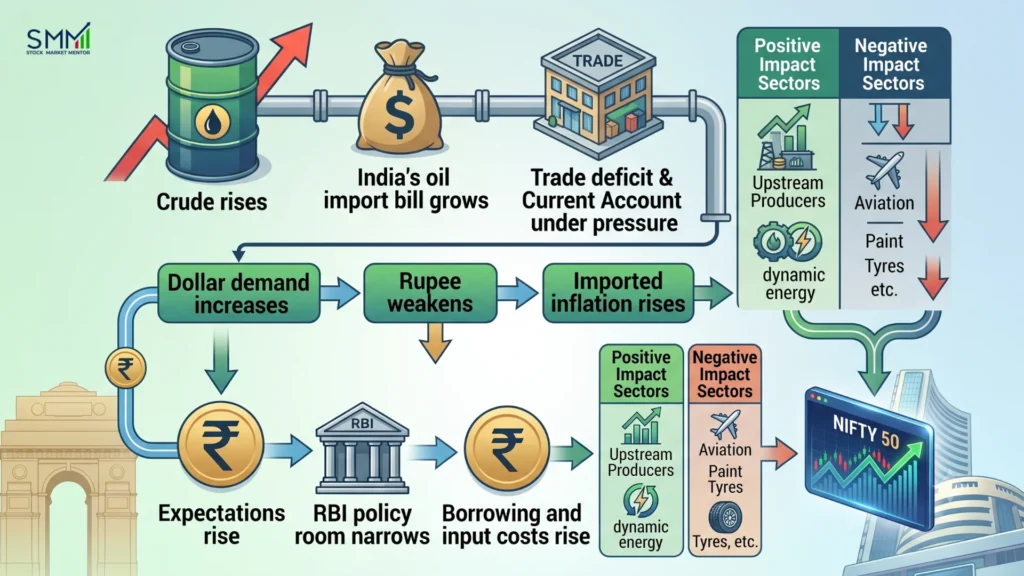
Oil rarely moves stock prices directly; it moves through a chain, and the current account is the bridge most people don’t know:
Crude rises → India’s oil import bill grows → the trade deficit and current account come under pressure → dollar demand increases → the rupee weakens → imported inflation rises → the RBI’s room to ease policy narrows → borrowing and input costs rise → earnings estimates get revised → valuations adjust.
The part that matters most: a company doesn’t need any direct exposure to oil for its stock to be repriced. A bank or an IT exporter can move purely through currency, rate expectations, or risk sentiment; no barrel of oil ever touches their balance sheet. For investors assessing oil-linked opportunities, understanding common mistakes to avoid in stock trading can help put short-term crude movements into a broader decision-making framework.

If Crude Oil Moves, What Should Indian Investors Watch?
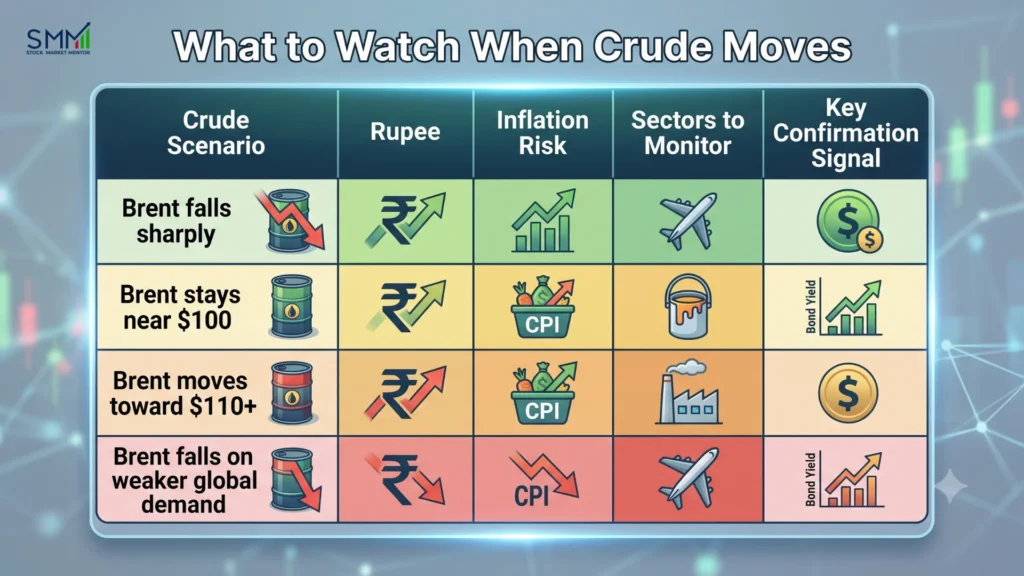
Rather than reacting to a single headline number, match the scenario to the right confirmation signal:
Crude scenario | Rupee | Inflation risk | Sectors to monitor | Key confirmation |
Brent falls sharply | Potential relief | Lower | Aviation, paints, tyres | USD/INR |
Brent stays near $100 | Depends on duration | Elevated | Fuel-sensitive sectors | CPI + RBI commentary |
Brent moves toward $110+ | Pressure likely | Higher | Aviation, logistics, OMCs | INR + bond yields |
Brent falls on weaker global demand | Could still improve import costs | Lower | Cyclicals may face growth concerns | Global PMI data |
The Five Questions to Ask Every Time Crude Moves
- Why is it moving? Supply, demand, geopolitics, or currency positioning each carry a different signal.
- How fast is it moving? A 2% daily wobble is noise; a sustained 15-20% move over weeks is a macro event.
- What is USD/INR doing at the same time? A weakening rupee can amplify an oil shock even if crude itself hasn’t moved much in dollar terms. Investors should also understand the broader principles of company analysis before investing when assessing how individual stocks may respond.
- Which sectors are actually exposed? When the price goes up, upstream producers, refiners and fuel consumers respond by reducing their demand.
- How long could it last? A one-day spike and a three-month plateau call for completely different responses. This is also why risk management tools for stock market traders can be relevant when crude-driven volatility increases.
“Retail traders tend to treat every crude oil headline the same way: buy the dip, sell the spike. What actually moves oil-linked positions is the combination of crude direction and rupee direction, not crude alone. That’s the first thing we check on the SMM desk before adjusting any oil-linked exposure,” says Rohit Sen, founder of Stock Market Mentor.

How Do Different Crude Oil Price Shocks Affect the Indian Stock Market?
Cause of the move | What it typically signals |
Strong global demand | Healthy global growth, often a net positive backdrop |
Supply disruption (e.g., pipeline attack) | A negative supply shock, cost-push, not demand-led |
Geopolitical risk premium | Uncertainty pricing, can reverse quickly if tensions ease |
Currency-driven (weak rupee) | Imported inflation risk, independent of global crude direction |
OPEC+ production decision | Deliberate supply management, usually a slower-moving signal |
Which Indian Sectors Are Most Affected by Crude Oil Prices?
Sector | When crude rises | Why |
Aviation | Negative | Aviation Turbine Fuel (ATF) is a major cost line |
Logistics & transport | Negative | Diesel is a direct input cost |
Paints & tyres | Negative | Petroleum-linked raw materials |
Chemicals | Negative | Naphtha and other crude-linked feedstock |
Cement | Mixed-negative | Fuel costs for kilns and freight |
Refiners (OMCs) | Mixed | Depends on refining/crack margins, not just crude level |
Upstream producers (ONGC, Oil India) | Potentially positive | Higher realised prices on crude sold |
IT exporters | Mixed | A weaker rupee (often crude-linked) can support export revenue |
Banks & NBFCs | Indirect | Move with inflation and interest-rate expectations, not crude directly |
Sector exposure is not the same as stock sensitivity. Hedging positions, inventory levels, pricing power, product mix, refining margins, and government intervention (fuel subsidies, price caps) can cause two companies in the same sector to react very differently to the same crude move. Two airlines or two OMCs are not interchangeable just because they share a sector label.
How Long Will $100 Crude Oil Impact Indian Stocks?
Duration at $100+ | Primary concern |
A single session | Sentiment and short-term volatility |
A few weeks | Import bill pressure, refining margins |
Several months | Inflation, current account, RBI policy stance, bond yields |
$100+ paired with a weak rupee | Amplified pressure across all of the above |
The RBI’s Monetary Policy Committee maintained the repo rate at 5.25% in its Aug 3-5, 2026 meeting, keeping a neutral stance but cautioning that energy costs were a danger to the inflation outlook. Its next scheduled review is October 5-7, 2026, worth marking if crude stays near $100 into that window.
Brent vs WTI vs MCX Crude: What Should Indian Investors Track?
- Brent crude: the global benchmark most relevant to India’s import bill, since most Indian crude purchases are priced off it.
- WTI (West Texas Intermediate): the US benchmark; moves with Brent but reflects US-specific supply and inventory data.
- MCX crude oil futures, traded on the Multi Commodity Exchange, are quoted in rupees per barrel and cash-settled against NYMEX WTI, converted using the RBI’s reference USD/INR rate.
An Indian trader checking crude oil trading today on MCX is really watching a rupee-converted WTI number, not Brent, which is why MCX crude and India’s actual import cost can diverge slightly even on the same day. Always confirm live lot sizes and margins directly on mcxindia.com, since these are revised periodically.
Please note: India doesn’t actually pay the Brent price. Its real import cost is the Indian Crude Basket, a PPAC-tracked blend of Sour (Oman/Dubai) and Sweet (Brent) grades, roughly 77:23. Discounted Russian Urals purchases since 2022 have kept India’s landed cost meaningfully below headline Brent.
Primary Sources for Tracking Crude and Indian Markets
Source | Best used for |
India’s crude import dependence, Indian crude basket price, petroleum consumption data | |
Monetary policy stance, repo rate decisions, USD/INR reference rate | |
Live Indian crude oil futures, lot sizes, margin requirements | |
Nifty levels, equity market data, index composition | |
Sensex levels, market statistics | |
FPI/FII flow data, investment adviser verification |
If you’re researching crude oil stocks in India or figuring out how to buy crude oil stocks in India, cross-checking a company’s crude oil share price in India against the official Brent/WTI number, rather than relying on the headline alone, is what separates an informed decision from a reactive one.
Final Thoughts
Crude oil will always matter to India because so much of the country’s oil is imported. But its effect on the crude oil and Indian stock market relationship isn’t as simple as oil going up and stocks going down. The rupee, inflation, interest rates, sector exposure, and how long crude stays elevated all matter. That’s the bigger picture worth keeping in mind. At Stock Market Mentor, market analysis is about looking at these connections rather than reacting to one headline. The same approach can help you understand what an oil move actually means before drawing conclusions from it. Investors should also consider the risks of investing in global markets when assessing how international commodity and geopolitical developments can affect Indian equities.
Disclaimer: This article is for educational and informational purposes only and does not constitute investment advice, a recommendation, or a solicitation to buy or sell any security or commodity.