

When people hear “Delhi economy,” they often think of government, services, or tourism. But local economic trends here ripple into India’s biggest stock indexes, the Sensex and Nifty. Traders and investors track Delhi closely because what happens here matters for money flows, corporate profits, and market sentiment.
In this blog, we will look at fresh data, link it to market moves, and show you what to look out for in the market.
Delhi’s Economic Pulse
Cooling Inflation
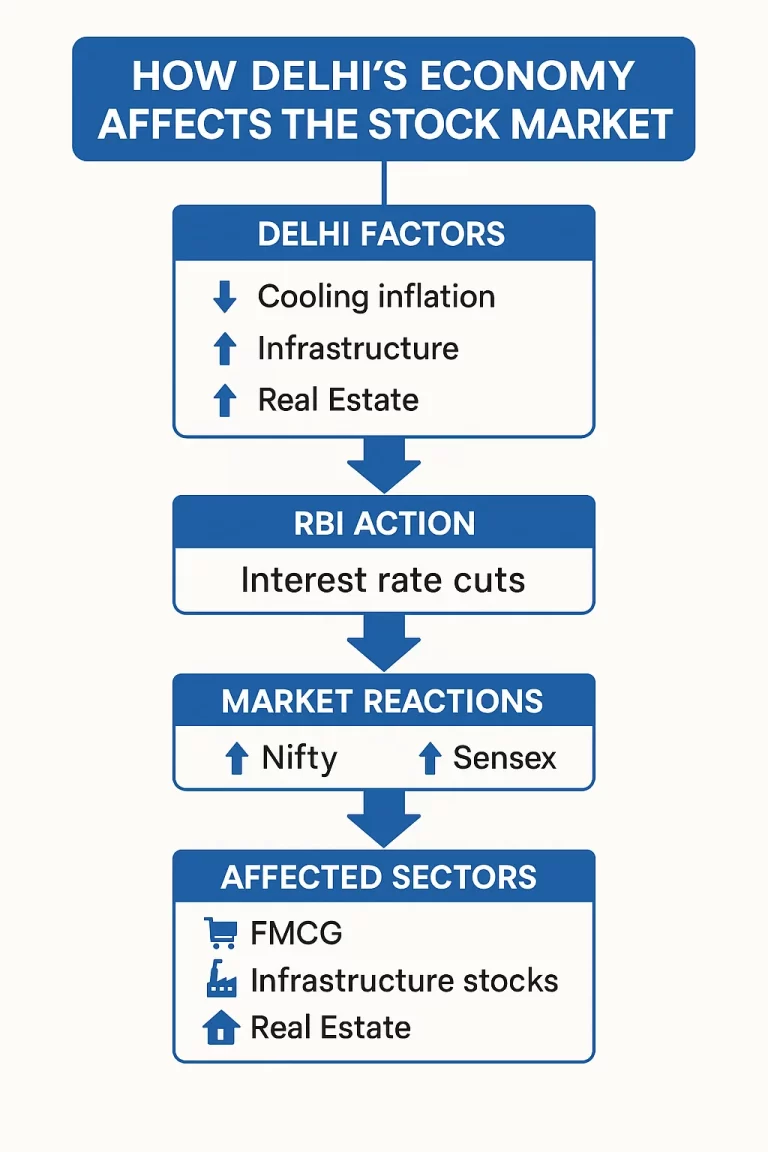
In June, India’s retail inflation hit 2.10%, a six‑year low, thanks to falling food prices like vegetables, down 19% from last year. Lower grocery expenses in Delhi eased the pressure on everyday expenditure. This contraction in the Delhi economy lowers living costs and enhances consumer confidence, which is a positive indication for stocks that rely on local demand.
Infrastructure Momentum
The metro lines are expanding fast. The Pink Line loop (Majlis Park–Maujpur) is nearing completion, and three new corridors to India Gate, T1 airport, and Kalindi Kunj have cabinet nod and ₹11,150 crore in funding. Infrastructure growth like this feeds directly into the economic health of the city.
Real Estate & Rentals
While rental inflation in major cities has moderated to 7-9%, some areas near new metro routes are seeing greater price increases. To stimulate growth, the Delhi Development Authority has decreased commercial property taxes from 10% to 1%. This regulatory shift positions the real estate sector for growth and quicker project rollouts, hence increasing commercial development and demand.
How the Delhi Economy Sends Signals to the Stock Market
Monetary Policy & Investor Response
Lower inflation gives the RBI space to cut interest rates, which directly affects the impact of inflation on stock market performance. In June, it cut the repo rate by a full 50 basis points to 5.5% and lowered the cash reserve ratio by 100 bps. Markets responded positively and the Sensex jumped 317 points and Nifty surged past 25,150 on July 15. Lower interest rates cut borrowing costs, boost corporate earnings, and increase market demand for risky assets.
Infrastructure Spending Boosts Stocks
Metro works and real estate policies benefit construction, cement, and infrastructure companies. As Delhi spends extensively on rail and road infrastructure, companies in these sectors appear to be gaining traction. Real estate regulations and urban expansion also drive growth in commercial property and related businesses.
Consumer Demand Impacts Retail and FMCG
With inflation low, families in Delhi have extra cash to spend on daily goods. Retail and FMCG companies benefit. Footfall in metro-accessible retail areas has increased, supporting stocks in those sectors. As retail consumption improves, so do earnings for national chains and packaged‑goods firms. If you’re still learning how to connect the dots between the economy and stock movements, Stock Market Mentor’s top-rated stock market course in Delhi can help.
Investor Sentiment and Market Moves
Domestic vs Foreign Flows
While foreign institutional investors (FIIs) have been volatile, sometimes pulling out due to global uncertainty, domestic investors (DIIs) have provided a base. Now that inflation is easing and the RBI is proactive, FIIs are coming back again. This stabilisation in capital flows supports the broader market rallies.
Delhi’s Role in Retail Investing
As the Delhi economy strengthens, more residents open trading accounts and invest via SIPs. That retail momentum helps small and mid‑cap stocks. Retail momentum supports small and mid-cap equities. Local consumer excitement transcends to rural and national purchase patterns, bolstering a broader market boom.
Short‑Term Global Shocks
Strong local data doesn’t shield us from global hits. US inflation, tariff tensions, and Fed policy can all shake Indian markets. However, Delhi’s resilience helps mitigate some of those effects, particularly with regard to infrastructure and inflation.
Delhi Economy vs Pan‑India and Global Market Trends
Alignment with National Trends
In the fourth quarter (January-March), India’s GDP increased by 7.4%, with construction and manufacturing leading the way. This is consistent with Delhi’s infrastructure push and real estate boom, enhancing investor confidence in infrastructure stocks in India. However, Delhi acts as a leader: local momentum often mimics national performance, especially in urban growth areas.
Global Spill‑Over Effects
Global economic issues, like rising US rates, trade tensions, or China slowdowns, affect capital flows everywhere. India’s central bank now takes a ‘neutral’ tone after aggressive rate cuts, and warned it would pause due to global uncertainty. However, strong local indicators, such as Delhi’s inflation hold, might reduce these global pressures.
What Investors Should Watch
- Inflation Trends in Delhi: Sharp actions imply RBI action.
- Metro and infrastructure update includes permissions and developmental milestones.
- Some real estate policies also integrate strategies like reduced amalgamation fees.
- Retail footfall data captures the activity of customers within shops and shopping centers.
- Capital flows (FIIs, DIIs) are useful indicators of market sentiment shifts.
- Global developments include US Fed movements, tariffs, and other triggers.
By combining these local Delhi economy signals with national macro data and global cues, investors can better time entries and exits across sectors.
Why the Delhi Economy Matters More Than You Think
The Delhi economy has an impact on not only local GDP but also RBI policy, investor sentiment, and national market patterns.
Tracking inflation, infrastructure, real estate, and retail shifts in Delhi, as well as global cues, provides you with better market insights.
If you’re still learning how to connect the dots between the economy and stock movements, Stock Market Mentor can help. Our courses break down the tough stuff, like inflation impact, sector rotation, and big-picture signals, into things you can actually use.
With real charts, live sessions, and step-by-step mentorship, you’ll learn how to turn insights like these into clear, confident trading decisions.