You sit in front of your screen for hours, tracking charts, waiting for that one perfect setup. Then you step away for a minute, and the move happens without you. Or you jump into a trade too quickly, and it goes the other way. This is a common struggle for traders who depend on manual decisions every day. It’s tiring, and mistakes add up.
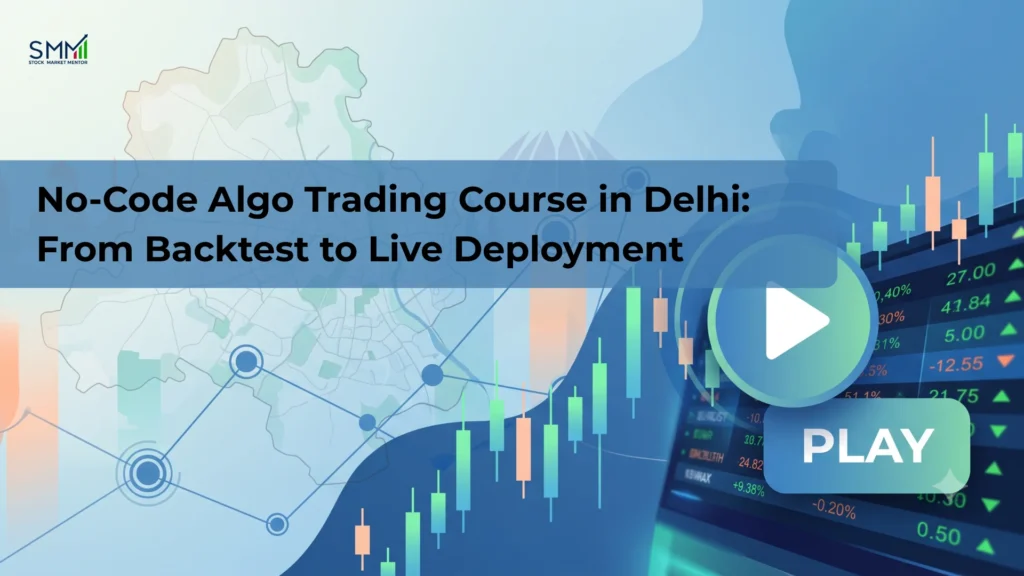
Now, things have changed. You don’t need coding skills to automate your trades anymore. A no-code algo trading course in Delhi shows you how to create rule-based strategies using simple tools. You set the logic, and the system handles execution.
In this blog, we’ll break down how this works, what you’ll learn, and how you can move from idea to live trading step by step. If you’re new to algorithmic trading, start with our Algo Trading Decoded guide to understand the basics before building your first strategy:
Data: QuantInsti’s 2026 research of NSE data shows automated involvement across NSE sectors to be as high as 73% in stock futures, a good stat to indicate that algo trading is no longer a minority or isolated method; it’s how the majority of futures activity is already being performed.
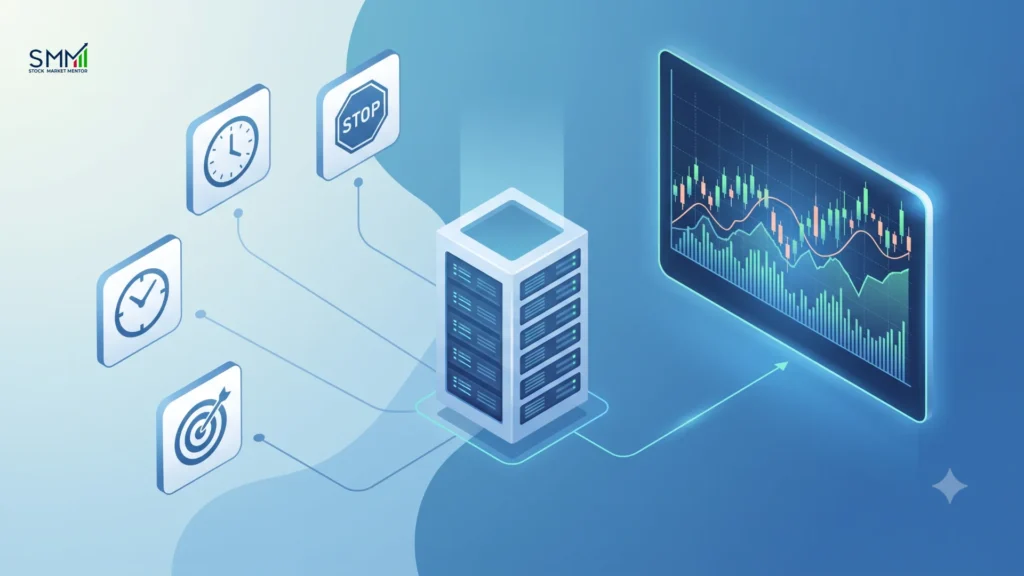
What Is a No-Code Algo Trading Course?
A no-code algo trading course in Delhi is just a way to learn algorithmic trading without using coding. You don’t need to learn Python or any programming language. Instead, you use simple tools where you build strategies by selecting conditions and connecting them visually.
Back in the day, algo trading seemed like something only the huge companies or the tech-savvy traders could do. Now, with modern automated trading platforms, even someone with basic market expertise can get started designing and testing strategies.
Understanding No-Code Algorithmic Trading
At its core, algorithmic trading just means placing trades based on rules instead of emotions. These rules determine things like:
- When to enter a trade
- When to leave
- How much money to spend
- Placing stop loss and targets
In no-code trading, you don’t write these rules in code. You just pick them from alternatives and link them with a drag-and-drop strategy builder.
For example, you do something like:
- Buy when the 20-day moving average crosses the 50-day moving average.
- Exit when RSI goes above 70.
- Risk only 2% of your capital per trade.
Once you set this up, the no-code trading platform handles everything. It watches the market and executes trades exactly as per your rules. No second-guessing, no panic decisions.
No-Code vs Traditional Coding-Based Algo Trading
Both approaches aim to automate trading, but they’re meant for different kinds of people.
Feature | No-Code Trading | Coding-Based Trading |
Programming knowledge | Not needed | Required |
Strategy creation | Visual setup | Written code |
Learning curve | Easier to start | Takes time |
Speed of development | Faster | Slower |
Best suited for | Beginners, traders | Developers, quants |
Who Should Enroll In This Course?
A no-code algo trading course in Delhi isn’t just for one type of person. It fits a lot of different people depending on what they’re trying to do.
- Beginners who want to get into trading without getting stuck in technical stuff.
- Manual traders who are tired of staring at charts all day and want to automate their setups.
- For people who work or don’t have time to follow the markets, yet wish to trade.
- For investors who like to decide by the rules, not by the news or their feelings.
- Students who are curious about markets and want to learn something practical.
- Options traders who deal with complex setups and want faster, more consistent execution.
Take the First Step Toward Automated Trading
What You'll Learn in a No-Code Algo Trading Course in Delhi
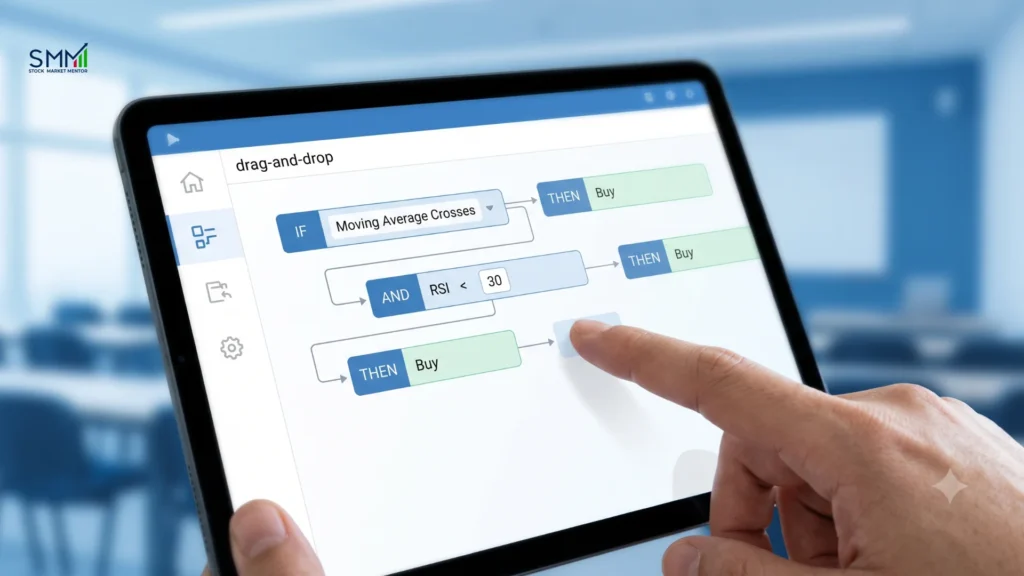
A good course not only shows you how to click buttons on a platform. It helps you understand how strategies actually work in real life and how to judge whether they’re worth using. If you’re just getting started, read our guide on Technical vs Fundamental Analysis: What to Learn First to understand which approach best suits your trading goals.
Algorithmic Trading Fundamentals
You’ll start with the basics: what algo trading is, how it works, and why it’s becoming so popular in algo trading in India. You’ll learn about things like trends, volatility, liquidity and how transactions actually get done in the market.
Market Structure & Order Types
Before you design anything, you need to know how the market behaves.
You will learn about the many types of orders: market orders, limit orders, stop-loss, stop-limit, and when to use them. You will also see phrases like bid-ask spread, slippage, and liquidity. These might sound technical at first, but they matter a lot when your strategy goes live.
Building Strategies Without Programming
This is where things start getting interesting.
Using a drag-and-drop strategy builder, you’ll create your own trading setups by combining different conditions. For instance:
- Never take a trade without trend and momentum on your side.
- Exit on stop-loss or target automatically.
- Avoid investing during times of higher volatility.
Technical Indicators
Indicators are tools that help you understand what the market is doing.
- Moving Average: Eliminates sharp price moves to reveal the trend. Crossovers are widely employed in the signal.
- RSI (Relative Strength Index): Tells us if a stock is overbought or oversold. Helps to find potential reversals.
- MACD: For trend & directional momentum. Typically used by traders as confirmation.
- Bollinger Bands: This will offer you an indication of volatility. Touching the bands in some cases, mean continuance, and in others, reversal.
- VWAP (Volume Weighted Average Price): Very popular among day traders. It provides the average price based on volume and helps to discover who is in control buyers or sellers.
Risk Management & Position Sizing
You’ll learn how much to risk per trade, where to place stop-loss, and how position sizing affects your overall performance. Even a good strategy can fail if risk isn’t managed properly. This part is what keeps you in the game long-term.
Strategy Optimization
Once your strategy is built, the next step is improving it. You’ll learn how to tweak things without overdoing it. Changing too many parameters can make a strategy look perfect on past data but fail in real markets.
Performance Metrics
Just because a strategy makes money doesn’t mean it’s good. You’ll learn how to measure it right with metrics like:
- Win Rate: The percentage of winners on the deals.
- Profit Factor: The entire profit divided by the entire loss.
- Maximum Drawdown: The largest decline in your capital.
- CAGR: Annual Growth Rate.
- Sharpe Ratio: Risk-adjusted return.
Expert Insight: In Stock Market Mentor’s Algo Trading Decoded curriculum, expectancy and maximum drawdown are taught as a pair, not separately. A strategy’s expectancy tells you whether it should make money over time, while its MDD tells you whether you can psychologically and financially survive the drawdown period long enough to see that expectancy play out. Traders who only chase win rate or CAGR, without checking MDD alongside it, often abandon perfectly good strategies right before they recover.
If you’re interested in building a strong foundation in options before automating your trades, explore our Option Trading Course for practical, market-focused learning.
Why So Many Beginner No-Code Strategies Fail Despite Profitable Backtests?
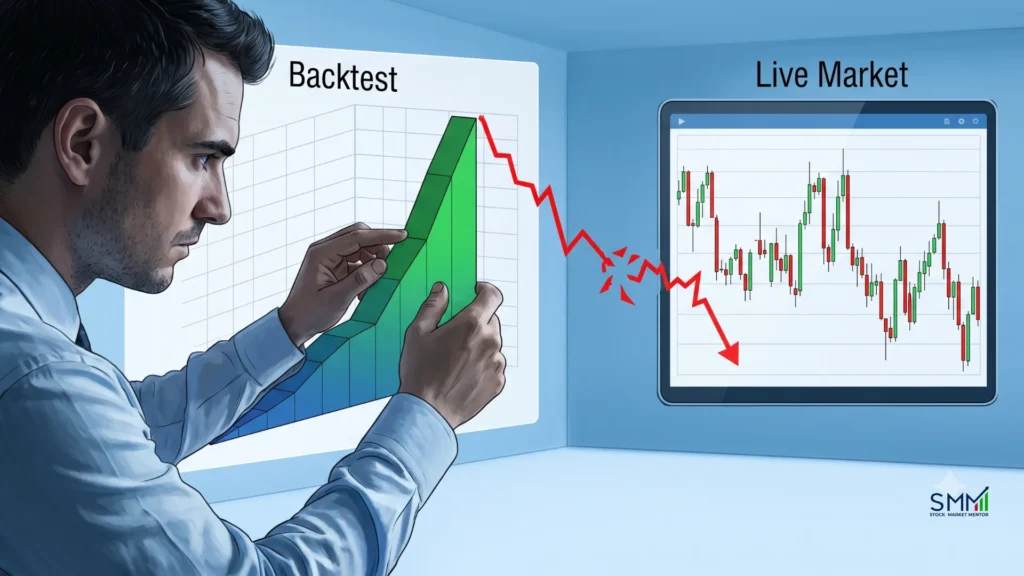
So why does a great-looking backtest so often fall apart live? Usually it comes down to a few things:
- You’ve over-tweaked the strategy until it fits the past perfectly, which really just means it learned the noise, not a real pattern.
- Your backtest probably didn’t account for brokerage, slippage, and impact cost the way real trading will.
- You never tested it on data it hadn’t seen before, so you don’t actually know if the edge is real.
- The market conditions it was built on have since changed, what worked in a calm, trending market can fall apart the moment volatility picks up.
- And live execution just isn’t as clean as a backtest assumes: fills, delays, and position sizing all behave differently with real money on the line.
Before you trust any backtest, ask these three questions:
- Does it account for real costs?
- Does it hold up on data it hasn’t seen?
- And does it fall apart if nudged one input by 10%?
If you can’t answer yes to all three, you don’t have an edge yet.
From Trading Idea to Live Deployment: Complete Learning Journey
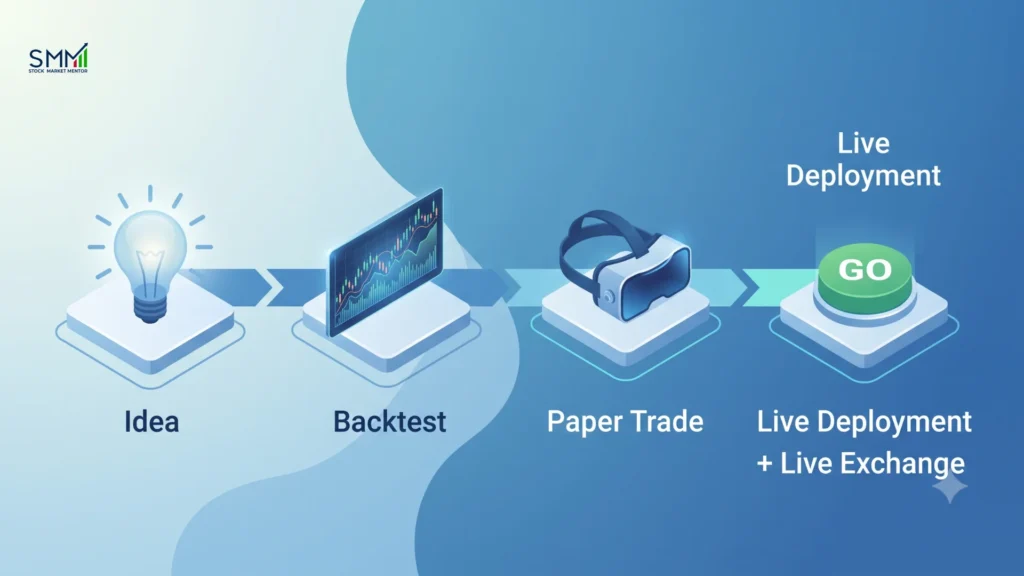
A smart trading strategy does not just arise out of nowhere. It takes time, testing and a little patience before you can risk real money on it. A lot of beginners skip the steps and jump straight into live trading, and that’s usually where things go wrong.
A better way to approach it is simple:
Idea → Backtest → Paper trade → Live deployment
Let’s break that down in a practical way.
Step 1: Start with a Trading Idea
Every strategy begins with something you’ve noticed. Maybe you’ve seen that a stock tends to move up after breaking the previous day’s high with strong volume. Or maybe you’ve observed that option selling works better when the market is calm.
Step 2: Turn That Idea into Rules
Here you only need to define things like when to enter, when to quit, your stop-loss, target and how much capital to spend.
You can also use a combination of conditions. For example, you may say: only take a trade if the trend is up, RSI is high and the volume is over average.
Step 3: Test It with Algo Strategy Backtesting
Once your rules are set, the next stage is this.
This just means checking how your strategy would have performed in the past using historical data. Instead of guessing, you get actual numbers.
You’ll start to see things like:
- How many trades it took.
- Whether it made money overall.
- How much risk it carried.
- Whether results were consistent or all over the place.
Step 4: Look Beyond Just Profit
A strategy might show great returns but also go through huge losses in between. That’s not something everyone can handle.
Instead, look at the full picture, win rate, drawdown, consistency, and overall risk. A steady strategy is usually better than one that looks amazing on paper but is stressful to trade.
Step 5: Move from Paper Trading to Live
Even if your backtest looks great, don’t rush. The smarter move is to go from paper trading to live.
Paper trading is a way to test your strategy in real time without using real money. This is where you see the real-world problems like slippage, execution delays or abrupt market movements. Most experienced traders spend a decent amount of time here before going live.
Step 6: Go Live (But Start Small)
Once you’re confident, you can connect your broker and deploy the strategy. But don’t go all in immediately.
Start small. Watch how the strategy behaves with real money. Even a good system needs monitoring once it’s live.
Step 7: Keep Monitoring and Improving
Track your results and compare back to your backtest. Don’t panic out if something doesn’t feel right. Watch and adjust if you need to.
If things are working well, you can slowly increase your capital.
Expert Insight: A well-run algo trading curriculum spends as much time teaching you what not to trust in a backtest as it does teaching you how to build one. At Stock Market Mentor’s Algo Trading Decoded program, this is treated as a core skill area rather than an afterthought.
Avoid the Biggest Mistake in Algo Trading: Overfitting Warning
One of the biggest traps beginners fall into is trying to build the “perfect” strategy. That usually leads to something called overfitting.
What Is Overfitting?
Overfitting happens when you tweak your strategy again and again until it looks perfect on past data. The problem? Markets don’t behave the same way every time.
So a strategy that looks amazing in backtests first can completely fail in live trading.
Why Great Backtests Can Still Fail
Backtests only show what happened in the past.
Live markets are different. There’s news, sudden volatility, liquidity issues, and execution delays.
So even if your backtest looks impressive, it doesn’t guarantee future performance.
Signs You Might Be Overfitting
Watch out for these:
- Very high returns with almost no drawdown.
- Too many indicators or conditions.
- Constant tweaking just to improve results.
- Strategy works in backtest but struggles in paper trading.
How to Avoid It
Keep things simple.
Test your strategy on data it hasn’t seen before (out-of-sample testing). You can also try walk-forward testing across different time periods.
And most importantly, don’t skip paper trading.
Popular No-Code Algo Trading Platforms You'll Learn
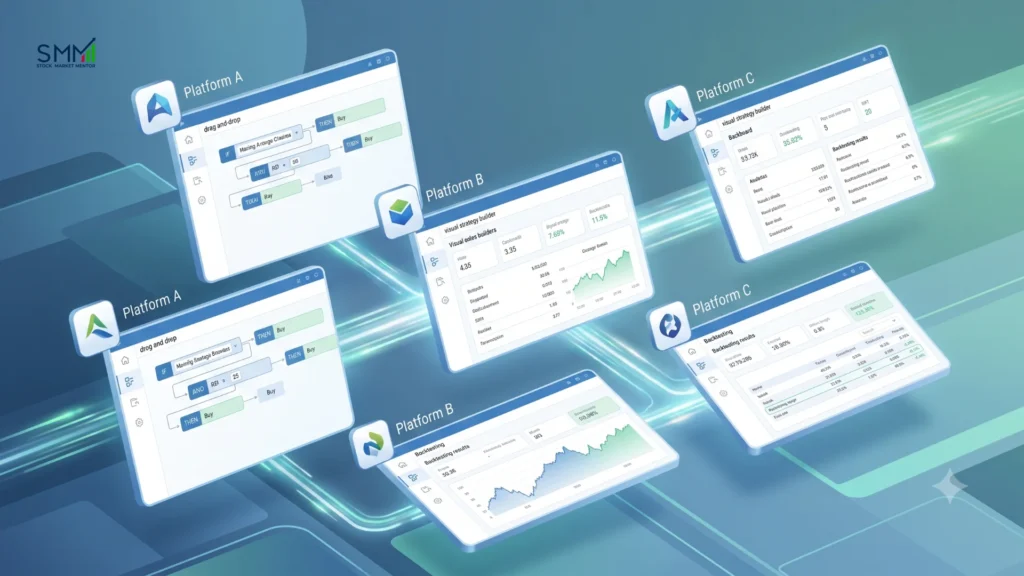
Most good courses don’t limit you to just one platform. You’ll usually get exposure to tools like Tradetron, Streak, AlgoTest, Quantiply, TradingView automation, and broker-based systems.
Comparison of No-Code Platforms
Platform | Best For | Live Deployment | Backtesting |
Tradetron | Beginners & Advanced Traders | Yes | Yes |
Streak | Beginners | Limited | Yes |
AlgoTest | Options Traders | Yes | Yes |
Quantiply | Active Traders | Yes | Yes |
You can verify which algo platforms are currently exchange-approved directly on NSE’s own list of empanelled algo providers, a genuinely useful step before you commit to learning any one platform, no-code or otherwise.
How to Choose the Best No Code Algo Trading Course Delhi?
- Look for one that actually lets you practice, live sessions, real algo strategy backtesting, paper trading, and strategy deployment.
- Watching videos is fine, but hands-on experience is what really helps.
- Mentor support also matters. Being able to ask questions and get feedback can save you a lot of time.
- If the course offers an algo trading certification, that’s a bonus. It won’t make you a pro overnight, but it does show you’ve gone through structured learning.
- Also, make sure the content is up to date. In February 2025, SEBI issued its circular on safer participation of retail investors in algorithmic trading, and after a phased rollout through 2025, the framework became fully mandatory for all stockbrokers from April 1, 2026. Markets and tools change fast.
Common Mistakes Beginners Make in Algorithmic Trading
Some common mistakes are:
- Chasing unrealistic returns.
- Ignoring risk management.
- Adding too many indicators.
- Skipping paper trading.
- Going to live with too much capital.
- Another big one is changing strategies too quickly after a few losses.
Join Our No Code Algo Trading Course Delhi
A good course can make things a lot clearer. Look for one that gives you flexible timings, online access, live market sessions, and someone you can actually reach out to when you’re stuck.
The idea isn’t just to understand concepts. You should be able to build your own strategy, test it, and see how it works in real conditions.
That kind of hands-on learning is what really helps when you start trading on your own. If you’re checking out options, Stock Market Mentor is one place where the focus stays on practical learning and real market experience.
No Code Algo Trading Course Delhi: Learn the Right Way with Stock Market Mentor
Choosing a no-code algo trading course in Delhi isn’t just about learning how a platform works. It’s more about understanding how to build a strategy that can handle real market situations. A lot of traders jump in without a defined plan and make the same mistakes. If you approach step-by-step, it’s easier to manage risk, and you can be consistent. If you want to learn by doing practically, rather than just watching, Stock Market Mentor focuses more on practical learning and real market examples. Take your time, keep practicing and let your transactions follow a plan.
Disclaimer: This article is for educational and informational purposes only and does not constitute investment, trading, or legal advice. Stock Market Mentor does not provide tips, advisory services, PMS, or account management services; it is solely an education brand.