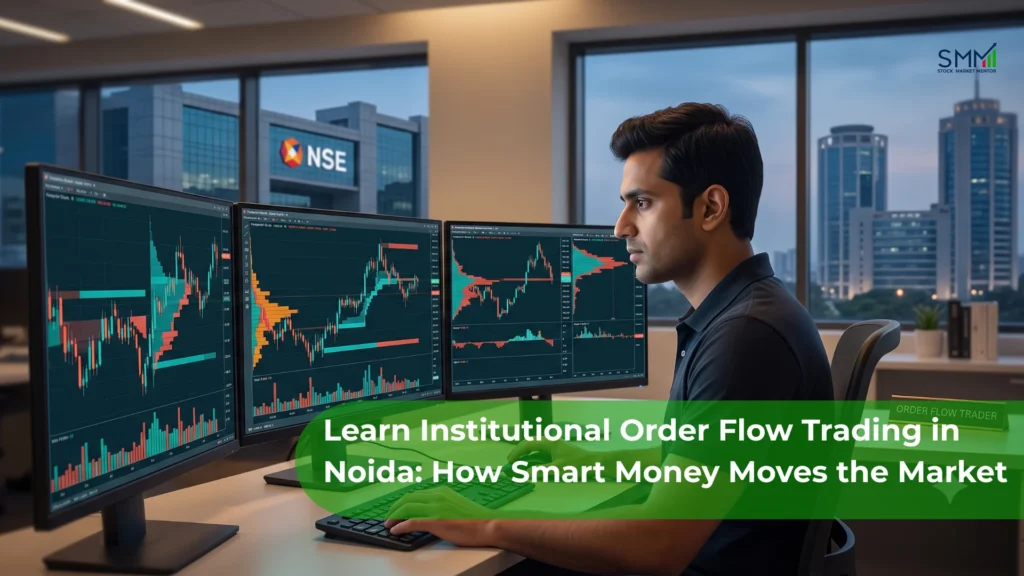
A software engineer had been searching for the right order flow trading course in Noida after one frustrating trading session changed the way he looked at the market. Like many beginners, he had spent months learning chart patterns, adding indicators, and watching YouTube videos. Some trades worked, but most ended the same way. His stop-loss would get hit first, and then the market would move exactly in the direction he had expected. It happened so often that he stopped blaming bad luck and started asking a better question: What are professional traders seeing that I’m not?
The answer wasn’t another indicator or a new strategy. It was understanding how institutions actually trade. Large players focus on liquidity, order execution, and market structure, while most traders merely check pricing. This is why understanding order flow has become so important for traders who want to get a sense of what’s happening behind every move. If you’re exploring different stock market courses, order flow is one of the most practical skills to learn.
In this blog, we’ll learn the smart money concepts, order blocks, as well as the lquidity grab patterns, so you can understand how institutional traders read the market and how you can apply the same thinking to your own trades.
A study by the Securities and Exchange Board of India, its “Comparative Study of Growth in Equity Derivatives Segment vis-à-vis Cash Market After Recent Measures” (July 2025), found that net losses of individual traders in the futures and options segment surged 41% year-on-year to about ₹1,05,603 crore in FY24-25 from ₹74,812 crore in FY23-24. The study covered close to 9.6 million individual investors and found that roughly nine out of ten of them ended the year in the red, with average per-person losses of about ₹1.1 lakh, the second straight year SEBI has recorded this pattern.

What Is Institutional Order Flow Trading?
In simple terms, institutional order flow trading is about understanding how the large players enter and exit the markets.
We’re talking about banks, hedge funds, prop firms, the ones trading huge volumes. They don’t just click “buy” or “sell” like retail traders. Their orders are too big for that.
So what do they do?
They break their trades into smaller pieces and execute them over time. And while doing that, they leave behind clues, in volume, in price behavior, in how the market reacts.
Order flow is basically learning how to read those clues.
Instead of asking, “Which indicator should I use?”, you start asking:
- Who is active here?
- Where is liquidity sitting?
- Why did the price react at this level?
Who Are Institutional Traders?
These are the players who actually move the market:
- Banks
- Hedge funds
- Proprietary trading firms
- FIIs and DIIs
Because they deal with large amounts of capital, they can’t just enter anywhere. They need liquidity, meaning they need someone on the other side of their trade.
How Institutions Move the Market
Let’s say an institution wants to buy a large position. If they place everything at once, price will shoot up, not ideal for them.
So instead, they wait. They look for areas where sellers are available, often around stop-loss zones or breakout levels. That’s where they quietly build positions.
Recent data: According to NSE’s Market Pulse research series, algorithmic participation in the stock futures segment has risen from 39% in FY15 to 73% in FY26 (year-to-date), while algo share in equity futures has grown from 39% to 69% over the same period. Separately, industry estimates place overall algo trading’s share of Indian equity market turnover at over 50% as of 2026, though this still trails the roughly 80% global average.
This is why you often see:
- Fake breakouts.
- Sudden reversals.
- Sideways movement before big moves.
If you’re new to trading, it’s also worth understanding Technical vs Fundamental Analysis before moving to order flow.
Want to understand how institutions read the market?
Retail Traders vs Institutional Traders
Retail Traders | Institutional Traders |
Trade small sizes | Trade large volumes |
Follow indicators | Focus on liquidity |
React to moves | Plan ahead |
Emotional decisions | Structured execution |
Core Concepts You Learn in a Live Order Flow Trading Course in Noida
When people hear “order flow,” they often think it’s complicated. And yes, there’s a learning curve, but once you get it, things start to click. Here are some of the key concepts you’ll come across:
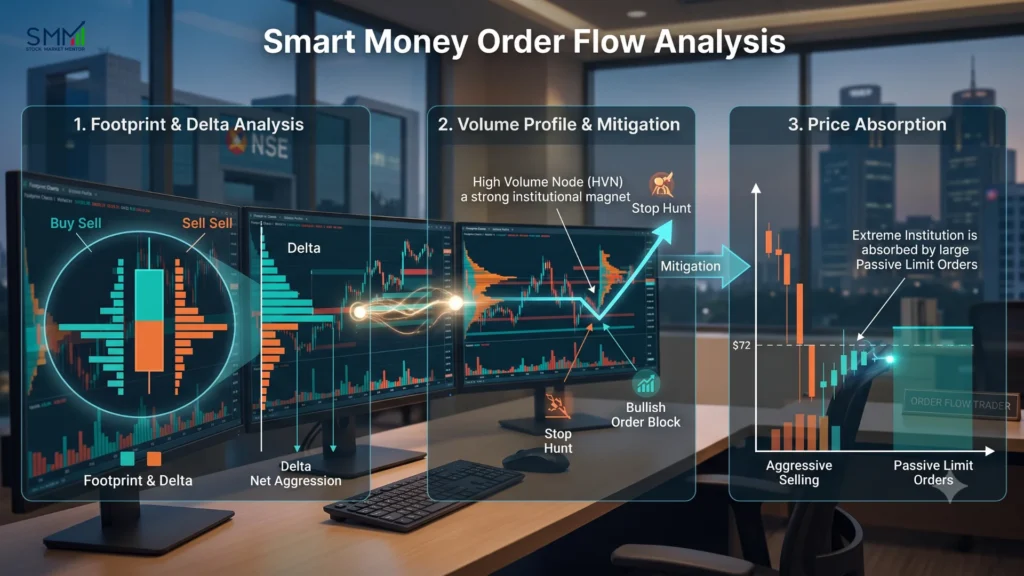
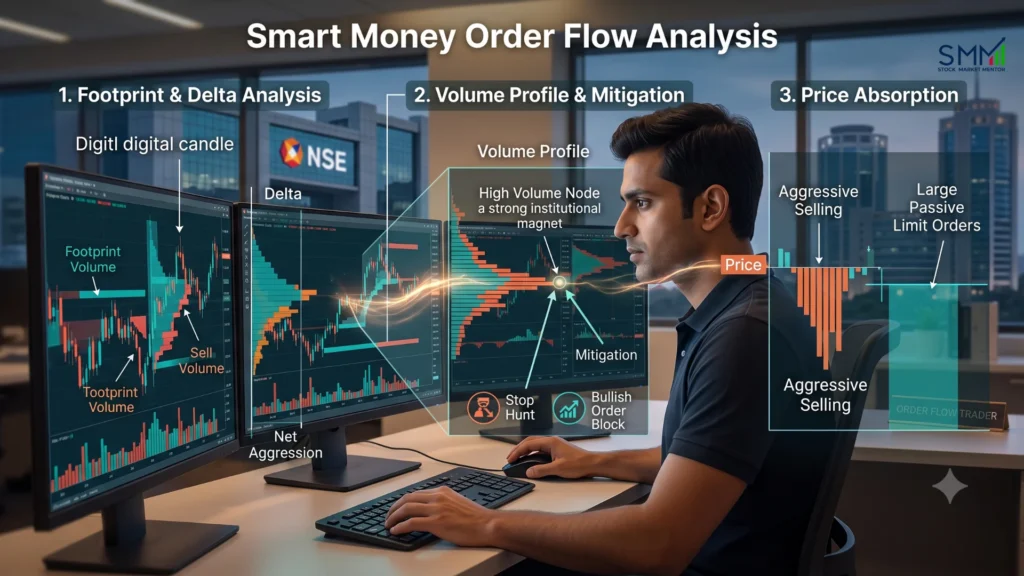
Footprint Charts
These show exactly how much buying and selling is happening at each price level. Instead of just seeing a candle, you see what’s happening inside that candle.
Volume Profile
This tells you where most trading activity has happened. These areas often act like magnets; price tends to react around them.
Market Profile
Helps you understand where the market is comfortable (balanced) and where it’s not. It gives a bigger picture of structure.
Delta Analysis
This shows the difference between aggressive buyers and sellers. It’s useful for spotting hidden strengths or weaknesses.
Order Book (DOM)
Shows pending orders, where buyers and sellers are waiting. It is a window into liquidity.
Liquidity Zones
These are areas where stop-losses and pending orders are clustered. Institutions often target these zones.
Absorption
When heavy buying or selling happens but price doesn’t move much, that’s absorption. This means someone big is active.
Imbalances
When one side (buyers or sellers) clearly dominates, price tends to move quickly.
Iceberg Orders
Large hidden orders that don’t show fully in the market. You won’t always see them directly, but their effect is visible.
Expert Insight: Order blocks and liquidity zones only work if you survive long enough to see them play out. We tell every batch the same thing on day one: position sizing and stop discipline aren’t the boring part of the course, they’re the part that decides whether you’re still trading six months from now.
Institutional Concepts Every Professional Trader Must Understand
Order flow becomes much more powerful when you combine it with an institutional trading strategy.
Order Blocks
Order blocks are basically zones where institutions have placed large orders before a strong move. Think of them as footprints left behind.
When price comes back to these areas, there’s a good chance something will happen again, because institutions may still be interested there.
Stop-Hunt Patterns
You’ve probably seen this happen: Price breaks a level, triggers stop-losses… and then suddenly reverses. That’s a stop hunt.
It’s not random. It’s a liquidity grab; institutions need those orders to fill their positions.
Accumulation/Distribution Phases
Before big moves, markets often go sideways. This is where institutions quietly build or exit positions.
- Accumulation → before upward moves
- Distribution → before downward moves
Real Market Example – Reading Smart Money on an Index Chart
Let’s break this down with a simple NIFTY example that most traders can relate to.
Say NIFTY has been stuck in a range between 25,000 and 25,150 for most of the day. Naturally, a lot of retail traders start treating 25,150 as resistance. At the same time, many place their stop-loss orders just below 25,000.
Now comes the interesting part.
The next morning, the price dips below 25,000. Stops get triggered. Some traders exit, others even jump in short, thinking a breakdown has started.
But within minutes, the market flips. Buyers step in aggressively, price moves back above the range, and NIFTY starts trending upward for the rest of the day.
This is what traders call a liquidity grab.
Big players don’t just randomly enter trades. They need liquidity, and where is that liquidity? Around stop-loss zones. So they push price into those areas, collect orders, and then move the market in the actual direction.
If you’re adding a chart here, make sure it clearly shows:
- Previous Day High and Low
- Liquidity Sweep
- Stop Hunt
- Bullish order blocks
- Volume Spike
- Absorption
- Delta Shift
- Entry Zone
- Stop-loss
- Profit Target
Expert Insight: Most traders come to us after they’ve already tried indicators and tips-based trading. The first thing we retrain is patience, waiting for a liquidity sweep to actually confirm before entering, instead of anticipating it. That one shift in discipline does more for consistency than any new indicator ever will.
What You Will Learn in an Order Flow Trading Class in Noida?
A good course isn’t just about showing charts. It’s about helping you actually understand what’s happening behind those charts. Here’s what you typically learn:
Module 1: Market Structure
You’ll learn how to read trends, ranges, swing highs and lows, basically how price behaves instead of just reacting to it.
Module 2: Institutional Trading Concepts
You’ll understand how big players operate, where they enter, and why price behaves the way it does.
Module 3: Footprint Charts
Instead of just candles, you’ll see actual buying and selling happening at each price level.
Module 4: Volume Profile
You’ll learn where most trading activity has happened; these areas often act like magnets for price.
Module 5: Market Profile
This helps you understand whether the market is balanced or trending, and where value is being built.
Module 6: DOM & Time and Sales
You’ll see real-time orders, who’s placing them, and how they affect price movement.
Module 7: Trade Execution Strategies
And this is where it all comes together, how to enter, manage and exit trades using order flow.
Module 8: Risk Management
No strategy works without proper risk control. You’ll learn position sizing, stop placement, and how to protect your capital.
Module 9: Live Market Trading Sessions
This is honestly one of the most valuable parts. Watching live markets with guidance helps you connect theory with reality.
Common Mistakes You Can Avoid with an Order Flow Trading Course in Noida
Some common mistakes:
- Blindly following indicators without understanding context.
- Jumping into every breakout.
- Ignoring order blocks and key institutional zones.
- Overtrading after a win or trying to win back losses fast.
- Risking too much on a single trade.
- Letting emotions drive decisions.
Who Should Join an Order Flow Trading Course in Noida?
Honestly, this isn’t just for advanced traders. It’s useful for:
- Beginners who want to start the right way.
- Intraday traders looking for better entries.
- Futures and options traders.
- Commodity and forex traders.
- Working professionals trading part-time. Working professionals looking to earn a second income through trading.
- Traders who are tired of relying only on indicators and want to understand an institutional trading strategy.
Join the Upcoming Order Flow Trading Course in Noida
If you’ve been trading for a while and feel like something is missing, this might be it. In case you are looking for an order flow trading course in Noida, then Stock Market Mentor is an institute that you may consider to join. The programs are designed to build practical trading skills for anyone planning a stock market career in India.
The upcoming Noida batch includes:
- Classroom and online learning.
- Live market demonstrations.
- Practical chart analysis.
- Direct mentor interaction.
- Assignments to build real understanding.
- Ongoing support after the course.
Stock Market Mentor has trained over 10,000 students with a 4.9/5 Google rating and 15+ years of combined mentor expertise, and its FNO Champion course specifically builds order-flow and derivatives-execution skills through live market sessions rather than recorded content alone. This aligns directly with the “practice before capital” approach outlined in the four-week framework above, the mentors’ emphasis is on independent chart-reading and risk discipline over tip-following, which is exactly the mindset order flow trading requires.
Ready to Join an Order Flow Trading Course in Noida? Here's One Place to Start
Learning order flow is a process. The more you study charts and practice the easier it gets to understand what the market is trying to tell you. If you are searching for a professional trading institute in Noida, then don’t only check the course fees or promises. Look for a place where you can learn with live market examples, ask questions, and practise what you learn. Stock Market Mentor is one option worth exploring if you want structured guidance and hands-on learning instead of just recorded lessons. The correct learning environment won’t make you an expert overnight, but it can help you avoid a lot of the mistakes that most beginners make.
Disclaimer: Stock Market Mentor is an education brand and does not provide investment tips, advisory, PMS, or account management services. Content in this blog is for educational purposes only and should not be construed as investment advice. Trading in derivatives carries a high degree of risk; SEBI data shows most individual F&O traders incur losses. Please consult a SEBI-registered investment advisor before making trading or investment decisions.