
The Indian stock market is not only expanding; it is bursting at the seams.
At a Nifty of 25,285 and Sensex of approximately 82,501 (as of October 2025), India has finally established itself as a rapidly changing financial centre in the world.
However, as it grows, it becomes complicated and among this clatter of figures, statistics and turbulence, one element stands out as the guide of an intelligent investor: technical analysis for the Indian stock market.
It is not merely a question of watching coloured charts or lines up and down. It is about learning the psychology of the market, when it is going to get money, when it gets gripped by fear and when it is going to turn. To Indian traders and investors, learning this art is no longer a choice; it is survival.
Understanding Technical Analysis for Indian Stock Market
So what exactly is technical analysis for the Indian stock market?
It is just the analysis of the price movement, trading volume, and past information in order to forecast a future market trend. Unlike fundamental analysis, which digs into a company’s balance sheet or earnings, technical analysis assumes that everything, from company performance to investor emotion, is already baked into the price.
And this is the interesting part: this strategy is particularly effective in the Indian markets.
One study conducted by Patel et al. (2015) revealed that the use of neural networks in conjunction with traditional technical tools achieved over 70% accuracy in forecasting stock behaviour in India. It is a massive advantage in markets characterised by volatility and retail-based trends.
This is the reason why websites such as Stock Market Mentor have demonstrated a strong emphasis on training Indian investors on how to decode charts, trends, and momentum as opposed to relying on quarterly results.
Chart Patterns in Trading: The Visual Language of the Market
All traders live by one thing: patterns.
Trading chart patterns are stories. They demonstrate the way buyers and sellers behave when greed prevails, when fear takes over. A study by the Journal of Business and Economic Policy indicated that the inverse head and shoulders pattern had a success rate of 75% signalling market reversals in India.
No, that is not luck; that is psychology repeating itself.
The late Rakesh Jhunjhunwala, who is sometimes referred to as the Warren Buffett of India, once put it in a nutshell:
“Buy when the share is in an uptrend and sell when the share goes in a downtrend.”
His well-known quote, in Gujarati, “vadhaare vadhaare levanu, ghataare ghataare bechvanu”, captures the mood of trend analysis in the Indian stocks. It is not about going against the market but with it.
Trend Analysis in Indian Stocks: Following the Market’s Mood
The Indian market is one thing that is always inconsistent. But in that mess is opportunity, and that is where trend analysis in Indian stocks shines.
Nifty Smallcap 250 gave 25% in 2024, whereas Nifty Midcap 150 provided 23%. That is the action of trend momentum.
According to a study by Business Perspectives Journal, with help of Bollinger bands and RSI indicators, Indian traders were able to make at least consistent profits in 11 out of 14 stocks in the Nifty 50, as compared to plain buy-and-hold strategies.
To traders who study with Stock Market Mentor, this type of trend analysis in Indian stock is taught as a science, to identify an early momentum, give it confirmation, and to leave at logic rather than emotion.
Technical vs Fundamental Analysis: Why You Need Both
It has always been a question, technical vs fundamental analysis, which one is better?
In brief: both, but due to varying reasons.
Fundamental analysis assists long-term investors in knowing what to purchase.
Technical analysis informs you when to make a purchase.
A study conducted by Chaudhury and Sahu (2012) established that technical analysis is effective in short-term and intraday trading, but fundamental analysis is effective in long-term investing.
One of the market veterans, Sunil Singhania, described it as follows:
“Markets are never linear… price is a function of EPS into P. EPS is the earnings, P is the perception.”
And that “perception” part? That is where the concept of technical analysis comes in.
This is the main part of every course at Stock Market Mentor, which teaches investors how to use charts and data to make balanced decisions.
The Modern Face of Technical Analysis for Indian Stock Market
Gone are the days when technical analysis meant just looking at moving averages on a screen.
Now, advanced traders use AI, algorithms, and machine learning to make sharper calls.
A 2024 study showed that integrating ML with technical analysis for the Indian stock market improved prediction accuracy by 15%. Combine that with indicators like MACD, RSI, Bollinger Bands, and Stochastic Oscillators, and traders today can read markets faster and more precisely than ever.
Platforms like Stock Market Mentor now help users understand how to use these advanced tools, turning complex-looking charts into simple, actionable signals.
Managing Risk with Technical Analysis
One of the biggest advantages of technical analysis for the Indian stock market is risk management.
Even professional traders lose on nearly 60% of trades, but they still make profits overall because of disciplined exits, stop-losses, and timing. Technical analysis helps do exactly that: limit the downside, protect capital, and ride winners longer.
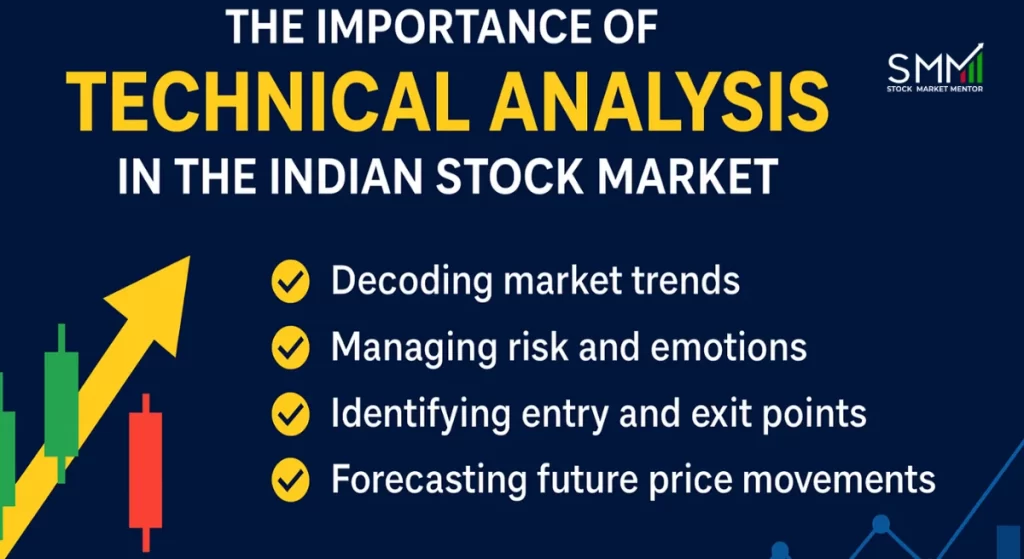
Smart investors combine trend analysis in Indian stocks with chart patterns in trading to spot clean entry and exit points. This way, you don’t rely on gut feeling; you rely on evidence.
Expert Advice on Using Technical Analysis in India
- Learn to Read Volume Before Price
Experts at Stock Market Mentor emphasise that volume always tells the truth. A rising stock with low volume often signals a false breakout. But when price and volume move together, that’s real conviction. - Avoid Indicator Overload
According to Motilal Oswal Research, traders who use too many indicators end up confusing themselves. Stick to 2–3 that you understand deeply. RSI, MACD, and Bollinger Bands are usually enough. - Combine Technicals with Market Sentiment
Experts from ICICI Direct advise blending technical vs fundamental analysis with macro news and investor sentiment. If the chart aligns with the story, that’s your confirmation.
Future of Technical Analysis in Indian Markets
The next phase of technical analysis for the Indian stock market will be all about automation and accessibility.
With India’s growing retail participation, over 12 crore active demat accounts in 2025, more investors are turning to data-driven trading. AI-powered screeners and backtesting tools are now mainstream, making professional-level analytics available to everyone.
As Stock Market Mentor continues expanding its learning ecosystem, the goal is clear: to empower Indian investors to make technical analysis part of their daily decision-making, not an afterthought.
The Bottom Line
The Indian stock market thrives on patterns, momentum, and sentiment. And if you can read those patterns, you’re already one step ahead.
From chart patterns in trading to trend analysis in Indian stocks, technical analysis gives you the edge to understand market rhythm, time your moves, and manage your risks like a pro.
At Stock Market Mentor, that’s exactly what investors are being trained to do: decode price behaviour, use logic over luck, and trade with confidence.
Because in the end, the markets don’t reward predictions.
They reward preparation, and that’s exactly what technical analysis for the Indian stock market is all about.