If you’ve just experienced some of your first losses in the stock market, don’t panic; this has happened to nearly everyone who gets into the markets at some point in time. You are not alone. According to a SEBI study, almost 70% of active retail investors in India experienced losses in the FY23 equity markets.
Your losses don’t have to be the end of the line; they can be the beginning of your financial education. Your ultimate goal is not to eliminate losses forever, but to have a better understanding of your losses and an infrastructure to manage your feelings and create lessons to foster a better mindset toward investing as a whole.
This guide has been built to help students and young investors understand that you will bounce back from mistakes, and even if you’re faced with early losses in the stock market, you can turn those early stock market losses into a stepping stone for future success.

Why Investors Lose Money In The Stock Market ?
A lot of new investors think they lose money because the market is “unpredictable.” While market instability is a factor, it is not the whole picture. Investor psychology is often far more impactful. For example, from September 2024 to March 2025, Indian equities lost $1 trillion in market value, while institutional investors ramped up their long-term positions during the same time period.
So, what accounts for the difference? They follow systems; beginners follow feelings.
Behavioral research demonstrates that losing $100 feels about twice as bad as gaining $100 feels good, and this bias in our psychology works against us by making us hold on to losing stocks too long and sell winning stocks too early.
Some of the most common biases include:
- Loss Aversion: You own a stock that decreased by 30%, yet you tell yourself it will bounce back, even in the face of unapologetic data.
- FOMO: You chase after a stock because “everyone is buying”, or, after seeing the stock double in one week, you believe you can now get that same result.
- Overconfidence: You have experienced a few early wins and now believe you are a pro and market master.
- Anchoring bias: You use the purchase price of an investment instead of today’s fundamentals to judge the merits of holding it.
These mistakes are the most common mistakes leading to stock market losses, and awareness of them is the first step to interrupting the cycle. For example, understanding the difference between Nifty and Sensex (Nifty vs Sensex) helps young investors realize that not every market index behaves the same way. This foundational understanding can prevent impulsive trades during short-term market swings.
What the Data Says About Investor Mistakes and Market Losses?
Trading too frequently and trading based on emotion can inflict more damage than a “bad” investment. A long-term study in Taiwan’s stock market showed that individual investors sacrificed an average of 3.8% in annual returns due to poor timing and trading too often. In a 30-year time horizon, this is a $1.2 million difference compared to simply investing at market averages.
Closer to home, SEBI reports that investors under 30, 76% lost money in FY23. As for individual traders, over 500 trades per year result in an 80% loss rate. On top of this, traders spent over 57% of their total losses on transaction and brokerage fees. According to a study, the majority of retail investors lose because of bad timing, frequently as a result of their ignorance of technical analysis. In our course on technical analysis in the Indian stock market, you can learn how experienced traders use data and patterns to make wise decisions.
Similarly, reviewing Indian Stock Market Chart Patterns can help identify optimal entry and exit points reducing emotional trades.
Recover From Stock Market Losses
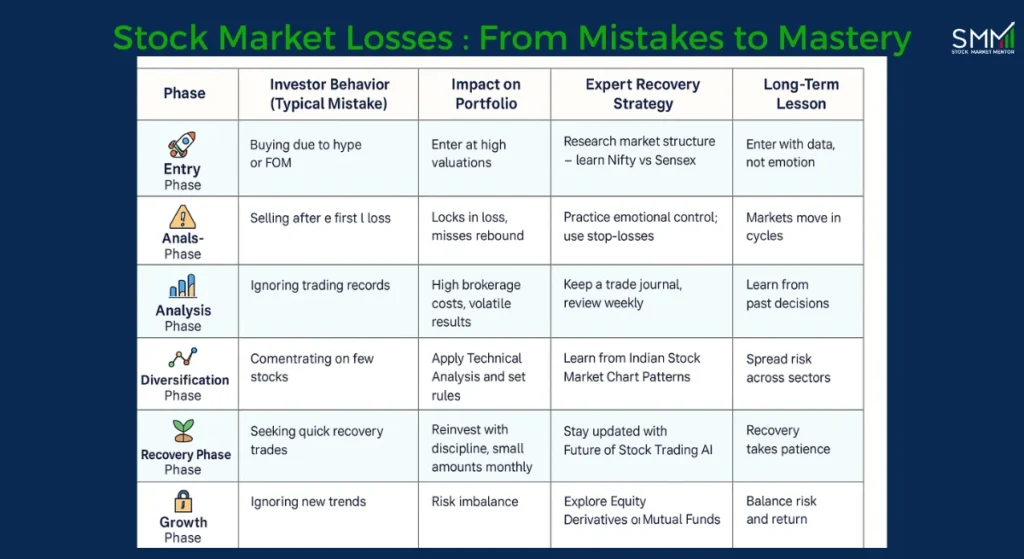
The process of how to recover from stock market losses is not about finding the “next big thing.” Instead, it is about choices; steps taken consistently and deliberately to rebuild your capital and restore your confidence. To discover how automation and machine learning can enhance the consistency of decision-making, read our insights on The Future of Stock Trading with AI.
Steps you can take begin with
Step 1: Accept the loss, do not chase it
The first law of recovery is to accept it. Do not try to earn it back immediately with a risky bet. Revenge trading is how small stock market losses can become big stock market losses. Even the greatest long-term investors, people like Warren Buffett, have had bad years, but they eventually move on with patience and discipline.
Quote Box: “Successful investing is not about avoiding losses — it’s about surviving them with discipline.”
Step 2: Review each trade
Open your records and review each one of the trades that lost money. Did you buy it because of the hype? Did you panic? Did you even have a stop-loss in? This process is not self-critical; it is called analysis. Top traders do this type of post-trade review regularly and it is how they find patterns to avoid making the same mistakes.
Pro Tip: Top investors perform post-trade analysis weekly not to judge themselves, but to identify repeatable mistakes and build pattern awareness.
Step 3: Use stop-loss orders every time
A stop-loss cuts off the loss by automatically selling the stock at a price you predetermined. If you buy a stock for ₹100 with a stop-loss of ₹95, if the stock falls to ₹95, it will sell automatically. It is a habit that cushions portfolios from catastrophic drops in value.
Step 4: Reinvest through consistency
Finding the right time to buy or sell is almost impossible. The better way is to adopt dollar-cost-averaging, which simply means investing a fixed amount (outlay of ₹5,000 for instance) every month in a quality stock or index fund. As the stock price drops, you will pick up more shares; as it rises, you will pick up fewer. In the long run, dollar cost averaging can help smooth out your experience over the volatile times and remove emotion from decision-making.
Step 5: Rebalance your portfolio
Following a market event, your portfolio could be shaken up and drift away from your goal allocation (70% stock, 30% bond for example). When you rebalance, you will take some money from the winning asset and deploy it into the losing asset. Basically, an automated/dollar-cost averaging way of “buying low and selling high”.
Expert Insight: “Diversification doesn’t eliminate risk — it smooths the emotional ride.”
Step 6: Diversify efficiently
Putting too much capital into a few companies can lead to 1-stock disasters. We want to spread our investments across different industries, geographic regions, and asset classes (equities, mutual funds/ETFs, bonds), to avoid losing all of our capital on one trade. If you’re unsure which suits your goals, this guide will help: Equity Derivatives or Mutual Funds – What Should You Choose?
How Stock Market Loss Management Changes Your Outlook?
Some of the best investors view losses as lessons, and not failures. Every mistaken trade is a lesson learned. Every wrong decision supports future discipline. Treat your early stock market losses as the cost of tuition to learn about finance; that’s precisely what it was. If you’re having trouble comprehending the emotional and technical aspects of trading, read Stock Market Difficulties Faced by New Investors, which delves deeply into the challenges that most novices encounter and explains how to get past them with the help of structured mentoring.
This is where a Stock Market Mentor becomes your greatest ally. Instead of going through endless cycles of trial and error, students can use the courses and mentoring programs to learn loss management strategies to use in the stock market.
A process for guided learning allows you to figure out what went wrong, how to recalibrate it, and how to ensure it never happens again, which can advance your learning years beyond self-taught investors.
Their ordered approach consists of:
- Developing an investment plan that has risk parameters and profit targets built into it.
- Creating a trade journal of every action and its outcome.
- Having realistic return expectations of about 10-12% per year, the average return of the long-term equity market over the years is.
- Understanding that short-term declines in the market are temporary and that the global market has recovered from 15+ major crashes in the last century.
Final Thoughts on Stock Market Losses and Long-Term Investing Mindset
Your financial success will not rely on how many times you fall, but on how quickly you stand back up and what kind of wisdom you ultimately find. The stock market will always be a challenge for you economically, emotionally, and mentally. However, if you learn from your stock market losses, keep your emotions in check and are willing to learn from the proper people you will, in fact, be even smarter and stronger.
With our programs run by experts, real-world knowledge and connections to a fantastic mentorship experience, turning a loss into learning becomes your first major winning experience.