Opening a Demat Account Made Easy: A Complete Walkthrough
In case you are planning to start investing in the stock market, your very first step will be opening a demat and trading account. Consider a demat account as a digital locker which safely stores all the shares, bonds, ETFs and mutual funds electronically. And without it, you just cannot buy and sell shares in India.
In India alone, more than 20 crore people already possess one, and this shows how popular investing has become. The good news? Nowadays, creating a demat account is fast, easy, and can be achieved entirely online. In this guide, we’ll walk you through the entire process step by step, explain the documents you’ll need, and also share tips from experts so you can avoid common mistakes.
Understanding How to Open Demat Account India: The Basics
A demat account is similar to the gallery application of your phone. Rather than storing photos, it stores shares, bonds, ETFs, and mutual funds safely in electronic form.
This matters because:
- No danger of misplacing paper certificates.
- Easy transfers in seconds.
- Compulsory according to SEBI requirements for any investor.
So, in case you are quite serious about the Indian stock market, the first thing you have to do is to learn how to open a demat account in India. Before diving into investing, it’s smart to understand the difficulties traders face in the stock market. This helps you prepare mentally and financially.
Who Can Open a Demat Account in India? (Eligibility Explained)
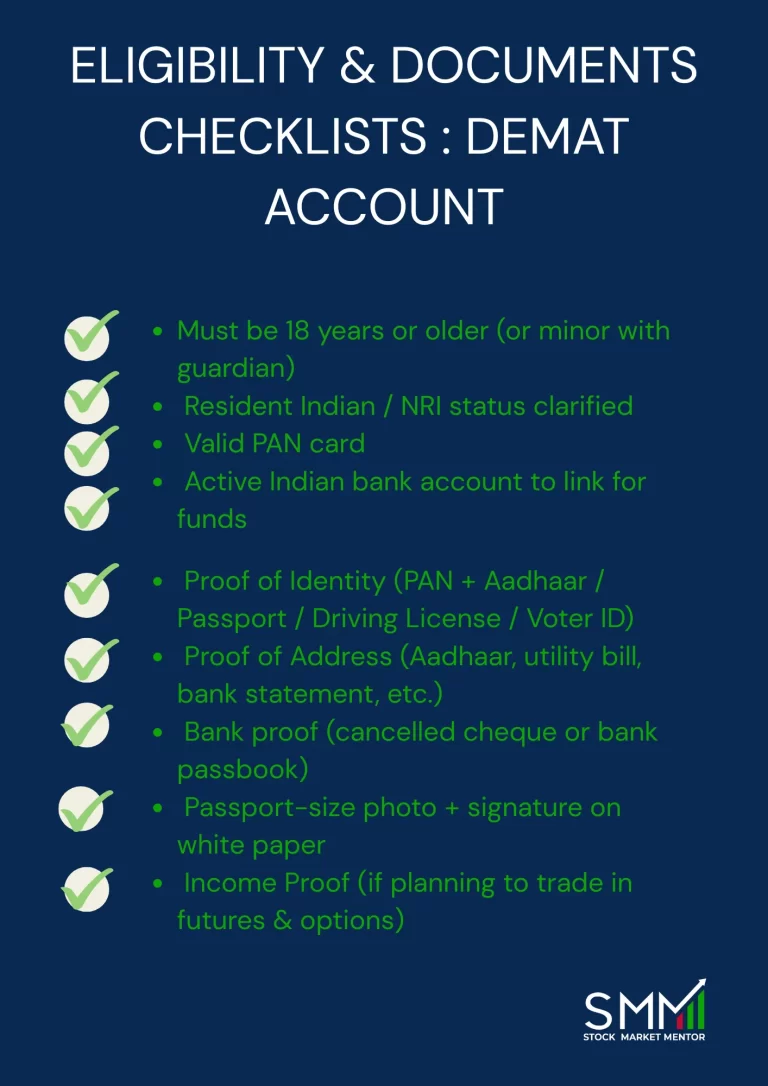
Before you make up your mind, here’s a quick list to check if you are eligible to open an account:
- Age: 18+ (minors can open with a guardian).
- Residency: Both resident Indians and NRIs are eligible.
- PAN card: Mandatory for all applicants.
- KYC: Must complete verification.
- Bank account: Active account in India for linking funds.
If you can tick all these boxes, you’re great to go ahead. According to SEBI’s master circular, investors must complete KYC verification and link PAN before account activation (SEBI Guidelines).
Not every investor is the same. Curious where you fit? Understand the types of investors in India to see which category matches your style.
How to Open a Demat Account Online? Step-by-Step Process
Here’s the process simplified:
Step 1: Choose the Right Depository Participant (DP)
Investors cannot open a demat account directly with NSDL or CDSL; they must go through a Depository Participant (NSDL official list)
When choosing, look at:
- Reputation: Go with established names.
- Charges: Compare account opening, annual maintenance (AMC), and transaction fees.
- Technology: A smooth trading app saves hours.
- Support: Quick grievance redressal is underrated but critical.
Zerodha, Angel One, ICICI Direct, Upstox, HDFC Securities, and Kotak Securities are some great choices.
| Feature / Broker | Zerodha | Upstox | ICICI Direct |
|---|---|---|---|
| Account Opening Fee | For resident Indian individuals. For Non-Resident Indians (NRIs), the account opening fee is ₹500 | First year it’s free and from the second year is around ₹150 per year (inclusive of GST) | ICICI Direct charges no fee for Demat account opening |
| AMC (Annual Maintenance) | ₹300–₹400 depending on plan | ₹300–₹500 | ₹700 + GST per year for a regular account |
| Trading Platform / App Experience | Highly rated mobile + desktop; good UI/UX | Good app & discounts for first-time users | More features; additional research tools but steeper learning curve |
| Customer Support & Branch Presence | Strong digital support; fewer physical branches | Strong digital; fewer branches than ICICI | Wide branch network + physical support |
| Research & Advisory / Value-Added Services | Basic research, community content | Moderate; newsletters, tips | Full-fledged research, advisory, fixed income, etc. |
| Brokerage on Intraday / F&O | Competitive slabs; low costs for active traders | Discounted pricing, offers occasionally | Premium pricing but added features & reliability |
Step 2: Fill Out the Online Application
On your chosen DP’s website or app:
- Enter your full name (exactly as on PAN).
- Add your mobile number (Aadhaar-linked preferred).
- Enter your email and bank details.
Step 3: Upload Documents Upload Your KYC & Bank Documents
You’ll need:
- Identity proof: PAN (mandatory), Aadhaar, Passport, Voter ID, or Driving License.
- Address proof: Aadhaar, bank statement, passport, or utility bill.
- Bank proof: Cancelled cheque or bank passbook copy.
- Photo + signature on white paper.
- Income proof (only if you want to trade futures & options).
Step 4: Complete In-Person Verification (IPV) via Video KYC
This is where SEBI ensures it’s really you. Most brokers now do this through video KYC.
- Turn on your camera.
- Show your original documents.
- Answer simple verification questions.
For joint accounts, every holder must do IPV separately.
Step 5: Use Aadhaar E-Sign to Confirm Application
The easiest part.
- Enter the OTP you get on your Aadhaar-linked mobile.
- E-sign all documents digitally.
Step 6: Account Activation & Getting Your Client ID
Once everything’s done, you’ll usually get your Client ID and password within 24–48 hours. That’s it, you’re officially ready to start trading and investing. Many new investors open a demat account without proper guidance. To avoid costly mistakes, go through these 10 questions to ask before taking a stock trading course.

BSDA: Affordable Demat Account Option for Small Investors
If you are a newbie and stressing up on the charges, look into a Basic Services Demat Account (BSDA).
Conditions:
- Only one demat account per PAN.
- Holdings below ₹10 lakh.
Benefits:
- Zero AMC for holdings up to ₹4 lakh.
- ₹100 annual charge for holdings ₹4–10 lakh.
- Free e-statements.
A great way for beginners to save money while learning.
Cost Breakdown Table: Regular vs BSDA Accounts
| Cost Component | Regular Demat Account | BSDA (Basic Services Demat Account) |
|---|---|---|
| Annual Maintenance Charges (AMC) | ~ ₹300–₹800 depending on DP / broker | ₹0 if holdings ≤ ₹4,00,000; minimal (₹100 approx) if holdings between ₹4–10 lakh |
| Transaction / Trade Charges | Standard brokerage + DP charges per transaction | Same brokerage when trading; DP / AMC advantages for smaller holdings |
| Eligibility for Free Statements, etc. | Some free e-statements; physical statements may cost | Free e-statements; often fewer or no physical charges |
| Minimum Holdings for Reduced Fees | N/A | Must maintain holdings within prescribed limits (e.g. ≤ ₹10 lakh) |
| Limitations / Trade-Restrictions | None specific to account size | Certain features or fees scaled down / limited to smaller portfolios |
All Charges You Should Know Before Opening a Demat Account
Before making up your mind, you need to know the charges in how to open demat account India:
- Opening fees: Often zero (promotional offers).
- AMC: Free (BSDA) or ₹300–800 for regular accounts.
- Transaction fees: Around ₹15–25 per trade.
- DP charges: Small fee when shares move out of your account.
Offline Process: How to Open a Demat Account in India?
Fan of old, traditional ways? You can still:
- Visit a broker’s branch.
- Fill out physical forms.
- Submit photocopies of documents.
- Complete IPV in person.
It surely takes a little longer, but some investors still prefer a personal touch.
Expert Tips for Opening a Demat Account (From Top Investors & Brokers)
- Rakesh Jhunjhunwala’s Philosophy: “Respect the market. Know when to stake, know when to cut losses.” Translation: Don’t just open a demat– choose wisely and trade responsibly.
- Nithin Kamath (Zerodha founder): “I had one demat for investments and another for trades.” Pro tip: Separate long-term holdings from daily trades to avoid mixing strategies.
- Dhiraj Relli (MD & CEO, HDFC Securities): “Nearly 75% of new demat accounts are opened by under-30 investors.” If you’re young, you’re in good company- but remember to learn the basics first.
- Financial Planners’ Tip: Start with a BSDA. You’ll save on fees while you’re still figuring out the market.
Common Mistakes to Avoid When Opening a Demat Account
- Submitting incorrect or incomplete documents.
- Not linking Aadhaar with your mobile number.
- Rushing multiple applications with different brokers.
- Skipping nominee details (always add one).
Ignoring the fine print of charges. Many traders rush into opening accounts without training. Should you learn online or offline? Here’s a comparison of stock market courses in Delhi 2025 to help you choose wisely.
What to Do After Opening Your Demat Account?
Learning how to open a demat account in India is just the first step. The real game begins afterwards:
- Track your portfolio regularly.
- Secure your credentials, never share OTPs.
- Update KYC whenever details change.
- Plan for taxes, know FIFO rules for capital gains.
How Technology Has Made Demat Account Opening Easier?
The process is now super swift, thanks to:
- AI-powered documents check.
- Biometric authentication.
- Mobile-first account opening.
With all this, you can easily go from just “thinking about investing” to “account ready” in under 48 hours.
Final Thoughts: Your First Step Towards Stock Market Investing
Learning how to open a demat account in India isn’t complicated anymore. You will be in business within a few days with the correct papers and an honest broker. However, keep in mind: It is easy to open the account. The real challenge is to invest wisely.
Be disciplined, always learn and seek the guidance of the experts before taking any steps. That is the way you make a demat account more than a mere login and your first proper step towards financial growth. Want personal guidance on getting started with stock market investing? Contact us here and our team will help you take the right next step.