How AI Is Transforming the Future of Stock Trading?
Have you ever wished you could know where the market is going tomorrow- well, you are not alone. There is, however, a twist to it all: artificial intelligence (AI) is already doing it. The future of stock trading is not only not about intelligent humans any more, it is also about intelligent machines. Since AI trading algorithms can analyse millions of data points in seconds and predictive systems can literally guess price movements prior to their occurrence, the game has evolved, and it evolves rapidly.
We are entering a world in which technology does not merely support, it outsmarts them (sometimes politely).
AI Trading Algorithms: The New Market Superheroes
Gone are the times when trading used to mean that you spent your day staring at charts and biting your nails at the dips on the market. Now, it is AI trading algorithms that are doing all the work, and they do not make a wry face, do not panic or need a coffee break.
Industry reports indicate that these algorithms process above 90% of Forex transactions and close to 70% of all the trades in India. These systems operate 24/7 and can study very large amounts of data in ways that no human brain will ever dream of doing.
The reason they’ve taken over? Speed + precision. AI algorithms are capable of identifying trends, testing them, and trading within a few milliseconds. Think of them as the “Sherlock Holmes” of trading, minus the drama, but with way more data.
Take JPMorgan Chase’s LOXM platform, for example. It applies AI to model millions of past trading conditions. The result? It can outsmart most human traders and execute lower trading costs and better timing on its best day. AI algorithms now dominate modern markets, executing trades faster and smarter than ever before. To understand how these systems work in the Indian ecosystem, check out our algo trading course in India that covers everything from automation frameworks to real-time AI trading tools.
Predictive Analytics in Trading: Seeing Tomorrow’s Charts Today
It is now time to get down to business. Predictive analytics in trading is like providing your investment strategy with a crystal ball, only instead of magic, it is math and machine learning.
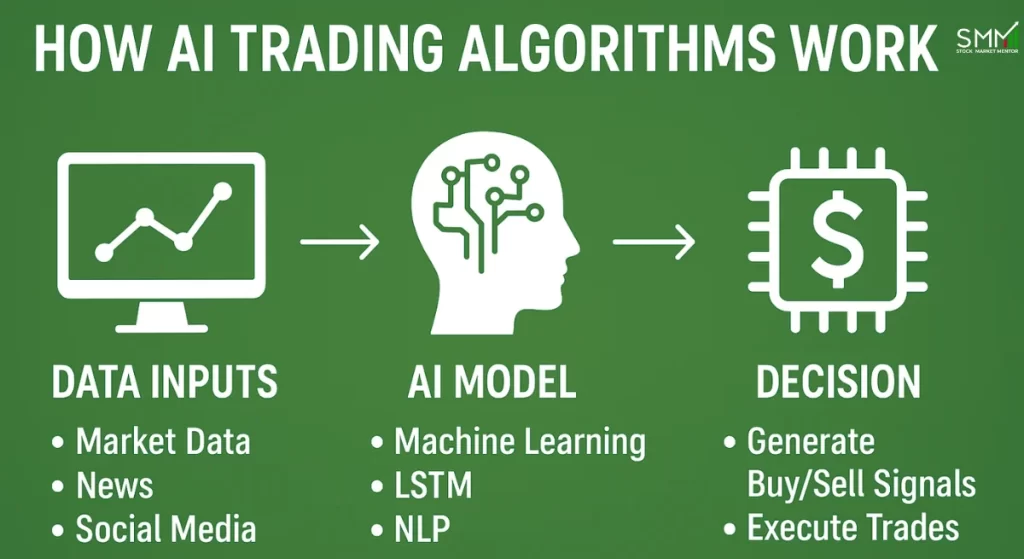
More intelligent AI applications, such as LSTM networks and Support Vector Machines, crunch all that, including the market history and world news headlines, and provide an opinion on where a stock is going to move next. Others even argue that its accuracy in predicting short-term trends is over 90%.
With the technology in the Indian stock market, these systems are getting even smarter. Natural Language Processing (NLP) now allows AI to read and comprehend news, social media, and even tweets posted by politicians to foresee market response.
To illustrate, a bullish signal could be startled by a good budget news announcement, whereas a red flag could be raised by an abrupt change in politics.
Concisely, AI no longer just looks at the numbers, but it reads the room as well.
Expert Insights: What Experts Say About the Future of Stock Trading?
To find out where the future of financial markets is taking us, we should listen to a few experienced professionals who have been keeping a close eye on this AI revolution.
Dr Ernest Chan, a highly regarded quantitative analyst around the world, thinks that AI is soon to assume more discretionary trading functions, where it analyses anything, including investor moods, to geopolitical factors. In his words, “Generative AI could outperform human discretionary traders under certain market conditions.”
Ray Dalio, the founder of Bridgewater Associates (the largest hedge fund in the world), is even more direct:
“The days of people making decisions in their own heads are ending. The gap between those who use AI effectively and those who don’t will only get wider.”
And Stefan Jensen, a veteran portfolio strategist, adds a dose of realism:
“AI trading algorithms are powerful, but they still need human supervision. Markets evolve constantly, and creativity and intuition remain essential.”
That is, AI could be the co-pilot genius; however, you remain the pilot. Many experts also emphasize learning from mistakes. You can explore our post on the common mistakes to avoid in stock trading to strengthen your trading discipline.
Technology in the Indian Stock Market: The Quiet AI Revolution
Do you believe that the Indian stock market is underperforming? You are mistaken. The technology in the Indian stock market is changing more rapidly than ever, with AI applications making inroads.
Here’s where AI is leaving its mark:
1. High-Frequency Trading (HFT)
AI systems are able to trade hundreds of trades in a few milliseconds, making money on even the slightest price changes. It is quick, intense and, best of all, profitable when done right. For traders exploring global markets, the forex trading course in Bangalore offers practical exposure to algorithmic forex systems and predictive analytics.
2. Portfolio Management
Robo-advisors are the new-age financial planners. They study your goals, risk appetite, and market conditions to build portfolios that adjust automatically. It’s like having a personal fund manager who never sleeps (and doesn’t charge a commission dinner).
3. Fraud Detection
AI systems are also becoming watchdogs. They spot unusual patterns, flag suspicious trades, and protect investors from potential scams. In a market where one wrong click can cause chaos, that’s a huge win.
These innovations show how AI trading algorithms are bringing transparency and speed to the Indian trading scene, all while helping everyday investors make smarter calls. Similarly, if you’re just starting your investing journey, our stock trading courses in Delhi provide structured learning on how to interpret AI-generated trading signals.
Predictive Analytics in Trading: Turning Data into Smarter Decisions
Let’s talk about impact. When we say AI is changing the future of stock trading, it’s not a marketing buzzword; it’s measurable.
Platforms like Jarvis Invest are already using predictive analytics in trading to send real-time alerts, track investor sentiment, and even spot hidden opportunities before they trend.
HSBC uses AI tools to find high-growth stocks faster, while TradingView has built-in AI that recognises complex chart patterns in seconds.
The best part? These tools aren’t just for Wall Street pros anymore. Even retail traders in India are using them daily.
The power once limited to global hedge funds is now sitting on your smartphone, in your trading app. And if you often compare Indian indices, here’s a helpful guide explaining the difference between NIFTY and SENSEX essential context for AI-based predictive modeling.
The Future of Financial Markets: Opportunities and Challenges
Now that AI has entered the chat, the future of financial markets will never look the same. But it’s not all smooth sailing.
One major concern is the “black box problem.” Many AI systems are so complex that even their creators can’t fully explain how they make decisions. This makes regulators nervous, and rightly so.
Then there’s overfitting, when an AI model performs brilliantly on historical data but falls flat in real-time markets. It’s like memorising exam answers only to find out the questions have changed.
Still, experts agree that the potential outweighs the risks. The AI-in-finance industry is projected to hit $190 billion by 2030, and by 2025, around 85% of financial institutions are expected to use AI in some form.
That’s not evolution, that’s a revolution. Curious about which platforms align with AI-powered systems? Check out Is Alice Blue good for trading? to evaluate one of India’s most talked-about brokers.
AI Trading Algorithms: The Next Big Leap Ahead
What’s coming next in AI trading algorithms? Expect trading systems to get more “human-like”, but without the bias and fear that usually cloud human judgment.
Here’s what’s brewing in the AI labs:
- Neural-Network Price Forecasting: AI models combining LSTM and CNN networks for even sharper predictions.
- Statistical Arbitrage Engines: Smart systems that exploit tiny mispricings between correlated stocks before the gap closes.
- Sentiment Signal Trading: NLP-based tools that turn social media buzz and news chatter into actionable trading cues.
These innovations will make the future of stock trading more automated, precise, and insight-driven than ever before.
Final Thought: AI Is Not the Future, It’s the Present
The future of stock trading is not just digital, it’s intelligent. AI is no longer the “next big thing”; it’s the now thing. Traders who embrace it early will ride the wave. Those who resist it might be left behind watching from the shore.
So, if you’re serious about investing in the markets of tomorrow, maybe it’s time to shake hands with your new trading partner: AI. Ready to upgrade your trading skills and learn how to integrate AI into your investment strategy? Contact us today to get personalized guidance and start your journey toward smarter, data-driven trading.