
Investing your hard-earned money is never a small decision. The real question most people face is simple but tricky: mutual funds vs. direct stocks, which one should you choose? If you ask your friends or colleagues, chances are you’ll hear very different kinds of answers. Some will swear by stocks, saying that nothing beats the thrill of owning a company directly. Others will tell you that the mutual funds are safer and smarter because experts manage them.
Both are true, in their own way. But here’s the catch: the best choice depends on you, your goals, your risk appetite, and the time that you can actually give to managing investments.
In this blog, we’ll break down the differences in simple words, look at real data from recent reports, and help you decide whether to put your money in mutual funds or direct stocks.
Mutual Funds vs Direct Stocks: What Do They Mean?
When comparing mutual funds vs direct stocks, the biggest difference lies in how your money is managed and the level of control you have. A mutual fund takes money from many people and puts it into stocks, bonds, and other assets. You don’t really own the stocks; you own units in the fund. It spreads your risk and is handled by professionals, so it gives you more options. With SIPs, you can also start small, making it easy to get rich over time.
However, direct stocks means you buy the shares of the companies directly from the stock market. You own a part of that company and you earn if its value rises. There’s no fund manager; you research, buy, and sell all on your own. It also gives full control and the chance for higher returns, but it also comes with higher risk if your chosen stock performs poorly. Here’s a breakdown of the common mistakes to avoid in stock trading before you buy your first share.
Mutual Funds vs. Direct Stocks: A Clear Comparison
Now, let’s see an easy comparison of both of them.
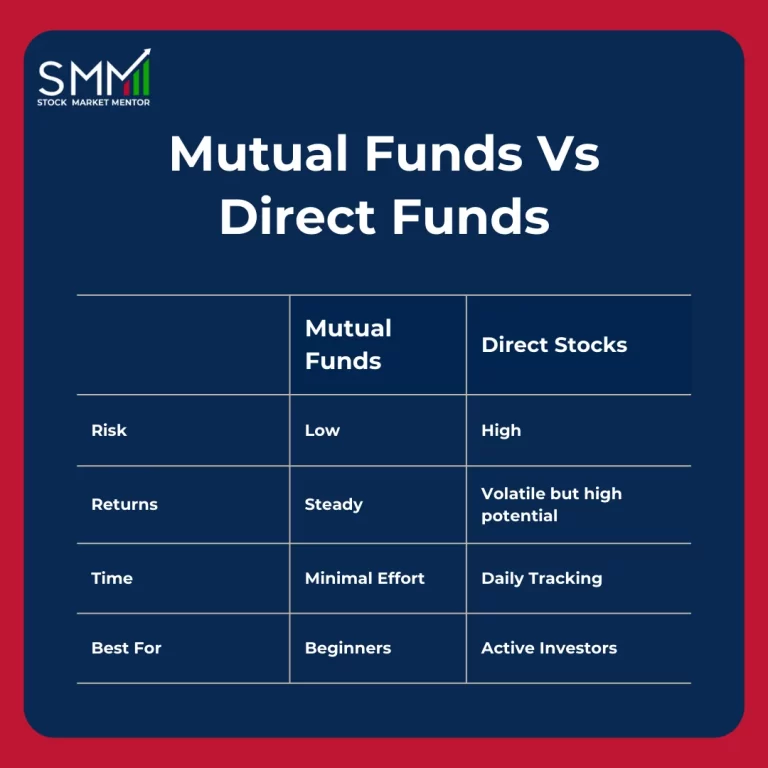
- Risk: When it comes to mutual funds vs direct stocks, risk is the biggest difference. Mutual funds invest your money across several companies and sectors, which spreads out the risk. So, even if that one stock performs badly, others can balance it out. In direct stocks, all your money is tied to a number of companies you personally choose. If one of them crashes, your portfolio takes a direct hit. That’s why mutual funds are generally safer, while stocks are more volatile.
- Time and work: Mutual funds are ideal for people who can’t track the market daily. A fund manager and research team handle everything for you. In contrast, direct stock investing needs your full attention. You have to learn about balance sheets, read about market patterns, and then decide when to buy or sell. It takes a long time, but it might be worth it if you know what you’re doing and are patient.
- Costs: Mutual funds have expense ratios, small management fees deducted yearly, and sometimes exit loads if you withdraw early. These charges cover professional management and research costs. Stocks don’t have fund fees, but you have to pay brokerage charges every time you trade. Over time, frequent buying and selling in stocks can also increase your total costs.
- Returns: Returns vary according to your selections and market conditions. Mutual funds typically provide consistent, market-related returns over time. While they may not yield immediate substantial returns, they provide potential for long-term gain with a moderate level of risk. Direct stocks, however, can yield significantly larger profits if one selects the appropriate firm, but may also result in substantial losses if one does not.
- Best suited for: Mutual funds are ideal for beginners, busy professionals, as well as those who prefer to be guided. Direct stocks suit those experienced investors who like to study company and market volatility. Mutual funds win for stability. If you desire control and bigger returns, consider stocks.
Check out our detailed breakdown on Stock Market vs Mutual Funds.
Investor Suitability
| Profile | Mutual Funds | Direct Stocks |
|---|---|---|
| Beginners | Best option | Risky without knowledge |
| Busy Professionals | Hands-off | Requires constant tracking |
| Risk Takers | Moderate | Ideal |
| Long-Term Planners | Stable compounding | If blue-chip focus |
| Traders/Short-Term | Not suitable | Preferred |
Every investor is different. Curious to know your style? Explore the different types of investors in India and see where you fit.

Mutual Funds vs. Direct Stocks: Quick Comparison
| Factor | Mutual Funds | Direct Stocks |
|---|---|---|
| Returns | Steady, market-linked; moderate long-term growth | Potentially higher, but depends entirely on stock-picking skill |
| Risk | Lower — spread across many companies/sectors | Higher — concentrated in the stocks you choose |
| Liquidity | High for open-ended funds; redemption usually credited in 1–3 working days (exit load may apply if sold early) | Very high — shares can be sold instantly during market hours and settled same/next day |
| Taxation | Equity funds: 20% short-term (<12 months), 12.5% long-term above ₹1.25 lakh exemption | Same rates as equity mutual funds: 20% short-term, 12.5% long-term above ₹1.25 lakh |
| Effort | Minimal — fund manager handles research and rebalancing | High — requires ongoing research, monitoring, and decision-making |
Latest Data & Market Trends You Should Know
- According to an Economic Times report (Sept 2025), 74% of equity mutual fund schemes gave negative returns on one-year lump-sum investments.
- Another ET analysis showed that the 18 equity mutual funds delivered over 30% returns since last year, especially the international and global tech funds (ET Markets).
- The Indian mutual fund industry’s assets under management grew by 11% in H1 2025, with inflows of ₹4.18 lakh crore.
- Direct stock buyers, on the other hand, saw big changes. Large-cap companies like Reliance and Infosys stayed mostly the same, but buyers in mid- and small-cap companies had to deal with volatility (Reuters).
This shows that funds are usually safer, but recent success shows how important it is to pick the right scheme or stock.

Costs, Charges & Taxes in India: Mutual Funds vs Stocks
Taxes and costs are a big part of stocks vs mutual funds, which is better.
- Equity mutual funds and stocks are taxed the same way. If you sell in less than 12 months, the gains are short-term and are taxed at 20%. If you hold on for a bit longer, the long-term gains above ₹1.25 lakh are taxed at around 12.5%.
- Debt funds are taxed differently, often as per your income tax slab.
- Mutual funds also charge an expense ratio. For example, the active equity funds often have ratios between 1%-2%, while index funds charge less than 0.3%.
- Stocks do not have fund expenses, but come with the brokerage and transaction charges.
How to Decide on Mutual Funds vs Direct Stocks?
If you’re still unsure which one fits you best in the mutual funds vs direct stocks debate, here’s a quick guide:
- Choose mutual funds: If you want steady, long-term growth with expert management and less day-to-day stress.
- Pick direct stocks if you’re good with short-term fluctuations, enjoy researching markets and companies.
- Equally possible is to accomplish both: For safety, put your money in a mutual fund. If you want to grow your money faster, buy a few stocks directly.
This manner, you can create money at your own speed while maintaining control and a sense of security in mutual funds and direct stocks.
Mutual Funds vs. Direct Stocks – The Smarter Choice for You
When it comes to mutual funds vs. direct stocks, there is no one-size-fits-all answer. Mutual funds give you diversification, professional management, as well as steady long-term growth, while direct stocks give you control, flexibility, as well as the chance of higher rewards with higher risks.
If you’re still not sure which way to go, Stock Market Mentor and other tools can help you learn, explore, and get clear on investing. That way, you won’t just invest without thinking, but you’ll also be able to make choices that align with your financial goals.