“What is liquidity in trading?” is one of those questions most people ignore, until the day a trade doesn’t go as planned.
You expect a simple buy or sell. Instead, the order sits, the price moves, and your expected profit starts shrinking before the trade even goes through. That gap between what you expected and what actually happened is often caused by poor liquidity.
Understanding how liquidity works can help you avoid these situations long before they happen. In this blog, we’ll break down what liquidity really means, how it affects your trades, and why it matters more than most people realise.
What Is the Meaning of Liquidity in Trading?
In simple words, what is liquidity in trading means how easily you can buy or sell a stock without affecting its price too much. If a stock is liquid, many people trade it. There are lots of buyers and sellers. That means you can buy or sell quickly, almost instantly, and get a fair price.
Liquidity is about the market’s “fluidity,” not your own money or assets. It does not mean how much cash you hold; it means how well the market can handle buying and selling activity without breaking down price-wise. If you’re considering diversifying outside India, it’s useful to understand the extra risks involved.
| Feature | Liquid Stocks | Illiquid Stocks |
|---|---|---|
| Daily Trading Volume | High | Low |
| Bid–Ask Spread | Tight | Wide |
| Order Execution | Fast, minimal slippage | Slow, high slippage |
| Price Stability | More stable | More volatile with sudden spikes |
| Suitable For | Intraday, swing traders | Long-term investors only |
| Examples (general) | Large-cap stocks | Small-cap / penny stocks |
How Do We Measure Liquidity in Trading?
You can’t “see” liquidity directly, but understanding what is liquidity in trading helps you know how easily a market can absorb your orders.
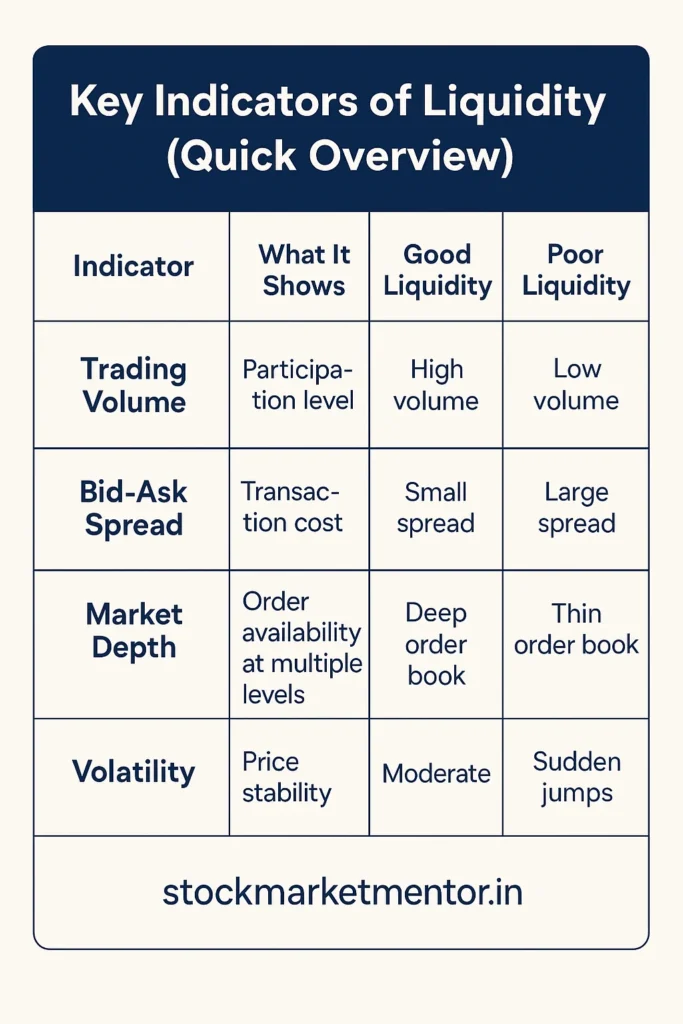
- Trading volume: If many shares are traded every day, that usually means lots of interest and a lot more buyers/sellers. High volume is equal to good liquidity.
- Bid-ask spread: This is the difference between the “bid,” or the highest price a buyer is willing to pay, and the “ask,” or the lowest price a seller is willing to accept. A small spread makes it easy to trade without having to pay more. It is usually hard to sell something when there is a wide gap.
- Market depth/order book depth: How many buy and sell orders are lined up at different price levels? If there are many orders both near and farther from current price levels, the market is deeper and is more liquid.
These signals help you gauge whether a stock (or asset) is “safe” to trade easily, or risky because of low liquidity. If you want to strengthen your understanding of chart reading along with liquidity concepts, explore our detailed guide on Technical Analysis in the Indian Stock Market.

Why Liquidity in Trading Matters In Stock Trading?
Liquidity isn’t just a technical word. Your trades may be directly impacted by your understanding of what is liquidity in trading. Here is how:
Fast execution
In a liquid market, when you place a buy or sell an order, it gets filled quickly. You don’t sit waiting, hoping someone matches your order. That can matter a lot, especially when prices move fast.
Lower cost / fewer surprises
A tight bid-ask spread means you don’t lose value stepping in or out. Also, because there are many orders, a large trade doesn’t push the price much. That keeps your cost low and predictable. Poor liquidity is also one of the hidden contributors to trading losses. To learn more about how traders commonly lose money, check out this resource.
Less price slippage
Slippage is when you expect to buy at, say, ₹100, but the actual execution might be ₹101 or ₹99 if liquidity is poor. In a liquid market, the slippage is small.
Ability to exit when you want
If you need to sell quickly, maybe the market moves against you; good liquidity lets you do that. In illiquid markets, you might be stuck or forced to sell at a bad price. Liquidity also varies significantly across major indices like Nifty and Sensex. Here’s a clear comparison to help you understand how index behavior affects liquidity.
Better “true value” discovery
When many buyers and sellers keep trading, prices adjust fast and reflect current information: news, earnings, macro events. Liquid markets discover true value faster and more accurately. To identify liquidity zones more accurately, it’s helpful to study common chart patterns used by Indian traders. If you’re based in Delhi NCR and want to understand concepts like liquidity, market depth, and technical analysis more practically, you may find these learning paths helpful: Stock Market Trading in Delhi NCR.
Slippage Examples in Real Trades
| Scenario | Expected Price | Executed Price | Slippage | Reason |
|---|---|---|---|---|
| Buy Order in Liquid Stock | ₹100 | ₹100.10 | ₹0.10 | Tight spread, fast execution |
| Buy Order in Illiquid Stock | ₹100 | ₹103 | ₹3.00 | Low volume, fewer sellers |
| Sell Order in Liquid Stock | ₹250 | ₹249.80 | ₹0.20 | Fair liquidity |
| Sell Order in Illiquid Stock | ₹250 | ₹245 | ₹5.00 | Thin order book, gaps in bids |
Liquidity Grab Trading and Why Some Traders Watch Liquidity
Some traders use liquidity intentionally, not just react to it. This is often called Liquidity grab trading. The idea: watch where orders cluster (stop-loss orders, pending entries, previous highs/lows), these spots often hold “liquidity pools.”
When the price moves to such a pool, it triggers many orders, and sometimes big players use that to enter or exit large positions. Once those orders are filled, the price may reverse direction. Traders who understand this can use it to anticipate reversals or breakouts.
In simple terms, if many traders have placed pending orders at a certain price, that area becomes a magnet, price might “grab” that liquidity before moving. Recognizing such zones gives you an edge (though it’s also riskier).
Simple Checklist to Check Liquidity Quickly
- Look at average daily volume (shares traded per day), high volume means better liquidity.
- Look at the bid-ask spread right now; a tighter spread is better.
- If you can, look at the order-book depth to see how many people want to buy or sell at prices close to the current one.
- Think about factors that are specific to the stock, like whether it is a large-cap or small-cap stock, current news, free float, and so on.
- If there isn’t much volume or if it’s spread out over a wide range, use a limit order, make your order smaller, or don’t trade at all.
Why Market Liquidity Is More Important Now
The central banks around the world, including the Reserve Bank of India (RBI), have done things to change the amount of money available in the financial system. For instance, the RBI said on December 5, 2025, that it would put up to $16 billion into the banking system to help with liquidity.
These kinds of moves don’t just affect bonds or banks, but they also change how people feel about the market, how easy it is for investors to trade, and how easily money flows. When liquidity gets better across the systems, markets tend to stay more stable, and trading gets much easier. A trader who knows about these changes can help plan when to buy and sell, especially when the market is volatile.
Why Knowing What Is Liquidity in Trading Matters
At the end of the day, understanding what is liquidity in trading can make or even break your trade. If you skip checking it, you risk orders hanging, surprise losses, or even getting stuck when you want out. But if you know what liquidity is and trade carefully, you can buy and sell with confidence, knowing that you won’t be squeezed by wide spreads or thin order books.
If you want more help with trading smartly and being aware of liquidity problems, Stock Market Mentor has clear market information and useful advice.