Crypto vs Forex: Comparing Volatility, Profit Potential, and Risk
Everybody wants to get into trading, but the biggest question is which one should trade in crypto or in forex? They both sound thrilling, both can make money, and they both can make you lose some as well. However, they are entirely different worlds.
It is not only about knowing which one is cooler: crypto vs forex. It is about trying which one suits you, your personal style, your own comfort level of taking risks, and your objectives.
In case you are computing this now, this basic breakdown by Stock Market Mentor will help you make your choice much easier.
Crypto vs Forex: Key Differences Explained
To begin with, it is important to clarify that crypto and forex are both types of currency trading, and the currencies themselves are quite different.
Forex is involved with actual money, such as USD, INR, EUR, or JPY. You exchange one government-backed currency with another, based on which one you believe is going to strengthen. The forex market is enormous, with over $7.5 trillion being traded on a daily basis.
Crypto is, however, regarding digital currency, Bitcoin, Ethereum, and thousands more. Banks and governments do not control these. They operate using blockchain technology, which is a fancy way of saying decentralised systems which keep track of all transactions in real time.
That’s the biggest of all differences between crypto and forex: forex is old-fashioned, controlled, and properly organised. Crypto is new and decentralised as well as developing. If you’re curious how traditional markets compare, you might also explore our article on Nifty vs Sensex: Which Index Should You Track?
Crypto vs Forex: Different Market Hours
Here’s something that instantly separates the two markets: timing.
Timing is one of the first factors that immediately isolates the two markets.
Forex operates on a 24-hour, 5-day-per-week basis. The action shifts between Sydney to Tokyo and London to New York, and this implies that there is always something happening but not in the time of weekends.
Crypto does not believe in rest. It’s open 24/7, all year round. You will be able to trade Bitcoin at midnight on Sunday or in the early morning on a public holiday.
Sounds great, right? However, constant availability implies constant price movement. The risk comparison crypto vs forex here is simple: you are always caught off guard with crypto. Forex, on the other hand, provides you with foreseeable hours, and it is easy to plan your trades.
Forex may be safer for you, in case you enjoy structure. Cryptocurrency will keep you glued to it in case you enjoy being flexible and do not care about riding the rollercoaster now and then. To learn how to start safely, our beginner’s resource Forex Trading for Beginners: How to Get Started walks you through platform setup, time zones, and basic trading strategies.
Forex vs Crypto Volatility: Which Market Moves Faster?
Here is where the majority of the traders fall in love or elope.
Crypto is famously wild. It changes the prices by 10-20% in one day. The market can be overturned by a mere tweet, government announcement or a new regulation.
Compared to forex, forex is so much calmer. Renowned currency pairs such as EUR/USD or USD/JPY tend to drift less than 1% in a day. The smaller moves are easy to predict patterns and manage the losses.
So, when we talk about the risk comparison crypto vs forex, crypto is evidently the more dangerous playground. But the greater the risk, the greater the potential reward, in case you know how to run it.
Liquidity Comparison: Forex vs Crypto Market Depth
Liquidity is another major determinant in the differences between crypto and forex, in how easily you can buy or sell without affecting the price.
The forex market is the liquidity king. You can easily open or close a big position in seconds with trillions of dollars being traded each day.
The liquidity of cryptos is coin-specific. Bitcoin and Ethereum are liquid, though smaller coins (so-called altcoins) are not easy to move fast. It may lead to what is known as slippage, where you don’t get the exact price you expected.
To the novice, the forex is smoother. Crypto, however, presents more possibilities to individuals able to cope with a degree of uncertainty.
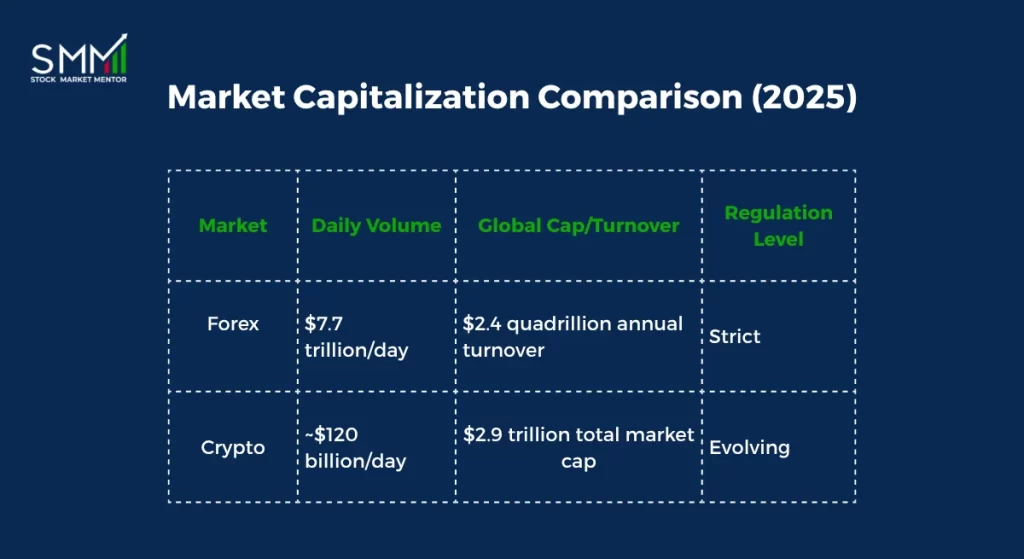
CoinMarketCap (2025) and the BIS Global FX Report (2025) state:
- After a decline in 2024, the global cryptocurrency market capitalization is currently $2.9 trillion.
- With 49% of the market, Bitcoin leads, followed by Ethereum with 18%.
- With daily trading of over $7.7 trillion, the forex market continues to be the biggest financial market globally.
Because of this enormous liquidity gap, forex trades execute more quickly than cryptocurrency trades, which can fluctuate greatly during shocks.
SMM Forex | Top Rated Forex Trading Course in India
Crypto vs Forex: Quick Comparison
| Factor | Forex | Crypto |
|---|---|---|
| Market Hours | 24 hours, 5 days a week | 24/7, 365 days a year (crypto trading hours) |
| Volatility | Low to moderate | High; often 10–20% swings daily |
| Leverage | Up to 1:500 with regulated brokers | Usually 1:10–1:50 depending on exchange (forex leverage vs crypto leverage) |
| Liquidity | Extremely high | High for Bitcoin/Ethereum; low for small-cap coins |
| Regulation | Highly regulated by global authorities | Partially regulated, varies by country |
| Risk Management | Predictable, rule-based | Complex; requires active monitoring |
| Profit Potential | Steady, moderate returns | High potential, high risk |
| Market Maturity | Established | Rapidly evolving |
Best Trading Platforms for Crypto and Forex in 2025
Forex traders use regulated applications such as MetaTrader 4 and 5, which are stable, provide advanced features, and protect the investor. Both Binance and Coinbase exchanges are used by crypto traders, with a large range of assets but less regulation.
Comparing crypto and forex trading platforms, forex is more predictable, and crypto is more flexible.
Stock Market Mentor regularly leads traders to begin with forex to develop powerful discipline prior to delving into crypto. You can explore our Forex Trading Course in Bangalore if you prefer instructor-led training and live practice sessions.
Expert Opinions: What Top Traders Say About Forex vs Crypto?
Each trader has their own version of the crypto vs forex debate.
Expert 1 – Dan Tapiero, founder of 10T Holdings and a prominent macro investor, noted:
“Crypto’s exponential growth is not replacing forex – it’s expanding the financial landscape. Smart traders now treat both as complementary tools: forex for hedging stability, and crypto for asymmetric growth potential”
Expert 2 – Timothy Peterson, economist at Cane Island Alternative Advisors, stated:
“Bitcoin’s extreme volatility makes it fundamentally different from forex. Crypto is driven by sentiment and technology cycles, whereas forex remains anchored in macroeconomic fundamentals like inflation, interest rates, and policy decisions.”
These facts point to what Stock Market Mentor frequently explains to its learners: there’s no one-size-fits-all answer. The right choice depends on you, not the hype.
Risk Management in Forex vs Crypto Trading
Traders either succeed or fail at risk management.
In forex, risk management is clear: follow economic indicators, watch central bank updates, and set tight stop-loss orders. The system is predictable and backed by decades of data.
Crypto is trickier. Apart from market volatility, you have to think about exchange hacks, wallet security, and regulations that can change overnight.
That’s why a Stock Market Mentor emphasizes building a solid foundation in risk control, no matter which market you choose. Understanding how to calculate position sizes and manage leverage is the real key to survival. Want to improve your risk-handling edge? Learn practical strategies from our detailed article on The Future of Stock Trading: AI Revolution it explains how automation and AI are reshaping both forex and crypto risk management.
Forex vs Crypto Trading Fees & Hidden Costs
The forex brokers often have small spreads, less than one pip, and some may even charge a small commission. Prices are clear, and you never know how much you are paying.
Crypto exchanges charge trading fees (usually 0.1%–0.25%) plus network fees for transferring coins. This is because these costs can go up rapidly during peak hours or during periods of price increase.
When you compare the differences between crypto and forex, forex is usually cheaper when active traders are concerned. The prices of crypto are based on the exchange, the currency and market activity.
Regulation & Market Maturity: Forex vs Crypto in 2025
Forex is one of the oldest, most regulated financial systems in the world. Bodies like the FCA, CFTC, and ASIC make sure brokers follow rules, protect client funds, and maintain fair practices.
Crypto? Still figuring it out. Each country has its own approach; some encourage it, some restrict it, and some keep changing their stance.
This uncertain regulation is another key factor in the risk comparison crypto vs forex. Forex traders know the rules. Crypto traders have to stay alert.
Technology & Learning Curve
Forex is simpler to start with. Platforms are stable, tutorials are everywhere, and demo accounts let you practice safely.
Crypto has a steeper learning curve. You need to understand blockchain, wallets, private keys, and sometimes even decentralised finance (DeFi).
If you’re a beginner, it’s wise to master forex first. Once you’re confident, crypto becomes easier to explore, and that’s exactly the approach Stock Market Mentor recommends to its trainees
Forex vs Crypto Returns: Which Offers Higher Profits?
Forex offers steady, consistent returns of 10–20% annually, while crypto can surge hundreds of percent in short periods.
The risk comparison crypto vs forex shows forex is safer, and crypto is far more volatile.
Final Verdict
Both crypto and forex can help you grow your money, but only if you understand what you’re getting into. Crypto offers innovation and volatility, while forex gives structure and global stability.
If you’re unsure where to start, Stock Market Mentor can guide you through both markets, helping you trade smartly, manage risks, and build confidence in your investment journey.