Nifty vs Sensex Explained: What Every Indian Investor Should Know
Investing in India is like entering a maze, more so when you keep hearing two names everywhere: Nifty vs Sensex. These are the hottest Indian stock market indices that serve as thermometers to the economy of the country. It is not only clever but necessary to know what the differences between Nifty and Sensex are, to make wise investments. If you’re new to trading, start with our Learn Stock Market Trading Course a step-by-step beginner program that explains how indices like Nifty and Sensex influence stock prices and investment strategy.
This guide is all you need to know why stock market updates always mention these two. We can simplify it down into a format that is easy to follow for any beginner.
What Are Nifty and Sensex? A Quick Overview
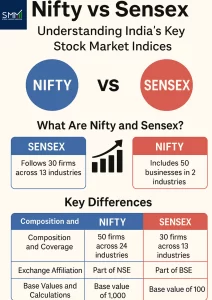
Let’s start simple. Sensex, or officially S&P BSE Sensex, was introduced in 1986 with a value of 100. It follows 30 prominent firms across 13 industries. Consider it to be the cream of the stock market of India.
Conversely, the Nifty 50 or National Stock Exchange Fifty started in 1996 with a base value of 1,000. It includes 50 leading businesses in 24 industries. In brief, Nifty is broader and more diversified than Sensex, representing about 55% of the free-float capitalisation of the NSE.
The knowledge of these Indian stock market indices provides investors with a clear picture of the market’s health at any point in time. If you want to understand where you fit within the investing landscape, explore our guide on Types of Investors it helps you identify your risk profile and investment approach before choosing between Nifty vs Sensex strategies.
Key Differences Between Nifty and Sensex
Composition and Coverage
This is the first and the most visible difference. Sensex follows a group of 30 leading firms, whereas Nifty follows 50. More companies imply more industries, and this fact makes Nifty vs Sensex an issue of diversification.
Nifty has 24 sectors, and Sensex remains at 13. So if you want broader market exposure, Nifty usually wins.
Exchange Affiliation
These indices trade on other exchanges. Sensex is a part of BSE, whereas Nifty is a part of NSE. The trading volumes and liquidity of NSE are greater, approximately 364 crore shares in a day, as compared to BSE 62 crore. That is why lots of traders like Nifty because of faster moves and better prices.
Base Values and Calculations
Both indices are computed by using the free-float market capitalisation; however, the base figures are different: Sensex at 100, and Nifty at 1,000. This is what makes Nifty numbers appear to be bigger, but it does not imply that it is a better one; it is just a matter of math.
Trading Volume and Liquidity
Liquidity is important when you are a regular trader. NSE has the largest volumes, most notably in derivatives. The derivatives market of Nifty is nearly twice that of BSE, and Nifty vs Sensex is a major option to traders interested in venturing into options or futures.
Performance Snapshot of Indian Stock Market Indices
In 2024, the indices gave attractive returns with Nifty 8.80% and Sensex 8.17%. Analysts tend to compare Nifty vs Sensex, not only in terms of figures but also in terms of strength. If you’re learning how company performance affects these indices, our Financial Statement Analysis Course simplifies balance sheets and ratios for smarter investing.
Shankar Sharma of GQuant Investech notes: “Even if Nifty dips 5% from its peak, structurally it remains strong.”
Radhika Gupta, MD and CEO of Edelweiss mutual fund, says: “Think of Nifty like Shah Rukh Khan, it may have bad days, but overall it delivers most of the time.” Her point? Nifty is reliable over the long haul.
Expert Advice on Nifty vs Sensex
- Raamdeo Agrawal, Motilal Oswal: By 2030 and 2035, Sensex may reach 1.5 lakh and 3 lakh, respectively. His rationale: The stable flow of domestic capital contributes to expanding the market.
- Nilesh Shah, Kotak AMC: The market is striking a balance between foreign investor distrust and confidence in the country. Recovery of earnings may occur by FY27, particularly in IT. He suggests diversification, a combination of Sensex and Nifty exposure.
- Shankar Sharma, GQuant Investech: Nifty can have a flat payoff in 4-5 years beginning in September 2024. Still, the market remains stable through domestic institutional flows.
These lessons indicate that investors can manage volatility by being informed about the differences between Nifty and Sensex.
Sectoral Composition: What Makes Nifty and Sensex Different?
Sector weights tell the full story. Banking, IT, and crude oil control the Nifty 50 at 20.22%, 12.49%, and 10.72%, respectively. Sensex is more focused, concentrating on financial services and some large sectors at a very high rate.
The broader market exposure of Nifty provides the investor with a more balanced picture of the outlook. For someone tracking Indian stock market indices, this makes Nifty a preferred choice for diversification.
Investment Strategy: Nifty vs Sensex
Here’s the practical takeaway:
- Beginners: Sensex’s 30-company focus offers stability.
- Active traders & institutions: Nifty’s 50-stock mix gives higher liquidity and more opportunities.
Both are excellent benchmarks for index funds or ETFs. Historically, over long periods, the differences in returns between Nifty and Sensex are minimal; it’s mostly about preference: concentration vs diversification. Want to turn this knowledge into actionable strategies? Check out our Stock Trading Courses in Delhi designed for investors looking to apply real-world trading methods.
Even experts agree: mixing exposure to both indices can smooth out risk and give a better overall market perspective.
Understanding Volatility in Nifty vs Sensex
Volatility is a big word that simply means “how much prices swing.” In Nifty vs Sensex, Sensex may show bigger jumps in short bursts because it has fewer stocks, and a single big company can move the index more. Nifty, with 50 companies, spreads the risk, making swings slightly smoother. To interpret how these indices move on charts, explore our Stock Market Chart Patterns for Indian Stocks guide it helps you visualize trends in Nifty and Sensex more effectively.
So if you’re a beginner, understanding this volatility helps you choose which index suits your style. Are you okay with bigger bumps (Sensex) or a smoother ride (Nifty)? For deeper learning on managing volatility with derivatives, explore our Option Trading Course in India to master hedging and income strategies.
Nifty vs Sensex for Long-Term Investing
For long-term investors, the story is similar. Historical returns for both Indian stock market indices are close to 10–20 years. Experts recommend looking beyond daily movements.
Radhika Gupta, MD and CEO of Edelweiss Mutual Fund, uses a vivid analogy to explain Nifty’s consistency:
“Nifty is Shah Rukh Khan because he has had some bad patches, but has delivered most of the time. In another interview, Radhika Gupta stresses SIPs: “Consistency matters more than timing the market.” This message reinforces the value of long-term investing staying invested and systematic, rather than chasing short-term volatility.- Raamdeo Agrawal highlights domestic flows: “Long-term structural growth in India supports both Nifty and Sensex.”
Bottom line: patience pays. Both indices reward disciplined investors over the long term.
Technology and Evolution of Indian Stock Market Indices
Both Nifty vs Sensex are not static; they evolve with technology:
- NSE’s fully electronic system allows lightning-fast trades.
- BSE’s huge company base ensures every sector is represented.
- Products like Gift Nifty and index derivatives show continuous innovation.
The differences between Nifty and Sensex aren’t just numbers; they’re also about strategy, technology, and market reach.
Conclusion: Making Sense of Nifty vs Sensex
At the end of the day, Nifty and Sensex are two sides of the same coin. Sensex offers concentrated exposure to blue-chip companies; Nifty offers broad, diversified coverage.
Understanding the differences between Nifty and Sensex and how these benchmark indices reflect India’s stock market performance helps investors build smarter strategies for index investing in India. Whether it’s for ETFs, mutual funds, or tracking the economy, both indices serve as reliable guides.
Experts agree: short-term ups and downs happen, but India’s structural growth story is intact. For investors ready to stay the course, Nifty vs Sensex is less about which is “better” and more about which fits your goals.
Tip: Explore insights, analysis, and strategies at Stock Market Mentor to stay updated and make smarter investment decisions.