Fundamental Analysis 101: Understanding a Company’s Financial Reports
Ever looked at a company’s annual report and felt lost in numbers, charts, and financial lingo? You’re not alone. Most people flip through the pages of revenue, profit, and cash flow without really knowing what it means. But here’s the truth: once you understand how to read a financial report of a company, you can see the story that those numbers are telling.
You can tell if the company is doing well, having trouble, or just making its books look better. Analysts and bankers aren’t the only ones who need this skill. This book is useful for people who want to trade, run a business, or just make smart money choices.
Why Financial Reports Matter?
A financial report is like a health check-up for a company. Just as doctors run tests to know how a body is doing, businesses share financial statements to show how much money they make, how they spend, how much they own, and how much they owe.
Learning how to read a financial report of a company helps you understand whether the profits are real or inflated, if the debt is manageable, and whether the business can survive downturns. Without this skill, investing in a company is like flying blind.
If you can read these reports, you can tell whether the profits are real or inflated, if debt is manageable, and whether the business can survive downturns. Without this skill, investing in a company is like flying blind. According to SEBI, timely financial disclosures and robust investor education are critical for market transparency and investor protection. (Source: ETCFO.com)
For instance, companies exposed to multiple geographies face currency and policy challenges, you can read more about the risks of investing in global markets.
The Three Core Financial Statements: Income Statement, Balance Sheet & Cash Flow Statement

To learn how to read a financial report, start with the three key documents: the income statement, the balance sheet, and the cash flow statement. They are interconnected and together provide a comprehensive view of a company’s financial health. As per the National Stock Exchange (NSE), interpreting these three key financial statements income statement, balance sheet, and cash flow statement is foundational to sound investment analysis.
Income Statement (Profit & Loss Overview)
The income statement, often called the profit and loss statement, shows performance over a specific time, usually of a quarter or a year. It begins with revenue, subtracts costs and expenses, and ends with profit or loss. When looking at this statement, focus on whether the revenue is growing year after year, whether the expenses are under control, and whether the net income is improving. If revenue is up but the profits are flat, that means the costs are eating up the earnings.
Balance Sheet (Assets, Liabilities, and Equity)
The balance sheet is a snapshot at a point in time. It lists assets (what the company owns), liabilities (what it owes), as well as the shareholders’ equity (what remains for owners). This is where you check the debt load, the amount of cash on hand, and whether assets are increasing.
A company with more assets than liabilities has a stronger foundation. If the short-term debts are high but cash and receivables are low, that is a warning sign.
Cash Flow Statement (Tracking Real Cash Movement)
Profits do not always mean cash in the bank. The cash flow statement reveals where money is actually moving. It splits into three parts: operating (day-to-day business), investing (buying assets or investments), and financing (loans, dividends, share buybacks).
Recent studies (2025) show that cash-flow-based ratios are often better at predicting financial distress than profit-based ones. This makes the cash flow statement even more important than many people think.
A healthy company usually generates steady operating cash flow. If net income is high but operating cash flow is weak, the business may be reporting profits it cannot turn into cash.
Case Studies
Infosys maintains a conservative debt-to-equity ratio of around 0.08, meaning it operates with very low debt. This gives it stability in downturns.
Lesson: A strong balance sheet with low leverage signals long-term safety.
Step-by-Step: How to Read a Company’s Financials?
When people ask how to read a company’s financials, the mistake they often make is jumping straight into numbers. The better way is to go step by step.
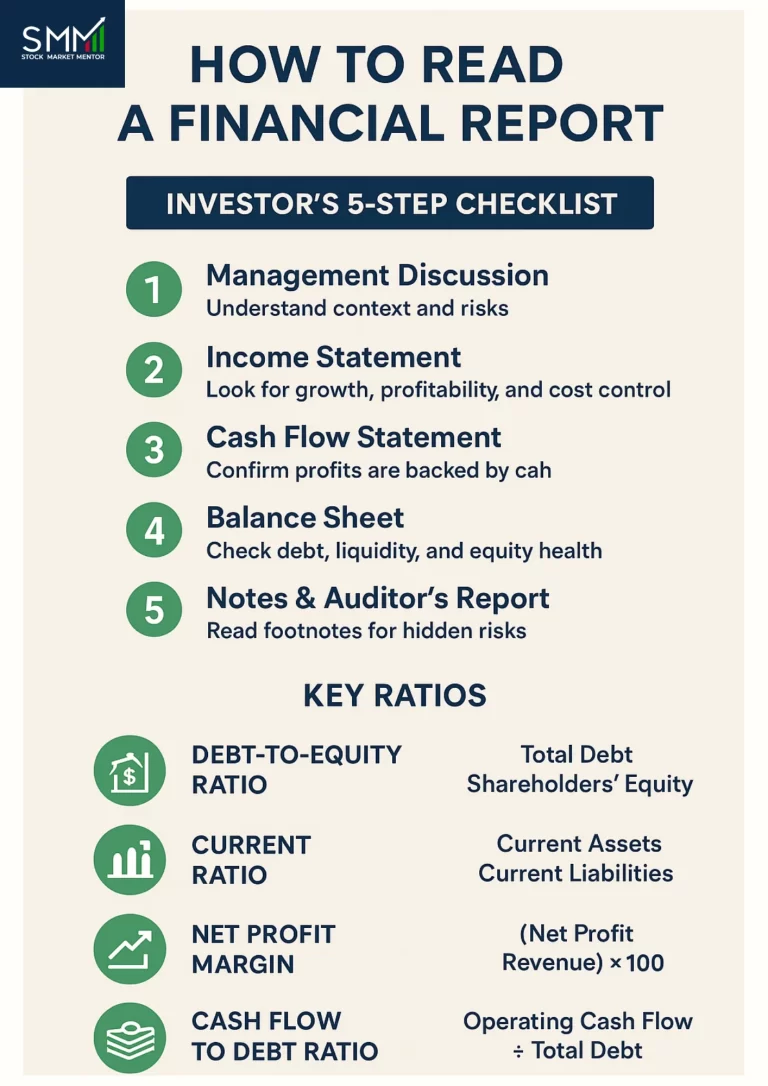
- Start with Management Discussion & Analysis (MD&A): This is usually at the beginning of an annual report or 10-K. It explains what management thinks about performance, risks, and strategy. While it can be polished, it helps you understand the context.
- Review the Income Statement for Growth Trends: Move to the income statement to see sales growth as well as profit trends.
- Confirm Profits with the Cash Flow Statement: After that, look at the cash flow statement to confirm whether profits are backed by real cash.
- Check the Balance Sheet for Debt & Liquidity: Finally, read the balance sheet to assess the debt, liquidity, and equity strength.
- Don’t Skip Notes & Auditor’s Opinion: End by reading the notes and auditor’s opinion; footnotes often hide key details about accounting choices, lawsuits, or contingent liabilities.
Also, keep in mind that new accounting standards in 2025 (IFRS and U.S. GAAP) have changed how some expenses and revenues are reported. Always check the notes to see if the company has adopted new policies, because this can affect year-to-year comparisons. If you want to go beyond self-study and get structured guidance, check out our stock trading courses in Delhi designed to help investors build strong fundamentals.
Quick Checklist: How to Read a Financial Report?
Investor’s 5-Step Checklist
- Read the Management Discussion (context & risks).
- Review the Income Statement (growth & profitability trends).
- Check the Cash Flow Statement (real liquidity).
- Analyze the Balance Sheet (debt, assets, liquidity).
- Look into Notes & Auditor’s Opinion (hidden details).
Ratios That Make Numbers Useful
Numbers in isolation do not mean much. But ratios turn them into insights.
- Profitability ratios such as gross margin, operating margin, as well as net margin show how much of the revenue turns into profit at different stages. If these margins fall year after year, costs may be rising or competition may be squeezing the prices.
- Liquidity ratios like the current ratio and quick ratio reveal whether the company can pay its bills soon. A current ratio below one can signal trouble meeting short-term obligations.
- Leverage ratios like debt-to-equity or interest coverage show how dependent the business is on borrowing. Too much debt, especially in times of high interest rates, can become a heavy burden.
- Efficiency ratios such as asset turnover and inventory turnover explain how well the company uses its resources. If the inventory turnover slows down, products might not sell as you had expected.
- Investors often use the valuation measures, such as price-to-earnings (P/E) or EV/EBITDA, to figure out whether a stock is fairly valued or not compared to its peers. Different types of investors in India may also interpret these ratios differently depending on their investment style.
Learning how to read a financial report of a company means learning to connect these ratios with real business situations.
The Role of Annual Reports and 10-Ks
What Is a Form 10-K?
Publicly traded companies in the United States are legally required to submit a Form 10-K, a comprehensive annual financial report, to the U.S. Securities and Exchange Commission (SEC). It offers a thorough and audited view of the business’s financial performance during the preceding fiscal year, going far beyond what is typically displayed in an investor presentation or annual report.
For public companies, the annual report or 10-K is the most reliable source. It contains not just financial statements but also risk factors, management commentary, accounting policies, and auditors’ reports.
Reading these documents regularly is the best way to build confidence in how to read a company’s financials. Most companies publish them on their investor relations websites, and regulators like the SEC (in the U.S.) or SEBI (in India) also host them.
Mastering How to Read a Financial Report of a Company?
Knowing how to read a financial report of a company is like learning a new language. At first, it’s going to feel complex, but with practice, you begin to see patterns, signals, and stories in the numbers. Income statements, balance sheets, as well as cash flows stop being abstract documents and turn into decision-making tools.
If you want to sharpen this skill further and apply it to real-world investing, platforms like Stock Market Mentor provide resources and guidance to help you connect financial reports with smarter investment choices. The more you practice, the more confident you’ll become in separating strong businesses from risky ones.